







Advancing Air Mobility: Overcoming Challenges, Seizing Opportunities

- The rise of Advanced Air Mobility (AAM), including Urban and Regional Air Mobility, aims to ease congestion and improve connectivity using eco-friendly, cost-effective air transport solutions like eVTOLs and hydrogen-fueled aircraft.
- For AAM to succeed, critical advancements in traffic management, automation, navigation accuracy, regulatory frameworks, and human oversight are essential, with global leaders like China and the UAE already implementing key infrastructure and policies.

Why AAM ?
The Surface Transport System is becoming increasingly inefficient due to heavy traffic congestion in Urban/Suburban areas, due to poor road connectivity and increased travel time to rural Towns, villages, remote locations and islands, which are locations of great interest for various reasons. Hence, travelling by air in a cost-effective manner across these locations has become an absolute necessity. All the new evolving technologies in transportation must be environment friendly, leaving the least possible carbon footprint, with due consideration to socio-economic developments.
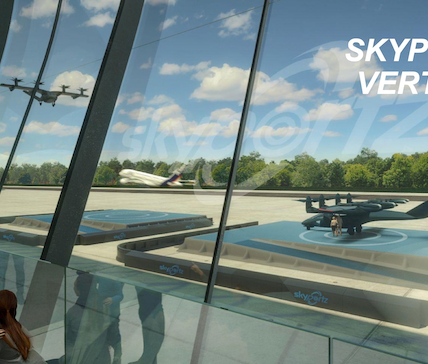
Urban Air mobility (UAM) is expected to transport people/cargo over congested cities, and Regional Air Mobility (RAM) is to facilitate quick connectivity to suburban areas, villages or remote locations. UAM and RAM together constitute the AAM. AAM is expected to comprise of aircraft with EVTOL capability or using hybrid fuels or Hydrogen fuel cells so as to develop into a cost-effective and environment friendly transport system for the future. In the near future, a sizable segment of passengers is expected to book Air taxis on their smartphones to reach railway stations, Airports or hospitals for quick medical assistance.
Following are the critical areas for safe and successful development of AAM systems, viz : Infrastructure development, Traffic information/management capability, seamless integration into the existing Air Traffic Management, Navigation system, technological innovations and development of appropriate regulatory and security frame works.
The Air Navigation Committee (ANC) under ICAO has already constituted the AAM study group as mandated by the 41st assembly of ICAO.
Air Traffic Management and Automation in AAM
Air Traffic Management for legacy operations is often pushed to its limit due to the increasing traffic. The AAM aircraft will have to be operated in a highly congested narrow airspace corridors with a great degree of automation and autonomy, while ensuring the safety risk analysis yielding the same or better safety standards as in practice for legacy aircraft operations. For this to be achieved, digital technology enablers, including their standards, have to be established. Functional delegation has to be made over to such autonomous systems with clear and safe demarcation from legacy aircraft operations, and it will be a paradigm shift from the conventional ATM systems and procedures. This system managing the AAM traffic with a high degree of automation has to be established as a distinct UAS Traffic Management System (UTM). Most of the services now being provided by the Air Traffic Controllers in ATM will be automated and provided by the UTM system with proper oversight by Humans. Procedures shall be evolved as to how the Controllers have to remain cognizant of the situation. Challenges to such high levels of automation in UTM will be to ensure multiple redundancies at the system level and bring in resilient cyber security into the system architecture.

Evolving Digital technologies and services are crucial for optimising the services using UTM. Considering the futuristic requirements UTM needs to evolve to new Traffic management capabilities. Testing new technologies and its validation in UTM will actually help to adopt those advanced technologies in the realm of upper airspace Air Traffic Management, which would help to significantly enhance capacity.
The Operational concept gets evolved through usage of Remotely Piloted aircraft, autonomous aircraft or even using manned EVTOL operations. Even new flight rules will have to evolve from VFR/IFR to Digital Flight Rules/Modes. Such changes in the concept of AAM aircraft operations will entail corresponding changes in standards and practices in Air Traffic Management systems.
There is a need to evolve the ATM System which is capable of mitigating the environmental impact – a new eco-system, more exchange of information, a higher degree of digitalisation, development of new architecture, and higher levels of automation to support and refine the role of humans. The roles and responsibilities of Humans in the loop in a highly automated environment have to be clearly defined. Concepts and principles of Air Traffic Management, which have been the bedrock for developing and evolving time-tested procedures ensuring the safe conduct of flights over the decades, may need a paradigm shift. But ATM does not change quickly and abruptly. It has to go through a rigorous process of validation of various new technologies and procedures leading to the development of new safety cases, which will definitely involve the development of new contingencies and fallback procedures/systems. This involves deconflicting between AAM aircraft, AAM aircraft and helicopter operations, and normal aircraft operations and AAM aircraft through effective coordination before departures from the vertiports. This is possible only through the complete integration of UTM’s infrastructure with that of ATM. In fact, UTM may eventually become a sub-system of ATM. Regulatory authorities and ANSPs have to establish close coordination on the R&D programs being carried out extensively across the industry with the objectives of understanding the new evolving concepts, standardising the requirements/procedures, and bring in adaptive changes to the Safety management systems.
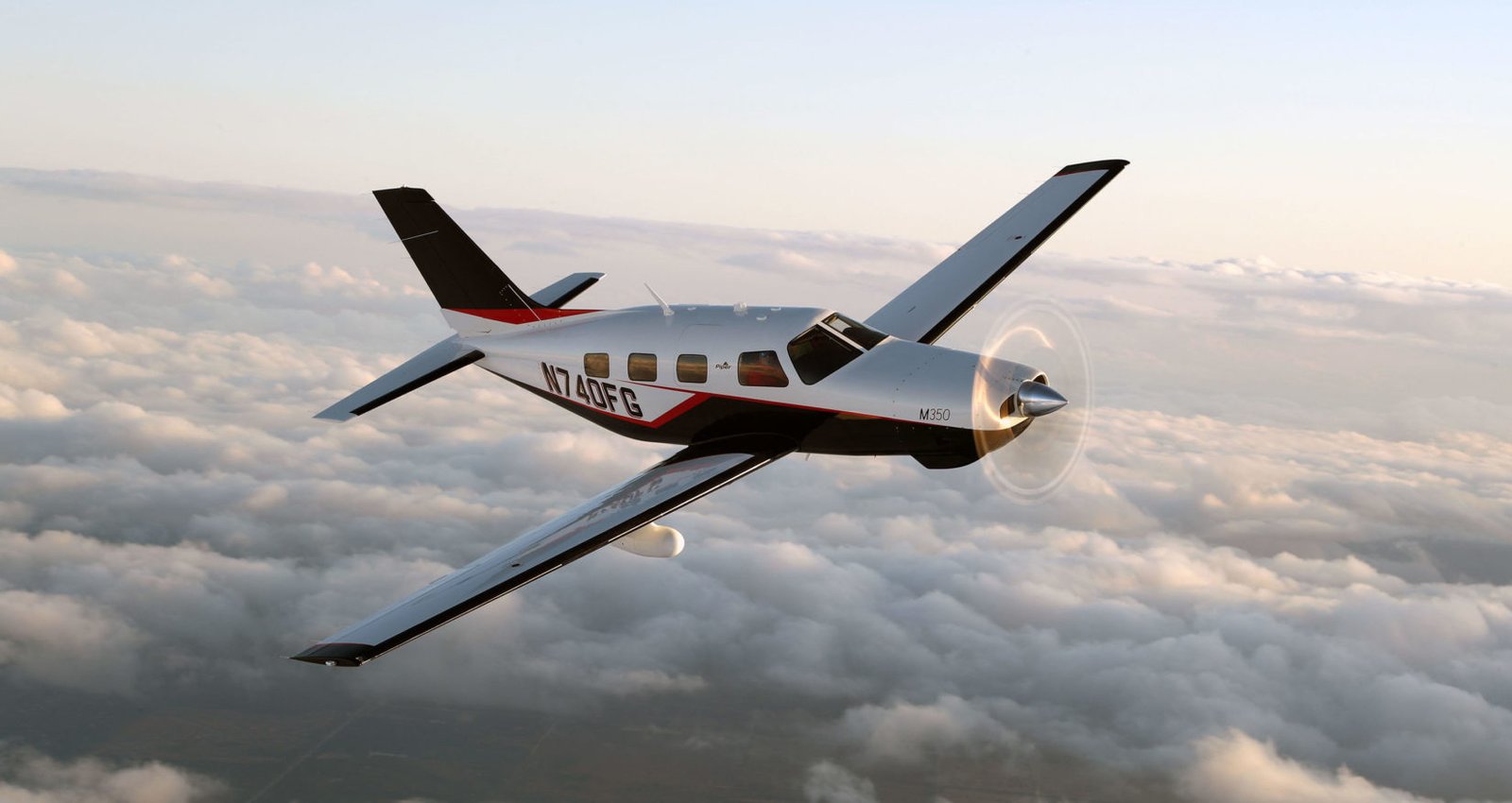
Third parties may be authorised to make provisions for UTM infrastructure and associated services under the guidelines of the regulatory authorities with adequate monitoring mechanisms. Provision of the infrastructure and service of UTM by third parties will accelerate the advancements and help to commence AAM operations with the required speed and efficiency. The challenge for the changes would be that the rate of change is slow in aviation as of now. When we develop standards and begin to practice the systems become obsolete. This lag in acceleration to embrace new technologies and evolving new standards will be addressed with the complete participation of the industry and all stakeholders working in unison. AAM need not be EVTOL alone; it can be a fixed-wing between smaller airports, hydrogen-powered aircraft or small drones. Hence the required flexibilities have to be brought into the technologies and practices for AAM and UTM.
Navigation
AAM aircraft will be required to operate mostly in a much more confined airspace compared to normal aircraft operations in civil aviation – both in the horizontal and vertical dimensions. Operating altitudes will be mostly at very low altitudes in urban areas. Hence the vertical and horizontal navigation have to be much more accurate than the ones practiced in aviation now. Accuracies are demanding to the tune of Centimeters, considering the operating environment of AAM operations.
Navigation may primarily depend on GNSS systems, and the signal availability could be a challenge to ensure the required accuracy, continuity, integrity and reliability of various constellations at very low altitudes and narrow airspace corridors in the urban environment. As the larger potential for AAM operations is in urban airspace, a multitude of operations are expected to be in narrow corridors confined in both vertical and horizontal dimensions; a very high level of accuracy is essential for navigation. To achieve such a high degree of accuracy, extensive R & D works are being carried out by various companies in the industry exploring innovative solutions such as dual multi-constellation receivers for GNSS signals, Visual Positioning Systems (VPS), Mapping the areas of navigation with self-contained systems, advanced inertial navigations systems and also by integrating various such sub-systems. It is also essential to develop spoof-proof technologies as solutions are all the more important considering the vulnerability of AAM aircraft to spoofing as they operate at low altitudes in urban areas.
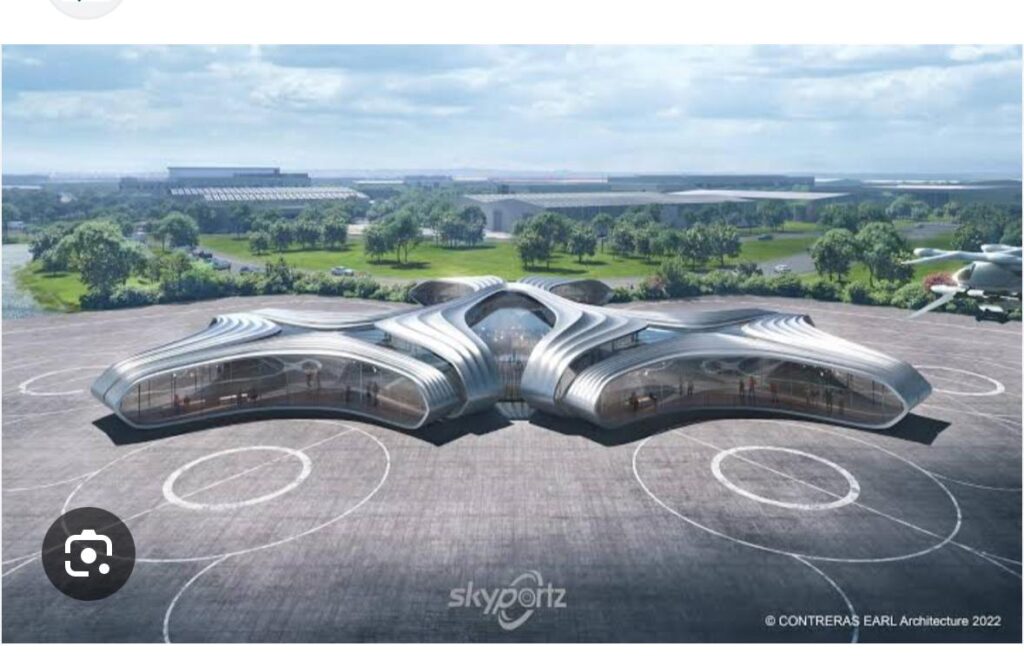
Adopting stringent Performance Based Navigation (PBN) requirements for the AAM aircraft is another option with highly accurate Navigation specifications for the airspace/ route segments in which they are expected to operate. Identifying the requirements for having a different common reference altitude for UAS operations is very important to ensure the required separation between legacy aircraft and AAM operations and also among the AAM operations. If so, procedures are to be adopted under the guidance of regulatory authorities and ANSPs.
Barometric vertical navigation for drones operating at very low altitudes could be a challenge. Industries have to explore the possibility of evolving alternate solutions such as Geometric altitude determination method. Integrating such new methods and procedures with the external UTM and ATM architecture will be an absolute necessity.
As the solutions are being explored through R&D programs of various companies, it is not easy to evolve standardised solutions unless an industrial collaboration is ensured. Such initiatives under the guidance of regulatory authorities will help the industries to collaborate and evolve the required new standards by the regulatory authorities.
Airspace design and operating rules
The concept of UTM initially evolved based on near-term requirements. The initial focus has been on very low altitudes – to about 400ft. To realise the demands and potential of AAM, aircraft with heavy payload carrying capacity, which may even include human transportation, will have to be accommodated. This necessarily entails operations at higher altitudes compared to smaller drone operations. This requires a paradigm shift in the airspace organisation, changes to the Drone Rules if found necessary, and changes to the principles and procedures of conventional Air Traffic Management. This new airspace for AAM operations must have distinct digital flight rules as a long-term measure in line with the progress in automation in the system.
Airspace layers need to be redefined, and necessary reclassifications need to be introduced. Necessary CONOPS need to be defined for AAM (UAM) operations in close proximity to busy airports, which is necessary due to anticipated heavy demands in congested urban areas.
Instrument Flight rules get evolved over a period of time as it is already happening. The responsibility of separation is also getting shared between Pilots and Controllers through the assistance of advanced systems on board. It will be wise to commence the AAM operation with essential infrastructures and procedures in place under the UTM, without drastic changes in flight rules, but it can help AAM to accept the responsibility of separation involving autonomous aircraft with a human-centric approach. This can evolve over a period of time to system centric. Otherwise the commencement of AAM operations itself may get unduly delayed.
Airworthiness in AAM
NASA, EUROPE, and CHINA have already started developing regulations on airworthiness. Through coordination with these countries, other member countries of ICAO can adopt the specifications and suitably make adaptive changes as per local requirements. Performance based regulation is the key to the future for certification and easy operability with different technologies and equipage. The Certification process is to be derived out of this concept of flexibility. There are basically two criteria such as the ones based on Design and the other on Operations, for developing procedures for certification.
Regulations have to be based on the operational criteria and the application of the equipment. Hence, a shift will be required from product centric approach to operation centric approach.
Human in the AAM automation
AAM will be operating at very low levels compared to the present day of aircraft operations. Most of these operations will be in congested urban airspace, in close proximities, and are expected to be in a highly scaled-up intensity of operations. Hence, the information available for Humans to control will be plenty, and the time available for resolving conflicts or tactical decision-making will be too short. It entails that a higher degree of automation is introduced into the system at the earliest. The potential of the AAM will be realised by more number of BVLOS operations in the non-piloted category. Hence the necessity of a very high level of automation for a ground-based command and control system to manage the UTM and more autonomy to the aircraft system in the AAM. However, humans in the loop are critical and inevitable. Systems need to be built up around the Humans. The developments in technology will be a kind of evolution, not devolution. Most of the functions in the current aircraft operations are safely automated including landing and take-off. In AAM, the whole system will be evolving into the next level of automation. It will be a big change to transition from small drones to aircraft carrying passengers with more degree of assurance required in terms of the safety of people on board and people around – both on the ground and on other aircraft operating in proximity, for public acceptance.
Cross-over from conventional aviation to AAM
Identify the data on which humans can act, and identify the time available for humans to act. Wherever it is felt that human intervention will be inadequate, opt for automation. Then, identify the information that needs to be made available to humans. Information required for pilots, controllers, engineers are vastly different. Again, it will be different in an automated environment. Defining the right level of information is safety critical. Identify the right level of information available for situational awareness for the persons required to ensure safety and efficiency. Ensure the workload is optimised. Identify what is to be done on the system architecture to prevent the errors from happening.
Early identification of the human’s role is important for the early training and preparation of the required manpower. Role of a pilot on board an aircraft and a remote pilot are quite different. The aviate and navigate functions are mostly taken away by the automation for an RPA. For autonomous aircraft, all these functions are going to be completely automated. The human role will predominantly be to act on the long-term decisions to be made. The role of the Remote pilot will be more like an ATCO or dispatcher with the required knowledge and the right amount of aeronautical knowledge. Human role evolves as the AAM advances.
Interesting Developments in China and UAE
Both China and UAE have already introduced AAM/UAM systems into their aviation industry. China has made big strides in the overall development of the UAM system. The Chinese government has already recognised low altitude economy as one of the national strategic industries for development, which includes small drones and large EVTOLs. More than Thirty provinces and major cities have already included the low-altitude economy in their government plans. The command and control system is in place to predetermine the route from point to point. The system is developed to verify the suitability of procedures en-route, systems onboard, including the batteries for the pre-determined route. The government initiatives have led to identifying the number of landing/take-off areas for drones and large vertiports in the cities and the command and control systems are put in place. The scale of operation expected is to the tune of thousands of EVTOL aircraft operating in the urban airspace of China.
UAE has also made significant advancements in AAM. They took a more pragmatic and collaborative approach as they project-managed the whole ecosystem, including infrastructure, applicable rules and procedures for the airspace, and ground infrastructures for the AAM.
AAM in India
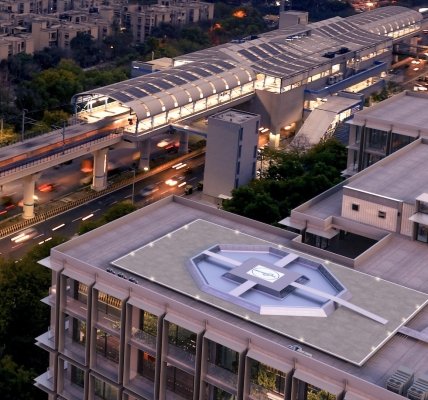
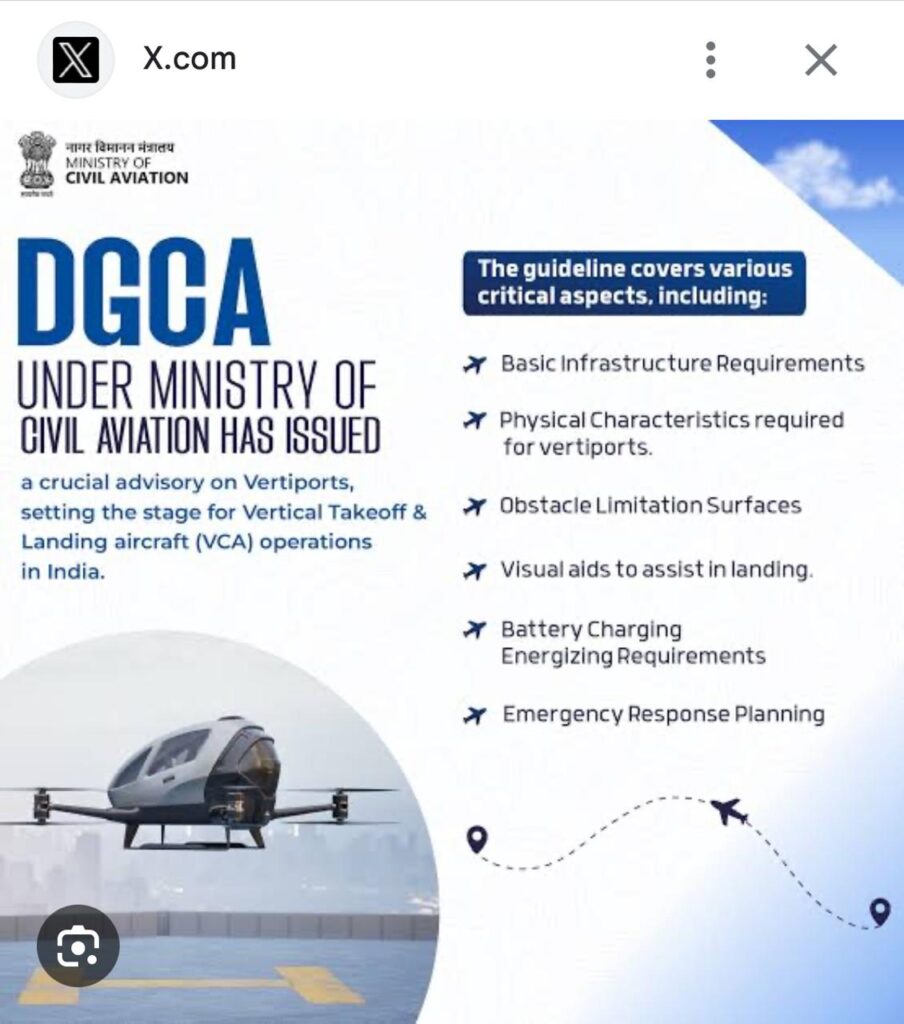
When such a paradigm shift is expected in the near term, as a country, we need to get the act together through industrial collaboration, collaboration amongst all stakeholders, including industries, regulators and ANSPs. It is important that the regulatory agency is also informed enough and skilled enough to oversee, guide and approve the developments and innovations. Review the Drone rules and amend if found necessary. The right approach would be, before transitioning into the fully evolved AAM operations, to include a strong presence of humans in the loop to provide the required confidence to the users. The degree of automation may evolve over time as the demand and the situation unfold. This approach will help us to commence the AAM operations without much delay. The required security framework and guidelines are also to be developed, considering our Geo-political complexities. DGCA has recently published the guidelines for establishing vertiports. This will help the private industry to evolve their suitable technologies to place the ground infrastructure. More to be done on issuing such guidelines on establishing the all-important UTM and its architecture and policy document on AAM traffic management so that the ANSP could evolve the procedures and airspace restructuring and industries may be identified to develop the UTM infrastructure. The proliferation of more autonomous aircraft into the AAM has to be analysed on the security landscape to identify threats and their mitigation.
But the Airports Authority of India, being the Primary Air Navigation Service Provider, has to take the lead in collaborating with the industry involved in developing suitable technologies to establish the command and control systems as part of UTM and its suitable integration into the Air Traffic Management. The decision to be made by the Government of India if the UTM service provisions have to be under Government control or may have a controlled but liberal approach for this service provisions by qualified private entities as this may help to accelerate the developments in line with the fast unfolding scenario in AAM. Even if the UTM segment is managed by private entities close, collaboration with AAI is inevitable to ensure that the AAM and conventional air traffic operations are safely conducted by developing suitable coordination procedures, airspace delegation
A collective approach by the DGCA, AAI along with the private/public industries will help to chart the right course for India so that we will not be left behind in developing the AAM. If we make the right investments now, we will be a self-dependent country in this space of AAM without the dependency on aircraft purchase, advanced Traffic Management systems, other advanced navigation systems etc. as is in the space of Civil Aviation now.