
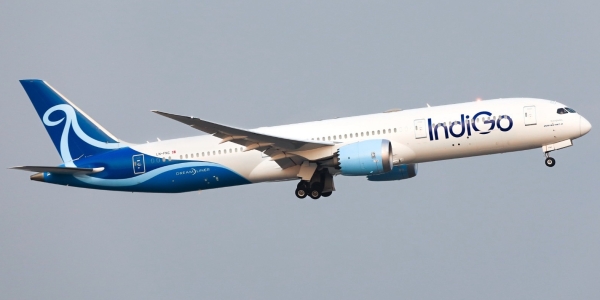
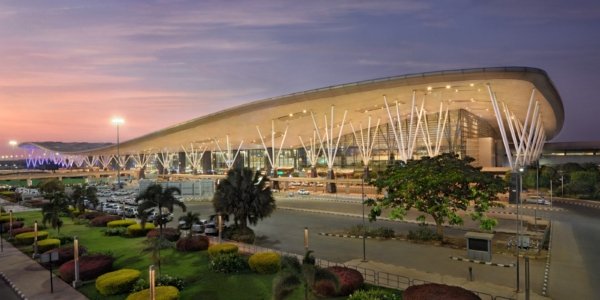
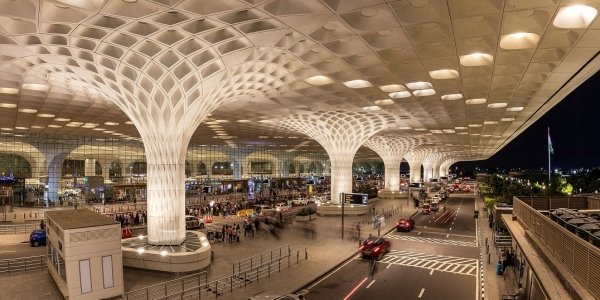
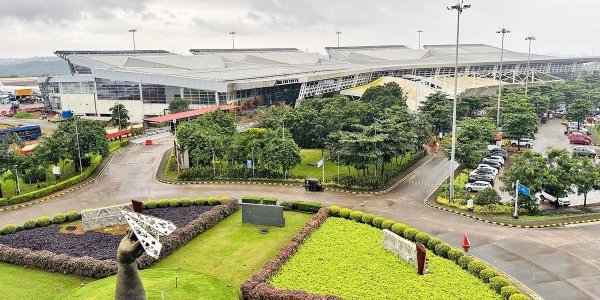









- India, the third-largest domestic aviation market, serves 240 million passengers annually and aims for 500 million by 2030, driven by the UDAN scheme’s regional connectivity.
- The aviation sector is expanding with 162 airports, over 2,000 aircraft orders, and a goal to become a $4 billion MRO hub by 2030, supported by policy reforms.
- PM Modi emphasised sustainable aviation fuels, digital innovations like Digi Yatra, and global collaboration to address challenges like infrastructure gaps and airspace restrictions.
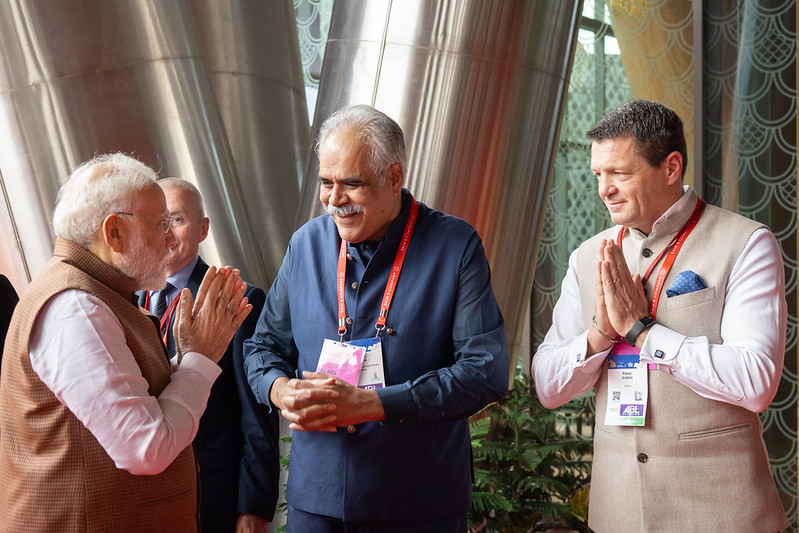
Prime Minister Narendra Modi delivered a landmark keynote address at the 81st Annual General Meeting of the International Air Transport Association (IATA) and the plenary session of the World Air Transport Summit (WATS) held at New Delhi’s Bharat Mandapam from June 1-3. The Prime Minister highlighted the significance of the event returning to India after four decades, during which the country has undergone transformative changes. He underscored India’s role in the global aviation ecosystem. The Prime Minister’s address resonated with industry leaders from across the world as he positioned India as an emerging global aviation powerhouse, blending economic opportunity with technological innovation and sustainable development.
India’s Aviation Milestones: From Aspiration to Achievement
The Prime Minister began by chronicling India’s remarkable aviation growth story over the past decade. India has firmly established itself as the world’s third-largest domestic aviation market, with 240 million passengers flying annually—surpassing the total population of most countries worldwide. This passenger traffic is projected to surge to 500 million by 2030. He particularly emphasised the success of the UDAN (Ude Desh Ka Aam Nagrik) scheme, which has revolutionised regional connectivity by making air travel accessible to over 15 million passengers, enabling many citizens to fly for the first time. This initiative, Modi noted, represents a golden chapter in India’s aviation history by democratising air travel and connecting remote regions to the national mainstream. He also stated that 3.5 million metric tons of cargo are transported by air annually in India, and this volume is projected to increase to 10 million metric tons by 2030.
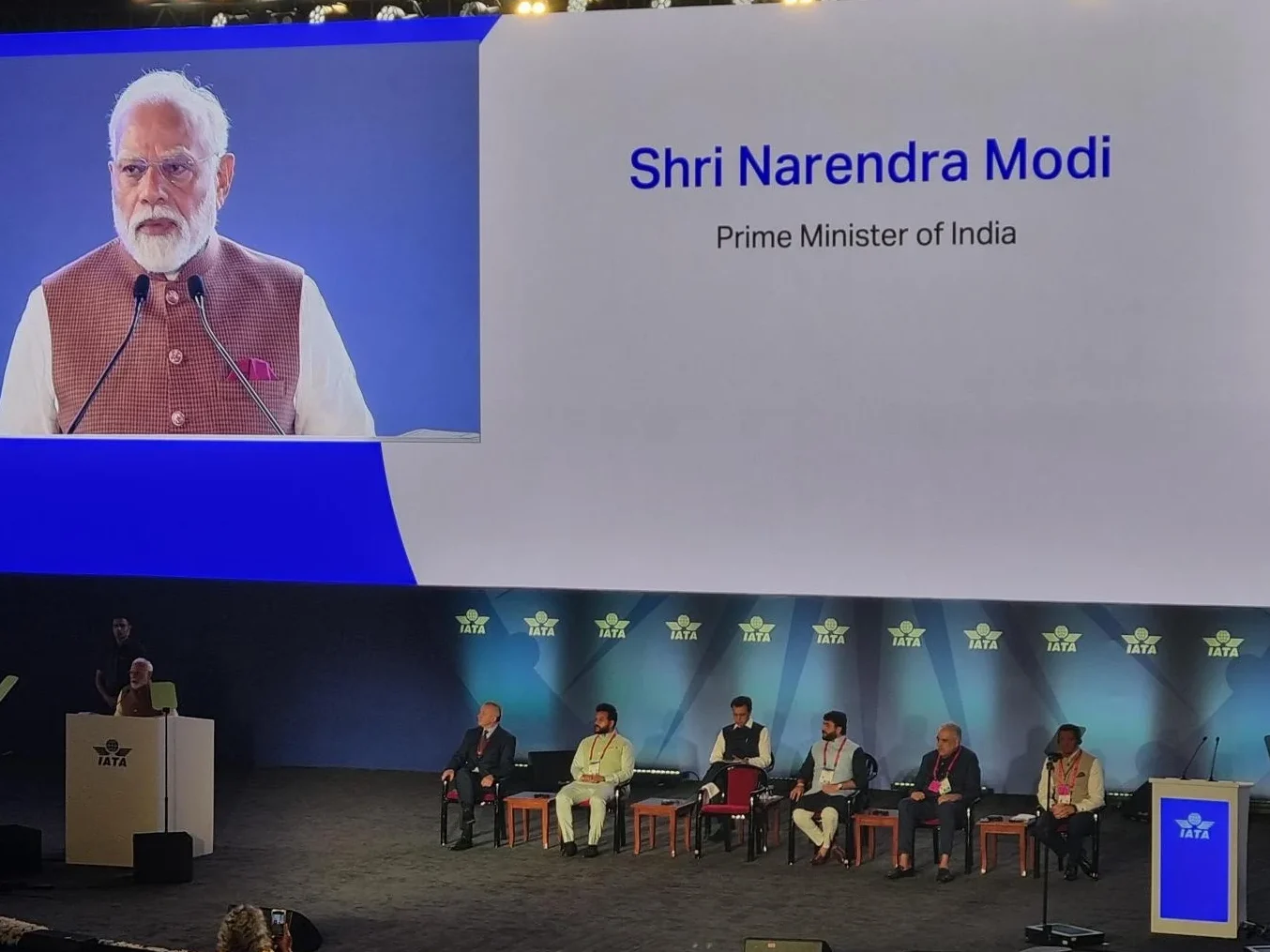
The address highlighted several transformative achievements, including the doubling of operational airports from 74 in 2014 to 162 in 2025, with ambitious plans to expand this network to 350 airports by 2047 as part of the Viksit Bharat vision. Modi pointed to the massive fleet expansion underway, with Indian carriers placing orders for over 2,000 new aircraft, reflecting the industry’s long-term growth confidence. On the sustainability front, the Prime Minister detailed India’s investments in green technologies and sustainable aviation fuels (SAF) as part of the nation’s commitment to reducing carbon emissions in line with global climate goals. India is committed to ensuring both progress and environmental security, reinforcing a balanced approach to development.
The PM spoke of India’s achievements in gender parity, with women comprising 15 per cent of pilots (three times the global average), which is three times the global average, and 86 per cent of cabin crew positions (while the global average of women in cabin crew is around 70 per cent), positioning this as a model for inclusive industry growth. He remarked that women engineers in India’s MRO sector too exceed global averages, demonstrating growing female participation in the industry. Underscoring that drone technology is a key component of aviation’s future, and India is leveraging it for technological advancements as well as financial and social inclusion, he highlighted that drones are being used to empower women’s self-help groups, increasing their participation in agriculture, delivery services, and various other sectors.
Three Pillars of India’s Aviation Strategy
The Prime Minister outlined three foundational pillars driving India’s aviation sector that leverage the country’s unique advantages. First, a vast market potential, driven by a burgeoning middle class that continues to fuel demand for both passenger travel and air cargo services.
Second, a strong demographic dividend, and talent pool—where young innovators are pioneering breakthroughs in aviation-related technologies including artificial intelligence, robotics, and clean energy solutions. He positioned this human capital as a global resource for the aviation industry’s future needs. Third, an open and supportive policy ecosystem—enabling aviation growth.
Mentioning that Mission Manufacturing was announced in this year’s budget, reinforcing India’s focus on industrial growth, he further highlighted the Protection of Interest in Aircraft Objects Bill, passed in Parliament this year, which aligns with the Cape Town Convention. He also pointed to the incentives offered at Gift City, stating that these measures have made India an attractive destination for aircraft leasing. The Prime Minister remarked that this legislation opens new opportunities for global aircraft leasing companies in India. He stressed India’s commitment to becoming a global manufacturing and Maintenance, Repair, and Overhaul (MRO) hub with strategic initiatives supporting this vision. He noted that in 2014, India had 96 MRO facilities, which has now increased to 154 while 100 per cent FDI under the automatic route, GST reduction, and tax rationalisation measures have given fresh momentum to this sunrise sector. He outlined India’s goal to establish a $4 billion MRO hub by 2030, reinforcing the nation’s aviation growth strategy.
Global Collaboration and Challenges
While positioning India as a “natural connector of the skies,” PM Modi acknowledged the need for balanced global collaboration in aviation. His address responded to concerns raised by international carriers like Emirates about restrictive bilateral flying rights, with the Prime Minister reiterating India’s commitment to the Chicago Convention’s principles while emphasising the need to protect domestic industry interests during this growth phase.
Emphasising that this summit and dialogue serve as a platform not only for aviation but also for advancing global cooperation, climate commitments, and equitable growth, he highlighted that discussions at the summit will provide a new direction to global aviation. Lauding aviation’s ability to cover vast distances and intercontinental journeys in mere hours, he pointed out that the aspirations of the 21st century continue to evolve beyond conventional travel, thanks to the rapid pace of innovation and technological advancements.
The Prime Minister candidly addressed several persistent challenges facing Indian aviation, including infrastructure gaps that risk stalling growth despite recent progress, with airport congestion and aircraft shortages emerging as critical bottlenecks. He acknowledged regulatory hurdles such as complex taxation structures and slow MRO facility expansion that continue to hamper efficiency. He also touched upon geopolitical constraints, particularly airspace restrictions due to regional tensions that inflate operational costs for Indian carriers.
Future Frontiers: Space-Aviation Convergence and Digital Innovation
Looking ahead, the PM spoke about emerging frontiers of commercial space flights and interplanetary journeys. He acknowledged that while integrating them into civil aviation will take time, they highlight aviation’s future as a centre of transformation and innovation, for which India is fully prepared, building on its successful space program. “Today, India is emerging as a global leader in space-aviation convergence”, remarked the Prime Minister.
The Prime Minister also showcased India’s digital innovations like Digi Yatra, a facial recognition-based seamless travel system that provides a complete, seamless travel solution using facial verification technology, enabling passengers to navigate airport entry to boarding gates without requiring paper documents or ID display. India’s innovations and experience in serving a large population can benefit many countries. He added, “Digi Yatra stands as a secure and smart solution, serving as a model of inspiration for the Global South.”
Engaging the Global Community
Reinforcing India’s commitment to international best practices, “Aviation safety has always been India’s top priority, he said, “India has aligned its regulations with ICAO’s global standards”. He highlighted that ICAO’s recent safety audit recognised India’s efforts in strengthening aviation security and the adoption of the Delhi Declaration at the Asia-Pacific Ministerial Conference is further proof of India’s commitment to global aviation excellence.
Modi framed aviation as a powerful catalyst for socio-economic progress, calling for collaborative efforts to make air travel “accessible, affordable, and secure for all.” He urged aviation companies to not only embrace ‘Make in India’ but also ‘Design in India’, reinforcing the vision of India’s leadership in global aviation innovation. “The new Indian Aircraft Act aligns aviation laws with global best practices, ensuring a streamlined regulatory framework, ease of compliance, and a simplified tax structure, which presents a significant investment opportunity for major international aviation companies”, said the Prime Minister.
Watch the Full Address: PM Modi’s Speech at WATS 2025