















- India’s aviation sector is witnessing the rise of secondary airports, with Goa’s Manohar International Airport (MIA) at Mopa leading the way.
- As cities like Mumbai and Delhi prepare for similar expansions, the article explores whether Goa’s success can be replicated elsewhere.

The Manohar International Airport (MIA) at Mopa in north Goa (IATA: GOX) started commercial operations on January 5, 2023. The project had seen its fair share of issues, with court cases and then the pandemic delaying construction. When it was finally ready, IndiGo became the lead player by launching flights to the new airport in an unprecedented manner. It has been a year and a half since the operations started at Mopa, and it has given astounding results to both the airport and the state. The airport has surpassed its first phase capacity within one financial year, and the traffic to Goa has grown at a faster rate, benefitting tourism and creating jobs.
While IndiGo made a dashing entry to the new airport, Go FIRST followed, and the new airport gave Akasa Air an opportunity to launch flights to Goa, which was hitherto not possible due to congestion at Dabolim. Within six months, there came a point where the traffic and flights to Mopa were fewer than those to Dabolim, but it was connected to more destinations than Dabolim, giving more options to passengers across the country to visit what is possibly the only party place in the country.
What do the numbers say?
In FY20, the domestic footfall at Goa’s Dabolim airport was 76,51,362 passengers, and its international footfall stood at 7,04,878 passengers. Barring the last six days of the year, there was a lockdown due to the pandemic.
In FY24, the last financial year, Goa’s Dabolim airport saw a domestic footfall of 64,45,322 passengers, while its international footfall was 4,27,089. It may seemingly look lower than the pre-COVID footfall but couple that with Goa’s new Manohar International Airport at Mopa in North Goa, which handled 1,15,288 international passengers and 42,90,799 domestic passengers, the growth was 40%, beating the country’s average of 8-10% growth across sectors.
The Dabolim airport is operated by the Indian Navy and has a civil enclave for civilian operations. There is no place left for expansion and there are time restrictions where exclusive naval flying takes place. Mopa’s additional capacity has meant that it suddenly became attractive, even though it is towards the north of the state, with luxury resorts in the south, but the state is undergoing transformation with new highways and bridges, which will help reduce the time of travel. The numbers and growth make it clear that passengers are always willing to travel provided there is capacity, and this holds true for most airports that are near saturation.
When the greenfield airports at Bengaluru and Hyderabad were operationalised, it led to the closing of their existing airports at HAL and Begumpet respectively. At Goa, while MOPA takes wings, Dabolim will remain active, and thus will be born a two-airport system with two different operators, providing a glimpse of what to expect in the years to come.
Two airport model
There are a lot of things happening in the airport space. In 2025, both Mumbai and Delhi metropolitan regions will have secondary airports towards the middle of the year. Mumbai, which is gridlocked, has been facing delays leading to airline networks being impacted across the country. Delhi, on the other hand, has scaled up its terminal capacity to 100 million passengers and now has a fourth runway – the only airport in India to have as many runways. However, its airside capacity is still a challenge and without adequate additional runway movements taking place to cater to the 100 million passenger mark.
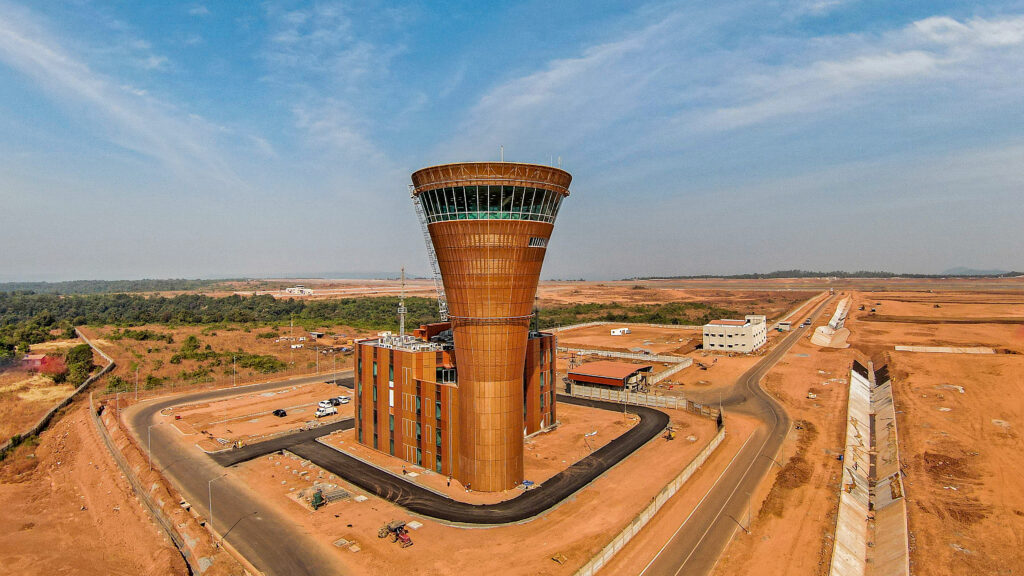
Noida International Airport is in Jewar, Uttar Pradesh, but it is planned to cater to the growing traffic in the National Capital Region. Navi Mumbai, on the other hand, is within the Mumbai Metropolitan Region (MMR) and with the Mumbai Trans-Harbour Link operational soon, it will be accessible from the business hub of south Mumbai.
On the back of two large orders at Paris Air Show — that of IndiGo and the formalisation of Air India order — there have been questions on the demand side in India and a small example of Goa gives a definite answer to this.
In all fairness, Goa is a state, unlike Mumbai or Delhi, where second airports are coming up, and many states have multiple airports. Besides, Goa has a population of two million, which pales in comparison to Mumbai and Delhi NCR, which are home to 20 million and 40 million people by some estimates. But Goa is a small state with both the airports catering to the same catchment area and set of travellers ― primarily tourists. No wonder Goa makes it to the top 10 domestic airports in the country. As MOPA becomes operational, Dabolim will continue to allow civilian flights. Better facilities at the terminal, a full-length parallel taxiway, and a lot more are under planning, indicating the seriousness of the state-run Airports Authority of India (AAI) in continuing to invest in its civil enclave at Dabolim.
While Navi Mumbai will compete with Mumbai, and both will be operated by the same operator (Adani Enterprises), this is not the case in Delhi, where GMR operates the Delhi Airport, while a consortium led by Zurich Airports is developing Noida International Airport at Jewar.
Beyond Jewar and Navi Mumbai
There are talks of another airport in Bengaluru as the current one would reach saturation over the next two decades. Bengaluru, India’s Silicon Valley, has long grappled with the increasing strain on its existing Kempegowda International Airport (KIAC). To address the rising demand for air travel and alleviate congestion, the development of a second airport in the city has been a subject of much discussion and planning. While the exact location and timeline for the second airport project are still under consideration, several potential sites have been explored. The proposed airport is expected to be a modern, state-of-the-art facility capable of handling a significant volume of domestic and international flights.
The construction of a second airport in Bengaluru offers several advantages. It would alleviate the pressure on KIAC, reducing congestion and improving operational efficiency. Furthermore, it could stimulate economic growth in the region by creating jobs and attracting new businesses. The second airport would also enhance Bengaluru’s connectivity and position it as a major aviation hub in India. However, the development of a second airport also presents several challenges. The project requires substantial investments in infrastructure, including runways, terminals, and supporting facilities. Land acquisition can be a complex process, especially in a rapidly urbanising city like Bengaluru. Additionally, there are environmental concerns to be addressed, such as noise pollution and air quality.
The Chennai-Parandur Airport Project, located approximately 65 kilometres northwest of Chennai, is a significant infrastructure development initiative aimed at addressing the growing air traffic demand in the region. The project will ensure that Chennai Airport’s current shortcomings are overcome and growth returns to more parts of Tamil Nadu.
The proposed airport at Parandur is expected to be one of the largest airports in the country, with multiple runways, state-of-the-art terminals, and advanced facilities. It will be equipped to handle both domestic and international flights, including wide-body aircraft. The airport’s strategic location will provide excellent connectivity to major cities in India and abroad, making it an attractive destination for airlines and passengers alike and open job opportunities for people.
Challenges remain
Operating two airports in a metro city presents a complex set of challenges. While it can increase capacity and offer passengers more choices, it also introduces logistical, economic, environmental, and operational complexities. Coordinating flight schedules, baggage handling, and passenger transfers between the two airports can be time-consuming and resource-intensive. Ensuring efficient use of infrastructure, such as runways and terminals, while managing air traffic flow to prevent congestion is crucial. Environmental concerns, such as noise pollution and air quality, are also significant factors to address, particularly in densely populated urban areas. Furthermore, ensuring passenger satisfaction and convenience requires careful planning and coordination, including easy accessibility to both airports and seamless connections between them. Overall, operating two airports in a metro city demands effective planning, collaboration, and investment to overcome these challenges and provide a sustainable and efficient air transportation system.
In India, where older airports like Bengaluru and Hyderabad are yet to see connectivity with the metro, connecting two airports in the same cities is a challenge like no other. It took a long time for Mopa to start international flights. India’s bilateral air services agreements have defined points of call and the two airport model was never in picture when the bilateral agreements were being signed. Will Noida and Navi Mumbai see international connectivity? In the case of Mumbai, it has no impact because the same company operates both airports, but in the case of Noida – it’s a different case. Will there be a tooth-and-nail fight? Will the passengers gain in the end? The answer is less than a year away.