






Drones Revolutionise Aircraft Maintenance: Faster, Safer, and More Efficient Inspections

- Drone technology cuts aircraft inspection time from hours to minutes, reducing delays and costs for airlines.
- Early adopters like Delta, KLM, Boeing, and Airbus show how drones boost efficiency, safety, and inspection accuracy.
- India’s airlines are poised to adopt drone-based inspections soon, pending regulatory approvals from the DGCA.

The commercial aviation Maintenance, Repair And Overhaul (MRO) industry is in the midst of a technological revolution, and one of the newest initiatives in this arena is the use of drones for aircraft maintenance inspections. A fundamental aspect of maintenance operations, aircraft inspections are a time-consuming and costly process, with manual inspections of a large commercial jetliner often taking several hours to be fully completed. The use of drones substantially reduces the time needed for these inspections. The implementation of drone technology for aircraft maintenance inspections will allow airlines to reduce maintenance costs and return their aircraft to service faster, supporting their efforts to reduce delays and cancellations for customers. With Indian carriers such as IndiGo, Air India, and Akasa Air all having large aircraft orders and growing operating schedules, it is expected that the use of drones in aircraft inspections will make its way to India sooner rather than later. However, at the moment, drone inspection for aircraft maintenance is the preserve of only a few international airlines.
A New Initiative
In what was an industry first, in October 2024, the U.S. Federal Aviation Administration accepted an airline operator’s plan to use drones for maintenance inspections. Delta is the first U.S. commercial operator to receive the FAA Certificate Management Office concurrence for using drones for maintenance inspections across its fleet. Delta began exploring the use of drones for maintenance inspections in 2017 and has partnered with one of the pioneering companies in this field, the Dutch drone specialist Mainblades.
Mainblade drone-based solutions digitise and automate the inspection process, saving airlines a lot of time, money, and resources compared to what they had to spend in the past. The use of drones for airframe inspection speeds up not only regular inspections but, importantly, unscheduled ones, too. With airlines undertaking several hundred inspections on average per year, the potential resource savings are expected to be quite significant.
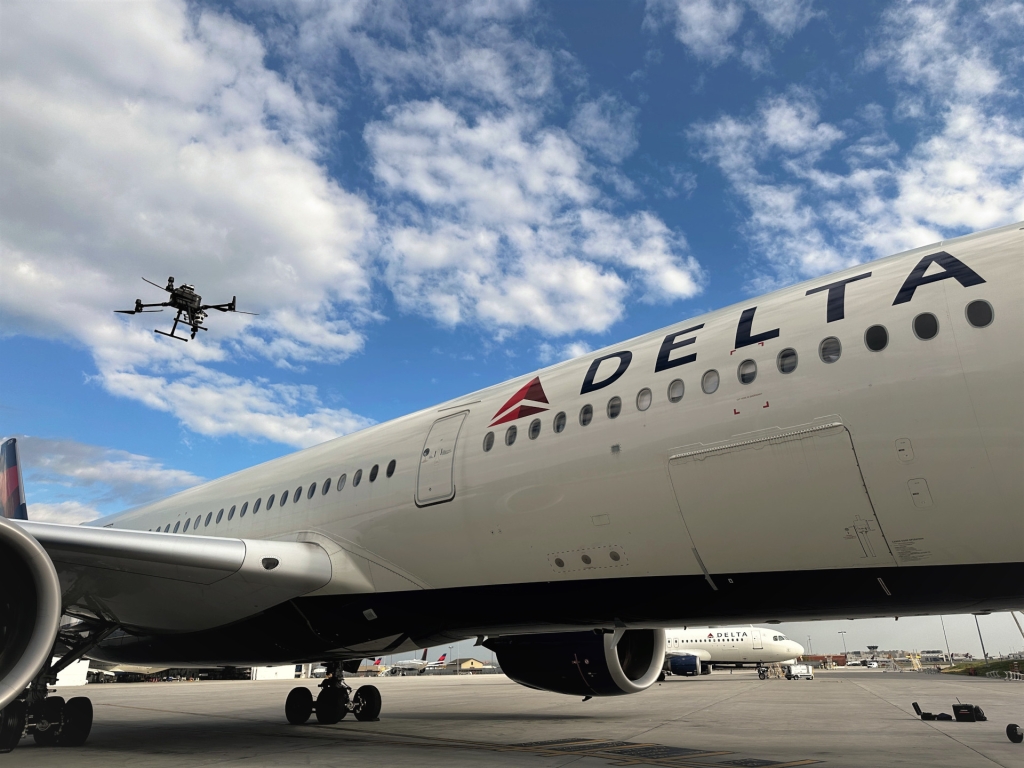
Photo: Delta Airlines
Delta TechOps was granted this acceptance by the FAA in 2024, and Delta will conduct visual inspections of its aircraft in operation using camera-based, small drones. The U.S. carrier’s MRO arm, Delta TechOps, is one of the world’s largest and most experienced airline MRO providers. The camera-based, small drones are being used to initially undertake conditional visual inspections following lightning strike events. An October 2023 article in Aviation Week quoted Emma Galarza, senior engineer for Delta TechOps’ technology development team, “Manual inspections average around 16 labour hours, requiring additional staff to help spot, manoeuvre, and mark down inspection findings. The drones significantly cut down on time, taking photos of an entire narrow-body aircraft in approximately 42 minutes and of an entire widebody in around an hour and 15 min.” The use of drone inspections has now been added to the Aircraft Maintenance Manual (AMM) for Delta’s entire mainline fleet.
Small, unmanned aircraft systems (sUAS) are semi-autonomous drones that navigate around an aircraft, taking images without manual inputs from a pilot. Visual inspection for the upper part of the aircraft is performed by the drone equipped with a high-definition camera, and it is flown using an automatic flight control system supervised by a human pilot. The drone follows a predetermined flight path, taking pictures along the way automatically, showing any potential scratches, dents and painting defects. These are then compiled in a 3D digital model, recorded in a database, and then analysed. This data helps improve traceability, prevention, and reduction of damage.
Once images of the airframe are captured, trained TechOps technicians and inspectors evaluate those photos to determine airworthiness before returning the aircraft to service. As per Delta, the technology helps technicians and inspectors make decisions on aircraft conditions up to 82% faster. There is also a very important safety benefit, as the use of drones for aircraft inspection removes the risks associated with technicians and inspectors working from heights using scaffolding, lifts, or cranes. Visual inspections are also challenging in poor weather conditions, and the use of high-resolution cameras on drones means that picture analysis can be done anytime afterwards and in an office.
Pioneering Initiative
The first drone inspection of a commercial jetliner was undertaken by KLM Engineering & Maintenance and Mainblades in August 2015, when a Boeing 737-800 (PH-BXY) was inspected for lightning damage using a drone. During the drone test, which took place in a hangar, the aircraft that had simulated lightning strike damage was viewed by the drone fitted with cameras that flew over the plane. Regulations call for inspection of lightning or hail damage, no matter how small, before the next departure of the aircraft. These inspections, which involve inspecting the aircraft hull and wings, are time-consuming and must be scrupulously conducted by highly trained employees.
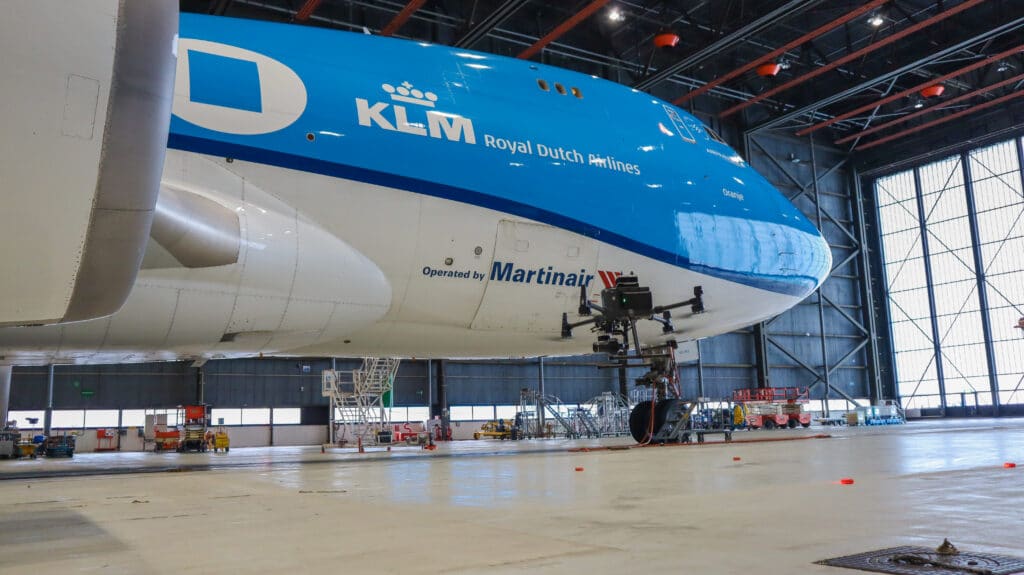
The use of drones for inspecting lightning or hail damage significantly reduces the inspection time, delivering substantial cost savings. This is especially the case when the drone inspection will be performed on large widebody jetliners. However, since the drone can cause damage to the aircraft’s skin or sensors/probes if there is a collision, both the drone and the drone operator need to be certified to do such work.
In August 2021, Mainblades announced that it had extended its partnership with KLM Engineering & Maintenance (KLM E&M) to perform automated aircraft drone inspections. As part of the renewed multi-year agreement, both companies set up a foundation to make the technology fully operational and to take the necessary certification steps required to inspect aircraft regularly at Schiphol Airport. “I could not be more excited about this new endeavour. The use cases are numerous because the Mainblades drone is a highly modular system. It works on any aircraft model, both inside and outside of the hangar, and most importantly, can be used while regular maintenance operations are in progress. This flexibility is unique in this field”, Bas de Glopper, Innovation Manager from the KLM MRO Lab, had said.
Boeing Moves Ahead
In January, this year, NASA announced that its ‘Small Business Funding’ had enabled aircraft inspection by drones. It stated that a small business called Near Earth Autonomy had developed a timesaving solution using drones for pre-flight checks of commercial airliners through a NASA Small Business Innovation Research (SBIR) program and a partnership with Boeing. “NASA has worked with Near Earth Autonomy on autonomous inspection challenges in multiple domains,” said Danette Allen, NASA senior leader for autonomous systems. “We are excited to see this technology spin out to industry to increase efficiencies, safety, and accuracy of the aircraft inspection process for overall public benefit.”
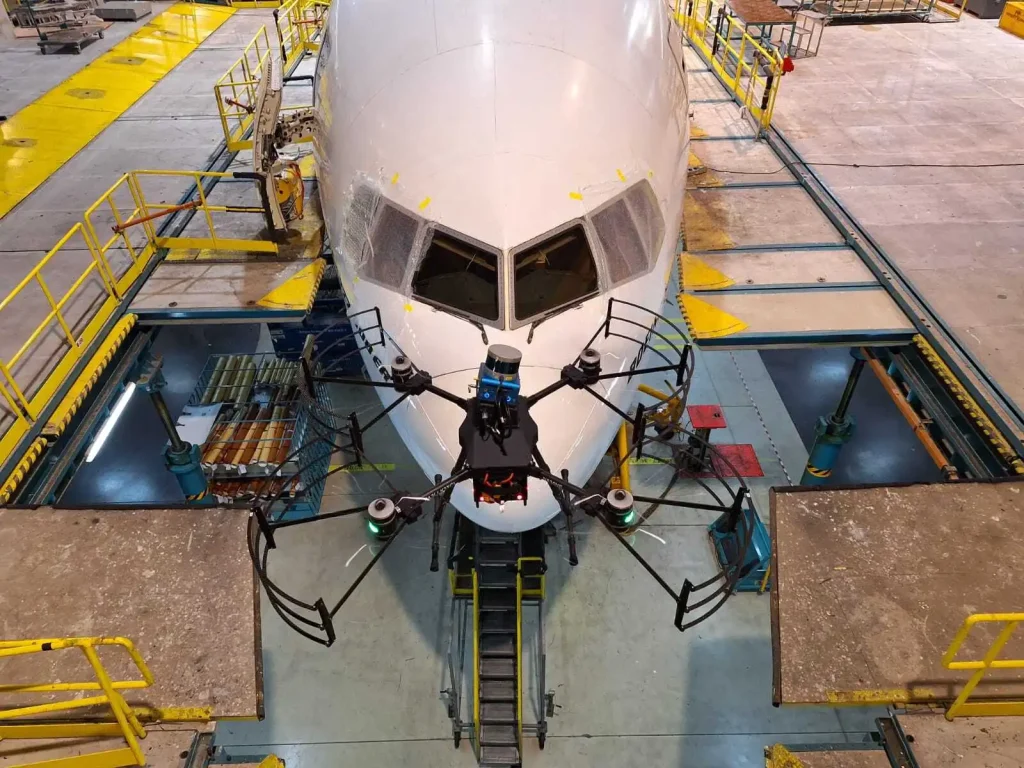
Near Earth Autonomy estimates that using drones for aircraft inspection can save the airline industry an average of US$10,000 per hour of lost earnings during unplanned time on the ground. A pre-flight inspection must be completed before commercial airliners are deemed safe to fly, and this is a process that can take up to four hours and can involve workers climbing around the plane to check for any issues, which can sometimes result in safety mishaps as well as diagnosis errors. Over the last six years, Near Earth Autonomy has completed several rounds of test flights with its drone system on Boeing aircraft used by American Airlines and Emirates Airlines.
Near Earth Autonomy’s drone-enabled solution can fly around a commercial airliner and gather inspection data in less than 30 minutes. It can autonomously fly around an aircraft following a computer-programmed task card based on the Federal Aviation Administration’s rules for commercial aircraft inspection. The images collected from the drone can be shared and analysed remotely, and the new images can be compared to old images to look for cracks, popped rivets, leaks, and other common issues, with experts in the airline maintenance field supporting repair decisions faster from any location.
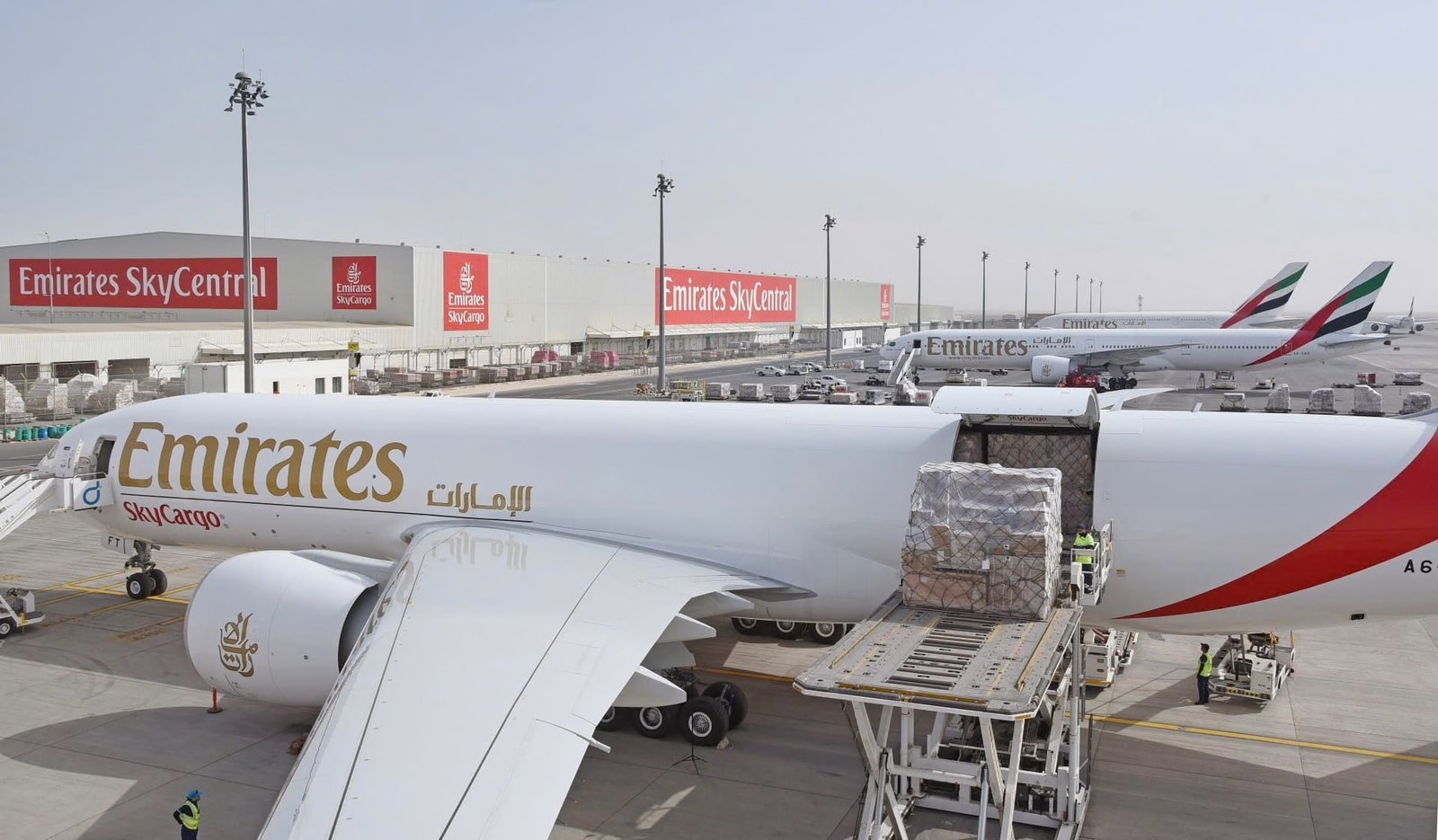
Emirates had earlier entered into a Memorandum of Understanding (MoU) with Boeing in November 2023 to leverage advanced digital technologies and accelerate improvements in maintenance operations. The key focus areas of the partnership included drone-assisted aircraft inspections, sharpening the precision and effectiveness of maintenance tasks through the use of virtual and Augmented Reality, in addition to next-generation prognostic and predictive maintenance.
“Our partnership with Boeing will enable us to maximise the benefits of advanced technologies and digital excellence to improve operational reliability, minimise disruptions and ensure our fleet operates at the highest standards, ultimately providing our customers a better travel experience. Whether it is drones conducting inspections with meticulous agility or AR visualisations that help engineers see behind panels or inside ducts to locate potentially defective components not visible to the naked eye without having to dismantle them, we’re taking significant steps to optimise aircraft maintenance to its full potential on our fleet of Boeing 777s,” Ahmed Safa, Divisional Senior Vice President Emirates Engineering had said.
As per Boeing, the integration of drone technology for maintenance tasks represented a leap forward for Emirates, helping speed up exterior inspections on widebody aircraft utilising ultra-high resolution cameras with the capability to reach every angle of the aircraft to detect surface imperfections.
Airbus Inspection Drone
Airbus first demonstrated aircraft visual inspection using a drone at the 2016 Farnborough Airshow. At the time, it had announced that aircraft downtime for inspection is reduced when drones are used with data acquisition by drone only takes 10-15 minutes, instead of two hours using conventional methods. Airbus had announced at the time that it was undertaking full-scale industrial testing on an A330 aircraft.
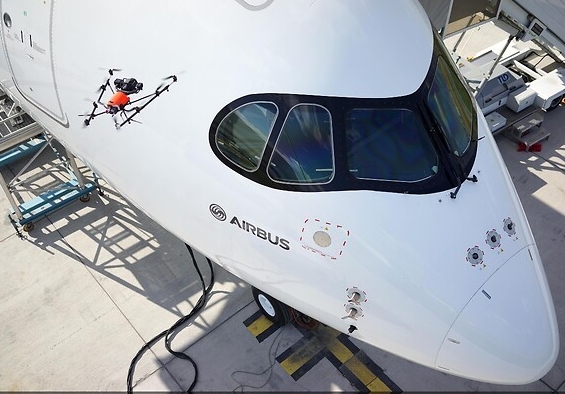
Airbus announced the launch of an advanced indoor inspection drone in April 2018 that would reduce aircraft inspection times and enhance report quality. The new drone-based inspection system was an element of Airbus’ ‘Hangar of the Future’ (HoF), an innovation maintenance project initiated by Airbus in Singapore in 2016.
This drone-based aircraft inspection system was optimised for inspecting the upper parts of the aircraft fuselage. The system was developed in cooperation with Airbus’ subsidiary Testia, which specialises in non-destructive testing. The innovative drone-based maintenance tool was for use inside a hangar and accelerated and facilitated visual checks, considerably reducing aircraft downtime and increasing the quality of inspection reports.
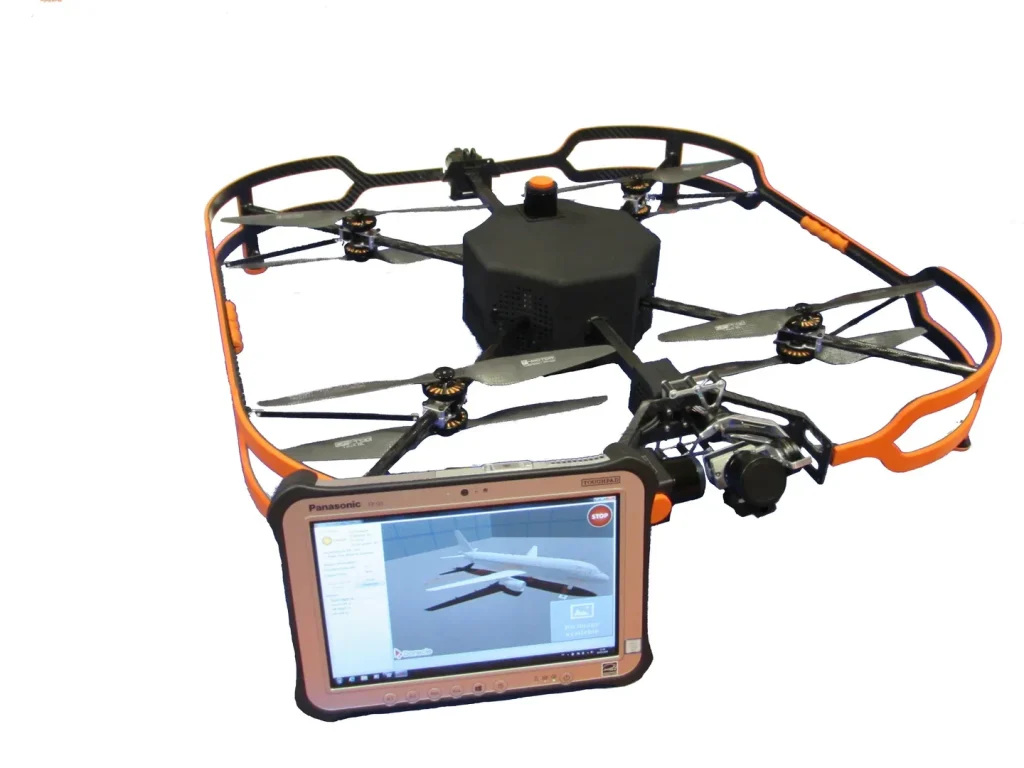
Airbus’ Advanced Inspection Drone combined the airframer’s extensive aircraft knowledge with smart drone technology to deliver a product consisting of a smart, automatic drone with an integral visual camera, a laser-based obstacle detection sensor, flight planner software and an Airbus aircraft inspection software analysis tool. The laser-based sensor on the drone made it capable of detecting obstacles and halting the inspection if necessary, allowing the vehicle to fly automatically without the need for remote piloting. The automated drone flies on a predefined inspection path, capturing all the required images with its onboard camera, which are then transferred to a PC database for detailed analysis using a software system. This operator, using the software, can localise and measure visual damage on the aircraft’s surface by comparing it with the aircraft’s digital mock-up.
In May 2019, Airbus announced that it was working on combining the use of drones, Augmented Reality (AR) and Artificial Intelligence (AI) for an innovative Airbus system that would revolutionise aircraft maintenance. Airbus had stated at the time that it was jointly developing ‘Drone and Augmented Reality’ inspection services with a military service for inspections of Airbus-built A400M heavy-lift airlifters. The airframer had further stated that its application could be further extended to cover three other Airbus military airlifters: the medium-lift CN235 and C295 transports, along with the A330 MRTT (Multi Role Tanker Transport).
As per Airbus, the external inspection of an aircraft such as the A400M, which has an overall length of 45 metres, would require weeks with traditional methods. Drone-based external inspection, however, would only require two hours. The airframer also stated that Drone and Augmented Reality inspections would also lower the risk of inadvertent damage caused by traditional inspection methods that require a build-up of scaffolding and the deployment of mobile equipment around the aircraft.
The drones would be equipped with high-definition cameras and a 3D augmented reality Light Imaging, Detection And Ranging Sensor (LIDAR) that would allow accurate positioning of the drone during the fly-around inspection. This Airbus technology would provide MRO operators with an end-to-end digital solution that increased operational efficiency while at the same guaranteeing quality and adherence to airworthiness standards.
Ready for the Future
It is evident that in the coming years, airlines and MRO operators will transition to using drone-based systems for aircraft inspection, increasing operational efficiency with speedier inspections that allow the aircraft to be released to service earlier. In some cases, inspections that would take a few hours are now completed in 30 minutes of drone image capture. The use of drones and their advanced cameras and software will also result in improved inspection report quality, damage localisation, repeatability, and traceability, in addition to greater digitisation of aircraft records. There is also the tangible benefit of far-improved safety for airlines and MRO personnel who no longer need to scale the heights of a large commercial jetliner to complete aircraft inspections. When it comes to Indian carriers, we can expect drone-based aircraft inspection to be approved by the Directorate General of Civil Aviation (DGCA) sooner rather than later and soon operationalised in the country.