












Deutsche Aircraft and DLR Successfully Complete Ground Vibration Test on D328® UpLift Demonstrator


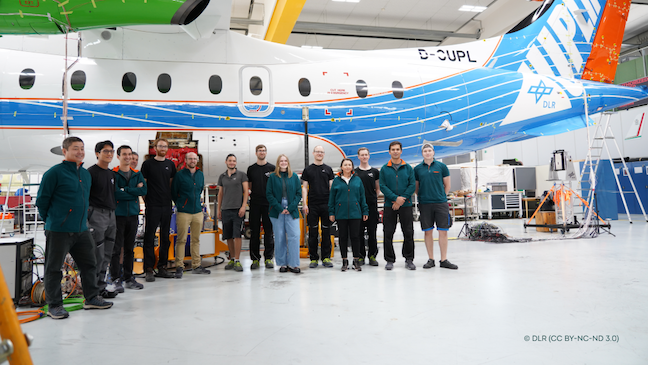
Deutsche Aircraft, in collaboration with the German Aerospace Center (DLR) Institute of Aeroelasticity, has successfully completed a Ground Vibration Test (GVT) on the D328® UpLift flying testbed, D-CUPL.
This achievement marks a significant step forward in the UpLift programme, an initiative funded by the Federal Ministry for Economic Affairs and Energy to accelerate the maturation of new technologies for sustainable aviation, boosting innovation and economic value creation.
What is the GVT?
The Ground Vibration Test is a critical procedure in aircraft development. It is used to determine the aircraft’s modal properties, including its natural frequencies, damping ratios and mode shapes. This information is essential for validating structural dynamics and refining the numerical models used in flutter analysis and loads calculation.
A Test of Precision and Scale
Over a two-week test period, the D328® UpLift was suspended using actively controlled air springs. The structure was excited at over 20 locations using electrodynamic shakers, while 237 acceleration sensors captured the dynamic response.
Key test outcomes:
- 3 aircraft configurations
- 45 hours of excitation time
- 50 distinct eigenforms identified
Simon Binder, Senior Engineer, Loads & Aeroelastics, at Deutsche Aircraft stated,
“This successful GVT campaign is a cornerstone in validating the Global Finite Element Model (GFEM) in support of the structural modifications designed for the UpLift D-CUPL.”
“With the ground vibration test, we have reached an important milestone in the UpLift project,” added Julian Sinske from the DLR Institute of Aeroelasticity. “We can now evaluate upcoming modifications to the research aircraft in terms of their aeroelastic behaviour. I’m pleased that we conducted the test efficiently and achieved high-quality results. The new air spring support played a decisive role in this.”
Ground Vibration Test: What Happens
Before a new or modified aircraft can fly, engineers must check how its structure responds to vibration. In a Ground Vibration Test (GVT), the aircraft is placed on very soft supports so it can move freely, almost as if floating in the air. Electrodynamic shakers then apply controlled vibrations at many points across the fuselage, wings and tail. Hundreds of sensors record how the airframe reacts.
A full GVT usually takes days or even weeks. Engineers repeat the test under different conditions—such as varying fuel load or equipment—to see how the aircraft’s behaviour changes. The result is a detailed picture of the aircraft’s dynamic behaviour that engineers use to plan safe flight tests.
Even with powerful computer models, regulators still want physical proof. GVT provides the real-world data needed to confirm that the aircraft will not face “flutter” (a dangerous vibration that can grow quickly) and other aeroelastic issues.
Why It Matters
In Europe, EASA requires manufacturers to show that aircraft are free of flutter across the flight envelope. Test data from GVT is compared with computer predictions to make sure the two match. This correlation is a key step before flight-flutter work and, later, certification. The approach is broadly aligned with the FAA in the United States.
For Deutsche Aircraft’s D328® UpLift, GVT sets a reliable baseline. UpLift will trial new propulsion systems, alternative fuels and advanced equipment. Each change can alter how the airframe vibrates. By completing a full GVT campaign now, Deutsche Aircraft and DLR can integrate future modifications more safely and move into flight testing with greater confidence.
What is the UpLift Programme?
UpLift is a German government–funded research initiative led by Deutsche Aircraft in partnership with the German Aerospace Center (DLR) and other industry players. Built around a specially modified D328® aircraft, the programme acts as a flying laboratory to test future aviation technologies. These include alternative propulsion systems, sustainable fuels, new energy storage solutions and advanced systems integration. The goal is to speed up the transition to greener, more efficient regional aircraft while also strengthening Germany’s aerospace innovation base.
A Collaborative Effort
The successful completion of this test powerfully demonstrated the possibilities when industry and applied research operate in sync.
The D328® UpLift continues to serve as a beacon of innovation, enabling real-world testing of future propulsion and energy systems, sustainable fuels and advanced systems integration to shape the future of aviation.
Also Read: Reimagining Regional Connectivity….