














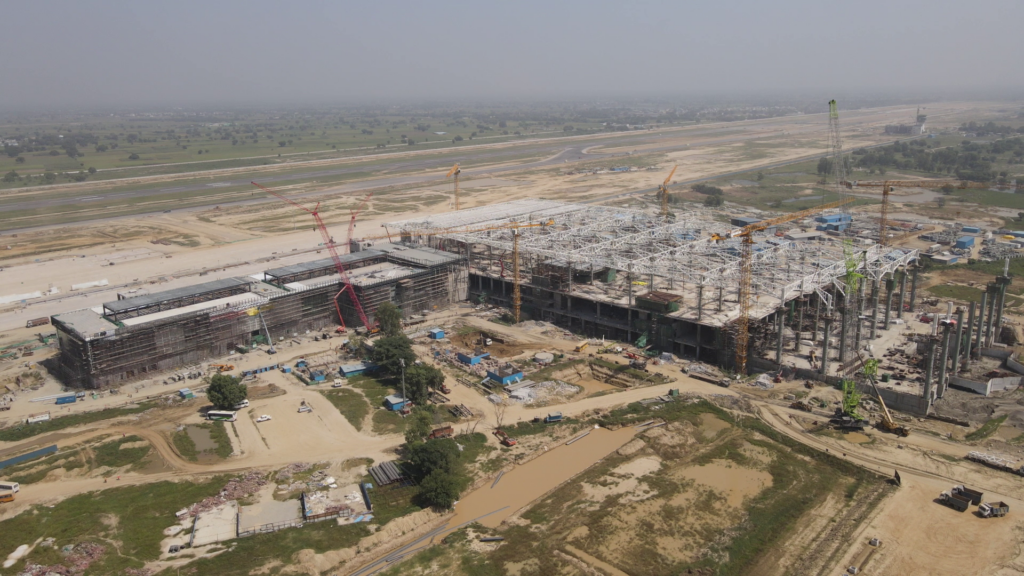
Noida International Airport (NIA), or Jewar Airport, is poised to become a significant player in India’s aviation landscape, attracting international airlines and boosting economic growth in the region. This is a widely held aspiration and goal that everyone, from stakeholders to the general public, eagerly anticipates becoming a reality. NIA, now expected to commence operations in April 2025, is advocating for significant revisions to existing government policies regarding bilateral air service agreements to work towards its goals and target.
According to the Uttar Pradesh government, the airport is being developed on the model of Zurich Airport in Switzerland, with enhanced passenger and flight handling capabilities to meet world-class standards. “Notably, the Noida International Airport at Jewar is being developed as the country’s first transit hub, with aspirations to develop it into an Asia Pacific transit hub, a first for India,” the government said.
According to Christoph Schnellmann, CEO of Noida International Airport Limited (NIAL), NIA is preparing to begin full-crew test flights by November 30. Before that, the Directorate General of Civil Aviation (DGCA) will carry out initial flight trials on November 25, followed by commercial test flights involving three to four airlines, including IndiGo and Akasa Air, representing domestic and international carriers.
The Jewar Airport concession period began on October 1, 2021, and will run for 40 years. Tata Projects was awarded the airport’s engineering, procurement, and construction (EPC) contract in June 2022. Upon full completion by the fourth phase, the airport will accommodate 500,000 flights and handle 70 million passengers annually.
NIAL plans to submit applications for Instrument Landing System (ILS) procedures and aerodrome licensing in December, aiming to secure the necessary DGCA approvals by March. The airport’s IATA booking code is expected to be published by February 6, after which ticket sales will commence.
The NIA is being developed across 1,334 hectares in Jewar, located in Uttar Pradesh’s Gautam Buddha Nagar district. The airport lies approximately 72 kilometres from Delhi’s Indira Gandhi International Airport, 52 from Noida, and 130 from Agra. Currently, over 7,500 workers are involved in constructing the airport, which, in its first phase, is expected to handle 12 million passengers and manage around 100,000 flights per year.
The airport’s management has scheduled calibration flights for its ILS between September and October, while validation flights for approach and departure procedures will follow in December. Upon completion of these regulatory steps, the airport will seek an aerodrome license from the DGCA.
NIA’s flight schedule comprises a plan for up to 65 daily flights—including 62 domestic, two international, and one cargo flight. Stakeholders have indicated that this flight schedule is expected to remain unchanged for next year’s launch. Talks have already begun with the IATA for international slots and the DGCA for domestic routes.
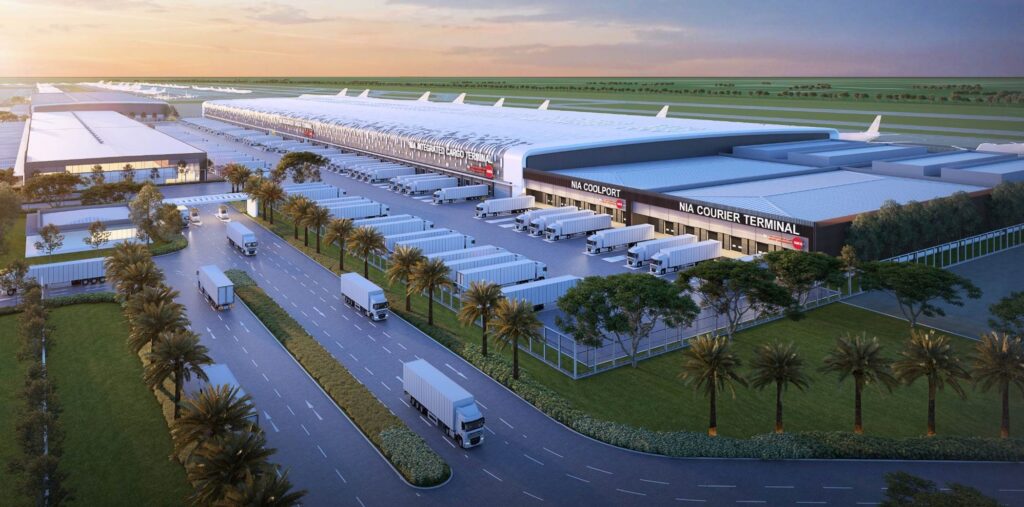
The first phase of Jewar Airport will have the capacity to handle 12 million passengers annually, with plans to expand it to 70 million passengers once all four phases are completed.
This additional capacity makes Jewar an attractive option for international carriers that struggle with congested slots and high operational costs at Delhi Airport.
Jewar Airport is being designed as a state-of-the-art facility. The airport will feature two runways. The stakeholders claim that it is also being built with a focus on sustainability. Jewar Airport is being developed as a greenfield airport, incorporating sustainable design and construction practices. The airport will focus on reducing its carbon footprint, using renewable energy, and implementing eco-friendly technologies.
According to NIA, the airport’s launch delays are attributed to disruptions in the supply of certain construction materials and equipment, largely caused by global supply chain issues stemming from geopolitical conflicts.
While the runway carpeting at NIA is complete, and the runway lights are expected to be installed within a month, work on the terminal building is ongoing.
Further, according to CEO Christoph Schnellmann, NIA is attracting significant interest from both domestic and international airlines. The airport’s potential as a major aviation hub is evident, with several carriers expressing keen interest in operating flights from the facility.
Domestic airlines like IndiGo and Akasa Air have already signed up for operations at Noida International Airport. Notably, these airlines are not only eyeing domestic routes but are also keen to explore international destinations from this strategic location. This indicates a growing confidence in the airport’s ability to serve as a gateway to India for international travellers.
Key aero concessions for services such as into-plane fuelling, ground handling, and cargo operations have been successfully awarded. Additionally, non-aero concessions, including contracts for retail, dining, lounges, duty-free, and hotel services, have also been finalised.

Factory acceptance tests for critical airport systems are complete, and equipment is arriving at the site. Check-in kiosks, self-service bag drops, and e-gates are currently undergoing testing.
Regarding operational readiness, agreements have been signed for essential services like airfield lighting, passenger boarding bridges, and lifts and escalators. The airport plans to apply for its aerodrome license by the end of 2024.
Unique Case for Noida International Airport
Despite various concerns related to connectivity and feasibility, industry voices argue that NIA’s situation is distinct, primarily due to its role as a second airport for the Delhi NCR, a region where air traffic demand is growing. These advocates are calling for a more flexible approach, including a possible Memorandum of Understanding (MoU) with various countries to establish a level playing field for NIA’s entry into the global aviation market.
| Airport’s advantage amid traffic and connectivity challenges It is true that many factors, backed by data, make it attractive for international airlines. According to the IATA, India is set to become the third-largest aviation market by 2024. This projected growth is driven by both domestic and international demand, particularly from business travellers, tourists, and the growing middle-class population. One of the airport’s most compelling features is its proximity to Delhi NCR. Currently, Indira Gandhi International Airport (IGI) in Delhi handles the majority of international traffic for North India, and it served more than 7.22 crore passengers in 2023. However, with traffic growing by around 9-10 per cent annually, the region needs additional capacity, making Jewar Airport an ideal solution. However, the issues of connectivity and traffic congestion remain highly pressing and require immediate solutions. While the NIA holds immense potential, its success hinges on seamless connectivity. Reaching the airport from any part of Delhi-NCR still remains time-consuming, with commuters dealing with massive traffic congestion. Some have pointed out that the lack of a dedicated rail link between the airport and central Delhi is a significant oversight that could hinder passenger traffic. A dedicated train or metro corridor would have provided a convenient and efficient transportation option, attracting more travellers and easing congestion at the airport. This approach has proven successful in cities like London, where multiple transportation modes, including express trains and metro lines, offer easy access to the city centre. Unfortunately, the lack of coordination between the state government and relevant authorities has hampered the development of such a vital infrastructure. By working together, they could have created a more compelling proposition for travellers, ensuring that the airport is not just accessible but also easily navigable. Investing in robust infrastructure is crucial to maximising NIA’s potential and attracting a wider range of passengers, both domestic and international. A dedicated rail link would have been a significant step in this direction, providing a seamless travel experience and enhancing the airport’s appeal. To mitigate the anticipated surge in traffic on the Noida-Greater Noida Expressway, the Noida Authority has announced plans to construct a new 30-kilometre alternative route. This ambitious project aims to alleviate congestion and improve commute times for residents and commuters in the region. The Noida Authority has taken a proactive step by requesting the Uttar Pradesh Public Works Department (PWD) to declare the proposed expressway as a National Highway. This designation is crucial as the National Highways Authority of India (NHAI) only handles projects with national highway status. While the approval process may take time, securing this designation will ensure that the project receives the necessary support and resources for timely completion. The construction of the new expressway is a significant investment in the region’s infrastructure development. Although no final details regarding deadlines are known yet, the Noida Authority undertook a feasibility study last year to assess the viability of constructing the proposed expressway. Further, NIA is set to gain a crucial connection with Film City through a new light rail transit (LRT) system. This LRT corridor will be integrated with the Regional Rapid Transit System (RRTS) route, providing seamless connectivity between the two important destinations. Originally planned as a pod taxi route, this corridor between NIA and Film City has undergone a change in plans. Following an unsuccessful tender process for the pod taxi project, the UP government decided to explore the feasibility of a light rail system. The UP government approved the 72km RRTS corridor between Ghaziabad and the airport, and the National Capital Region Transport Corporation (NCRTC) subsequently submitted a project report that included the option of either a pod taxi or a light rail system. Media reports state that the project is slated for completion by the year 2031. Industry watchers and experts claim that the government could have executed all of this infrastructure planning well before the airport became operational. While penalties are in place for NIA’s delays, the question remains: who will be held accountable for the infrastructural shortcomings that continue to impact the airport’s connectivity and overall functionality? |