










AgustaWestland AW609 TiltRotor
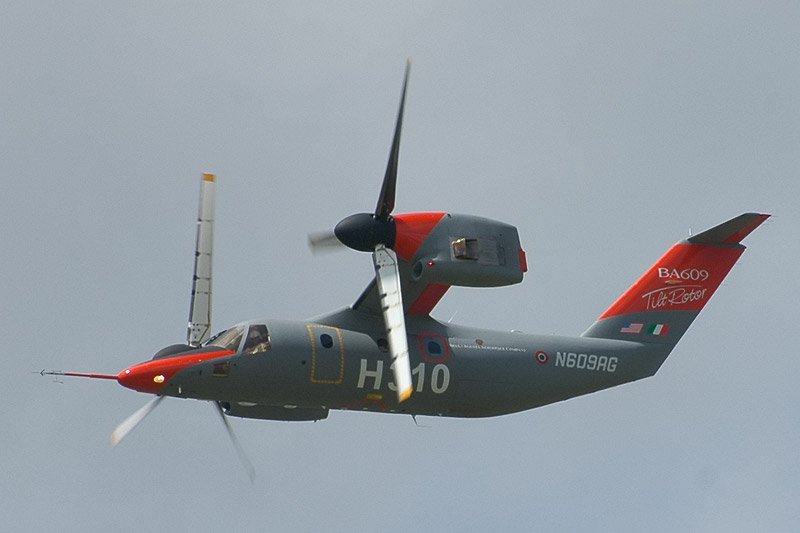
The AgustaWestland AW609 TiltRotor, developed by Leonardo Helicopters, merges the vertical take-off and landing (VTOL) capabilities of a helicopter with the speed, range, and efficiency of a fixed-wing aircraft. Initially conceived as the Bell/Agusta BA609 in 1996, the AW609 has evolved through a complex development journey, with AgustaWestland (now Leonardo) taking full control by 2011 after Bell’s exit. The tiltrotor achieved a significant milestone with its first flight in 2003 and is now on the cusp of FAA certification under the new Powered Lift category, expected in 2025, with EASA certification to follow in 2026-2027.
Designed for civilian applications, the aircraft represents a groundbreaking leap in aviation, targeting a diverse range of missions, including VIP and executive transport, offshore oil and gas operations, search and rescue (SAR), and emergency medical services (EMS). With a global order backlog estimated at 60 units, launch customer Bristow Helicopters is set to receive the first production model, assembled at Leonardo’s Philadelphia facility, where a full-flight simulator aids pilot training. The AW609’s unique ability to fly at nearly twice the speed of conventional helicopters—up to 509 km/h (275 knots)—and its capacity to cruise at 25,000 feet above turbulent weather, positions it as a transformative platform, potentially revolutionising urban air mobility and remote connectivity with unmatched speed, range, and versatility for operators worldwide.
Cabin Experience
The helicopter’s cabin offers a spacious and adaptable interior, measuring 1.60 meters (5.25 feet) in width, 1.37 meters (4.49 feet) in height, and 2.20 meters (7.22 feet) in length, providing 6.5 cubic meters (229.5 cubic feet) of usable space. Pressurised and constructed with composite materials, it can accommodate up to nine passengers in a VIP configuration, with plush leather seats, ambient lighting, and soundproofing that keeps noise levels below 80 decibels, ensuring a serene environment akin to a business jet. The wide cabin door and low sill height facilitate easy boarding, even for elderly passengers or those with mobility challenges, while large windows provide panoramic views and enhance visibility and comfort. For EMS missions, the cabin accommodates two stretchers with full medical equipment, allowing 360-degree patient access for medical teams—a feature critical for rapid response in India’s rural and disaster-prone regions. The flexible layout also suits SAR and security operations, with reconfigurable seating and equipment mounts for tactical gear, while a separate baggage compartment of 1.5 cubic meters (53 cubic feet) ensures ample storage for mission-critical supplies or executive luggage, accessible during flight.
Technology (Engine and Avionics)
The AW609 is powered by two Pratt & Whitney Canada PT6C-67A turboshaft engines, each delivering 1,940 shaft horsepower, equipped with Full Authority Digital Engine Control (FADEC) systems that optimize performance and enable safe single-engine operation (OEI) with autorotation capability. Its 30-minute run-dry transmission enhances reliability, a critical feature for offshore missions in India’s Arabian Sea oil fields. The Collins Aerospace Pro Line Fusion avionics suite features three 14-inch touchscreen displays, integrating navigation, communication, and mission systems with Synthetic Vision and Night Vision Goggle (NVG)-compatible lighting for enhanced situational awareness during night or low-visibility operations. The triple-redundant fly-by-wire flight control system, a first for tiltrotors, reduces pilot workload by automating transitions between helicopter and airplane modes in just 40 seconds. An ice-protection system allows flights in known icing conditions, making the AW609 ideal for India’s diverse climates, from monsoon-heavy coasts to Himalayan winters, while its modular design supports mission-specific upgrades like FLIR cameras for SAR or maritime surveillance systems for the Indian Coast Guard.
Performance
The AW609’s combines helicopter versatility with airplane efficiency. It achieves a maximum speed of 509 km/h (275 knots), a cruising speed of 463 km/h (250 knots), and a service ceiling of 7,620 meters (25,000 feet), allowing it to fly above adverse weather and turbulence. With a maximum range of 1,296 kilometres (700 nautical miles)—extendable to 2,037 kilometres (1,100 nautical miles) with auxiliary fuel tanks—it can connect cities like Delhi to Kolkata non-stop, cutting travel time significantly compared to traditional helicopters. Its ability to take off and land vertically eliminates the need for runways, making it perfect for urban helipads or remote sites in India’s Northeast, while its autorotation capability ensures safety during emergencies. The tiltrotor can carry an external load of up to 1,360 kilograms (3,000 pounds), supporting utility roles like disaster relief logistics in flood-affected areas like Assam, where its speed and range can deliver aid swiftly.
Leonardo Helicopters supports AW609 operators through a global network of over 50 service centres, including facilities in India, providing 24/7 technical support and parts availability. Maintenance includes 600-hour inspections and 2,500-hour major overhauls, with Leonardo’s HeliWise platform offering predictive analytics to minimise downtime. Direct operating costs are estimated at $3,500 per hour, reflecting its advanced technology, while ongoing developments, such as potential hybrid propulsion, aim to enhance efficiency and align with India’s sustainability goals in aviation. The AW609’s production in Philadelphia, alongside plans for a second assembly line in Italy, ensures scalability, with the first serial aircraft undergoing FAA function and reliability testing by late 2025, paving the way for widespread adoption.
Specifications
| Category | Metric | Imperial |
| Length | 13.40 m | 44 ft 0 in |
| Wingspan | 14.10 m | 46 ft 3 in |
| Height | 4.60 m | 15 ft 1 in |
| Cabin Length | 2.20 m | 7 ft 3 in |
| Cabin Width | 1.60 m | 5 ft 3 in |
| Cabin Height | 1.37 m | 4 ft 6 in |
| Passenger Capacity | Up to 9 | Up to 9 |
| Max Take-off Weight | 7,620 kg | 16,800 lb |
| Max Range | 1,296 km | 700 nm |
| Max Speed | 509 km/h | 275 kts |
| Cruising Speed | 463 km/h | 250 kts |
| Service Ceiling | 7,620 m | 25,000 ft |
| Rate of Climb | 7.6 m/s | 1,500 ft/min |
| Engines | 2 × Pratt & Whitney PT6C-67A | 1,940 shp each |
| Fuel Capacity | 1,200 L | 317 US gal |
Takeaways
The helicopter blends Leonardo Helicopters’ legacy of innovation with cutting-edge tiltrotor technology to redefine point-to-point transportation. Its spacious cabin, advanced avionics, and powerful Pratt & Whitney engines make it a game-changer for VIP transport, offshore operations, and emergency services, with significant potential in India for urban air mobility and disaster response. Globally, its appeal spans from Bristow’s offshore missions in the North Sea to potential military applications with the Italian Army, while its ability to connect remote regions—like India’s Andaman Islands to the mainland—offers a lifeline for isolated communities. With certification on the horizon, competitive operating costs, and a focus on sustainability, the AW609 is poised to lead a new era of aerial mobility, marking a paradigm shift in aviation.