















Table of contents
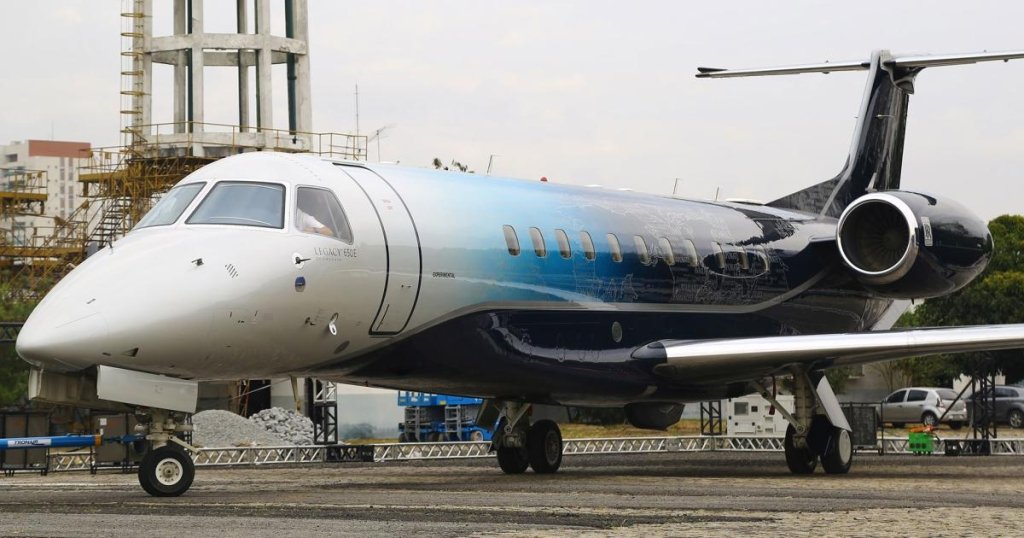
Embraer Legacy 650E
Launched in 2016 as the final and most refined iteration of the Legacy 600/650 lineage, Embraer’s Legacy 650E retains the tried-and-tested airframe based on the ERJ-135 regional jet, while introducing next-generation enhancements, including Honeywell’s Primus Elite avionics, increased range, refined cabin amenities, luxury interiors, and other business aviation requirements. The “E” stands for “Evolution,” signifying the ultimate evolution of Embraer’s large-cabin business jet lineage, combining transcontinental range with exceptional dispatch reliability, improved fuel efficiency, and cost-effectiveness.
With a maximum range of 7,223 km (3,900 NM), the Legacy 650E effortlessly connects key global business hubs, including New York to London (5,585 km); Hong Kong to Sydney (7,364 km with one fuel stop), and Dubai to Paris (5,222 km). Certified in 2019, it remains a top choice for corporate flight departments, private owners, and charter operators seeking a spacious, high-performance jet with long-range capabilities.
Embraer Legacy 650E: Cabin Experience
This aircraft builds upon the generous cabin proportions of the Legacy 650 by adding improved materials, ambient lighting options, and a quieter, more comfortable ride. It sets a new standard for large-cabin comfort, offering a length of 12.95 m (42 ft 6 in); width of 2.10 m (6 ft 10 in), and height of 1.82 m (6 ft). The three-zone cabin can be configured for up to 14 passengers, with multiple layout options including executive club seating, a divan convertible into a bed, a dedicated dining or meeting area, and a private aft lavatory with optional shower, all separated for enhanced privacy and functionality, and a productive and restful inflight experience.
The interior offers both luxury and practicality with high-end materials, fully reclining seats, and a modern cabin management system that supports high-definition video, surround sound, and personal device integration. It is also equipped with a walk-in baggage compartment that remains accessible in flight—offering 286 cubic feet of storage.
In terms of its rivals, the Challenger 650 offers a slightly wider fuselage, but the Legacy 650E compensates with its longer cabin and more flexible layout. The Gulfstream G280 may be faster with slightly more runway performance under hot-and-high conditions, the 650E offers more space for passengers and luggage, turning out to be highly valuable for long-haul operations where cabin comfort matters.
Embraer Legacy 650E: Technology (Engine ad Avionics)
Powered by two Rolls-Royce AE 3007A2 turbofan engines, each delivering 9,020 pounds of thrust, this aircraft cruises at Mach 0.80 and has a certified ceiling of 41,000 feet. Its cockpit is equipped with the Honeywell Primus Elite avionics suite with synthetic vision, graphical flight planning, auto-throttle, and advanced weather radar, along with electronic charts and dual flight management systems. The auto-throttle system, previously optional, comes as standard in the 650E, reducing pilot workload and improving fuel efficiency.
While the Challenger 650 features Rockwell Collins Pro Line 21 avionics and the G280 boasts Gulfstream’s PlaneView280 (based on Rockwell Collins Fusion), the Primus Elite scores in terms of its intuitive layout, lower upgrade costs, and ease of training for pilots already familiar with earlier Legacy cockpits. It may not be as cutting-edge as the PlaneView280, but it strikes a practical balance between capability and simplicity.
Embraer Legacy 650E: Performance
The aircraft’s take-off distance of 5,741 feet and landing distance of 2,346 feet give it excellent access to shorter runways and secondary airports. The aircraft offers superior operating economics, a smoother passenger experience, and shines in the long-term value it delivers in the large-cabin segment. With the lowest acquisition and operating cost, spacious cabin size and baggage volume it appeals strongly to high-utilisation operators, corporate flight departments, and charter services.
Its industry-leading 10-year or 10,000 flight-hour warranty sets a new standard, underlining Embraer’s confidence in its engineering and support infrastructure. Maintenance intervals are generous and predictable, and thanks to its regional jet lineage, parts availability and technical familiarity among MROs are widespread.
Embraer Legacy 650E: Specifications
| Parameter | Details |
| Manufacturer | Embraer Executive Jets |
| First Delivery | 2017 |
| Engines | 2 × Rolls-Royce AE 3007A2 |
| Thrust per Engine | 9,020 lbf |
| Max Cruise Speed | 460 knots (Mach 0.80) |
| Range (4 pax, NBAA IFR) | 3,919 nm (7,260 km) |
| Service Ceiling | 41,000 ft (12,497 m) |
| Max Take-off Weight | 53,572 lb (24,300 kg) |
| Cabin Height | 6 ft (1.82 m) |
| Cabin Width | 6 ft 11 in (2.11 m) |
| Cabin Length | 42 ft 4 in (12.91 m) |
| Max Passengers | Up to 14 |
| Baggage Volume | 286 cu ft (8.1 m³) |
| Take-off Distance | 5,741 ft (1,750 m) |
| Landing Distance | 2,346 ft (715 m) |
Key Takeaways
The Embraer Legacy 650E remains a favourite with operators seeking long-range capability, superior cabin space, and advanced technology. With its updated avionics, improved interiors, a refined, spacious, three-zone, quieter cabin and competitive operating economics—particularly when factoring in total lifecycle costs—it continues to provide great value in the large-cabin business jet market. It offers transatlantic range, and one of the best warranties in the industry at a lower price point than most rivals. Despite its cos-efficiency, it delivers luxury, performance, and proven reliability of the ERJ platform for intercontinental travel without compromise.
The aircraft is a highly competitive option for charter operators, corporations, and high-net-worth individuals seeking global reach without global costs. It combines reliable, regional jet-proven engineering with executive-class refinements, making it a favourite among high-utilisation operators seeking intercontinental capability without compromising on cabin comfort or ownership economics. Its overall value proposition is difficult to beat—especially when factoring in its industry-best 10-year warranty and low operating costs.