












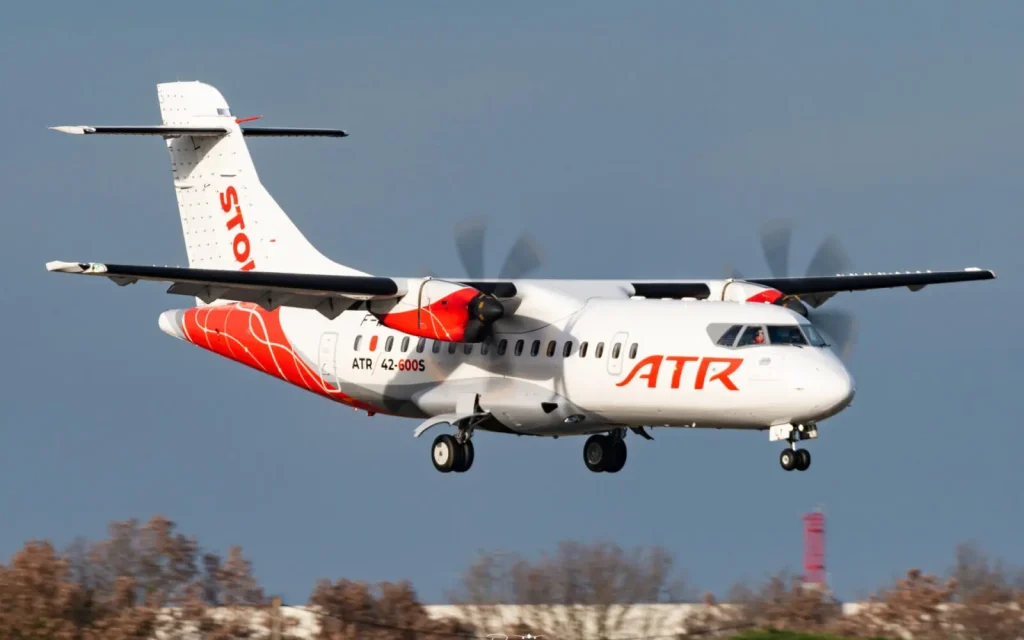
ATR 42-600S (STOL)
ATR 42-600S is a STOL variant of the ATR 42-600. STOL in aviation stands for ‘Short Take-off and Landing’ and refers to aircraft that can reduce take-off and landing distances. Its ability to operate in areas with challenging conditions, such as high-altitude airports, short runways, rough terrain, or places with no prepared landing strips – or all of these at the same time – allows it to sustain operations in regions with limited infrastructure. Their special features and configurations enable them to operate in tight spots like
ATR 42-600S has been enhanced to reduce the required take-off and landing distances, down to just 800M. Over 1,000 airports have a runway between 800 – 1,000m (2,625 to 3,281 feet) that could welcome ATR 42-600S, offering airlines new commercial opportunities and providing local populations with simple access to the global economy, healthcare, education and culture.
Cabin Features
The ATR 42-600 features the largest cabin in the turboprop segment, designed by the Italian design house Giugiaro. The Armonia cabin, standard on all ATR –600 series aircraft, offers a spacious and tranquil environment with flexible layouts depending on airlines’ needs and incorporates cutting-edge cabin technologies to offer each passenger a spacious environment, along with a sense of tranquillity and ease.
With modular seating and galley configurations, and the possibility to increase the cargo space or carry stretchers, the flexible and adaptable cabin is able to address any specific needs and fulfil the aircraft’s essential mission to offer a quick, reliable and comfortable access to healthcare, education and the world economy
The ergonomic 18 inch-wide seats have been specifically designed to provide great personal space, optimum support and relaxation throughout the flight, offering comfort levels equivalent to latest widebody aircraft. They are also lightweight, contributing significantly to heightened fuel efficiency and a notable reduction in the aircraft’s environmental footprint.
The overhead bins have been carefully designed to store the widest carry-on luggage. Added to this, advanced structure design, soundproofing material, LED lighting create a tranquil atmosphere in the cabin. Other amenities include a standalone In-Flight Entertainment system, USB ports in the seats, and New Air Management System.
Cockpit
ATR’s continuous cockpit innovation is engineered to deliver efficiency and enhance safety margins, whilst reducing pilot workload, setting new standards for optimal operations in the regional aviation sector.
The full glass cockpit provided by Thales seamlessly integrates advanced software-based avionics and intuitive control systems. Equipped with 5 large high-resolution Liquid Crystal Displays (LCD), it offers an immersive and comprehensive view of flight information. State-of-the-art and future-proof, the cockpit provides pilots with a panoramic view of critical flight information.
Available on all ATR aircraft, Performance-Based Navigation is a satellite-based navigation system that allows for more precise and reliable aircraft guidance. It replaces conventional ground-based navigation aids with advanced technology, enabling aircraft to navigate with pinpoint accuracy, without the need for expensive infrastructure.
The advanced Performance-Based Navigation capabilities — Baro Vertical Navigation (Baro VNAV), Localizer Precision with Vertical Guidance (LPV), and Required Navigation Performance with Authorisation Required (RNP AR) 0.3/0.3 —provide pilots with cutting-edge tools for navigating the skies with utmost precision and safety.
ATR has seamlessly integrated electronic checklists into its Flight Management System, along with the installation of an Electronic Flight Bag (EFB) for easy access to essential documents and information. Through digitalisation, all performance calculations are handled by on-board performance software, and documentation consultation is now simplified and streamlined in a fully digital format.
The aircraft also utilises audioback concept, a hearing aid loop designed to capture any audio input, such as in-flight announcements, and send it via a magnetic field signal to hearing-impaired passengers, whose hearing aids are equipped with a Telecoil.
Safety instruction signs in Braille are also available on seats to cater to the needs of visually-impaired passengers. The cabin is also accessible to passengers with reduced mobility with a wide aisle compatible with the use of on-board wheelchairs and fully foldable armrests which ease passenger seating.
Performance
ATR 42-600S redefines the standards of passenger comfort in regional travel to offer an optimal experience, from take-off to landing. As you cruise at a maximum of 25,000 feet, the high-wing design offers you the possibility to marvel at breathtaking landscapes.
Through the aircraft’s innovative systems, pilots have access to real-time data, predictive tools, and direct flight paths, enabling them to make informed decisions with confidence. It results in smoother operations, reduced fuel consumption, and a lowered environmental footprint.
ATR 42-600 excels in high-altitude operations and performs efficiently in “hot and high” conditions, making it ideal for regions with challenging terrains.
With a minimum runway length requirement of just 1,000 meters, ATR 42-600S can access a wide range of airports, including those with short and unpaved runways.
Technology
Pratt & Whitney Canada’s relentless focus on innovation is the driving force behind the PW127XT engine series – introducing cutting-edge technologies to create an engine that redefines efficiency.
When you choose the PW127XT engine series, you’re embracing a solution that provides: 40% more time on wing for fewer maintenance events, 20% reduction of direct maintenance costs, at least 3% block fuel savings, for lower emissions.
With this new engine series, ATR continues to serve the various needs of its customers, setting new standards for fuel consumption, carbon and NOx emissions as well as operating economics for regional aviation. Improved fuel efficiency and durability have been achieved through redesigned low- and high-pressure compressors, and a new power turbine module.
The PW127XT engine series is certified to fly with 50% Sustainable Aviation Fuel, and ATR is actively collaborating with Pratt & Whitney Canada to fulfil its commitment of achieving 100% Sustainable Aviation Fuel (STF) capability by 2025.
Specifications
| Category | Features / Details |
|---|---|
| Dimensions and Capacities | |
| Overall Length | 22.7 m |
| Cabin Length | 12.6 m |
| Fuselage Max Diameter | 2.57 m |
| Max Cabin Width | 2.57 m |
| Wingspan | 24.6 m |
| Height | 7.6 m |
| Seating Capacity | 30–50 seats |
| Weights | |
| Max Take-Off Weight (MTOW) | 18,600 kg (41,005 lb) |
| Max Landing Weight (MLW) | 18,300 kg (40,344 lb) |
| Max Zero Fuel Weight | 17,000 kg (37,478 lb) |
| Operational Empty Weight | 11,750 kg (25,904 lb) |
| Max Payload | 5,250 kg (11,574 lb) |
| Max Fuel Load | 4,500 kg (9,920 lb) |
| Performance Metrics | |
| Range with Max Payload | 726 NM (1,345 km) |
| Cruise Speed | 289 KTAS (535 km/h) at 95% MTOW and FL240 |
| Fuel Consumption in Cruise | 620 kg/h (1,367 lb/h) |
| Minimum Runway Length | 1,000 m |
| Environmental Performance | |
| CO₂ Emissions per Seat/km | 93 g |
| NOx Emissions per LTO Cycle | 1.8 kg |
| Noise Margin | -11.4 EPNdB compared to ICAO Chapter 14 |
Takeaways
In the world of regional aviation, an aircraft is the lifeline that connects communities and businesses, and ATR 42-600S (STOL) programme is a testament to this. This new 30 to 50 seater aircraft, capable of taking-off and landing on shorter runways,brings benefits to both passengers and airlines, providing greater, quicker, more comfortable, and responsible regional connectivity and access to essential services and transport of vital goods.
ATR 42-600 plays a vital role in enhancing connectivity and economic growth in remote regions. Its ability to operate on runways as short as 800 meters makes it a game-changer for communities with limited infrastructure. With a focus on sustainability, ATR 42-600S reduces fuel consumption and emissions, supporting global environmental goals. Whether for passengers enjoying the spacious cabin or airlines benefiting from operational flexibility, the aircraft delivers an exceptional experience and value.