
















- Akasa Air is pursuing a carefully sequenced international strategy—starting with high-yield Gulf routes, then adding leisure markets like Malé and Phuket.
- The airline is anchoring its network around Mumbai for Gulf traffic and Bengaluru for Southeast Asia, balancing steady revenues with growth opportunities.
- With its all-Boeing 737 MAX fleet and steady deliveries, Akasa is building a sustainable regional presence distinct from larger rivals.
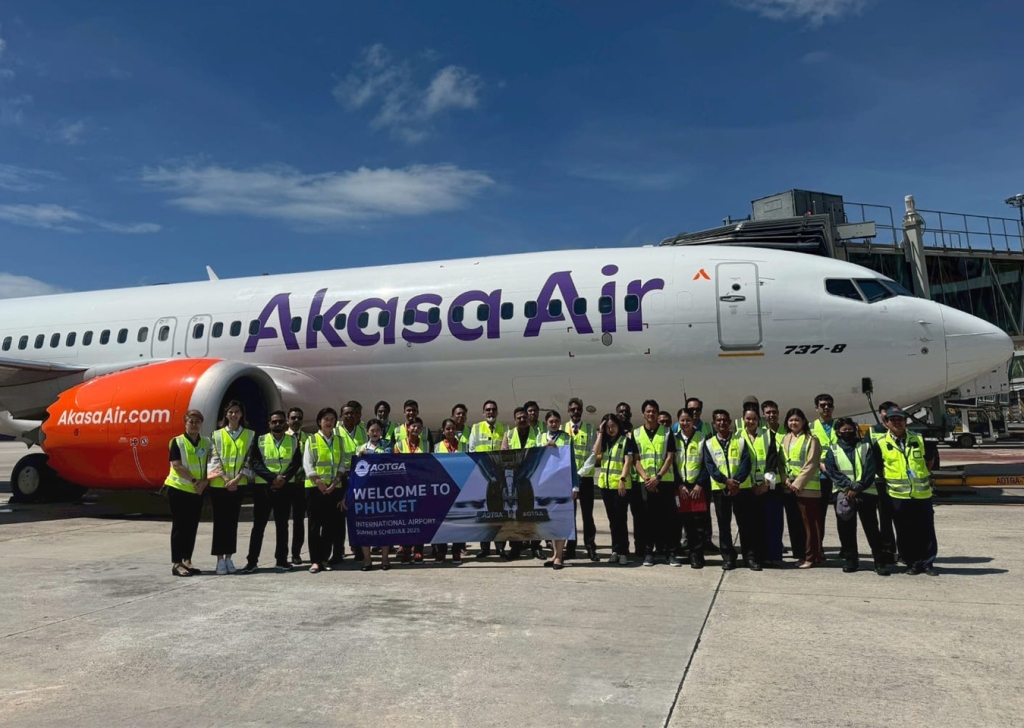
When Akasa Air touched down in Phuket this September, it wasn’t just another Indian airline testing the waters of Southeast Asia. It was the latest chapter in a carefully sequenced international strategy—one that has seen India’s youngest carrier evolve from a domestic upstart into a methodical regional player, stitching together a network that now spans the Gulf, the Maldives, and Thailand.
The narrative could have been written differently: a flashy entry into a tourist hotspot, trumpeted as proof of ambition. But Akasa has resisted such theatrics. Instead, it has chosen a deliberately paced approach—first flying to cater to predictable, high-yield Gulf traffic, then adding high-yield leisure markets in the Indian Ocean and Southeast Asia, and lastly, anchoring them to distinct hubs. Result: a blueprint of what the airline wants to be in the region.

Today, Akasa’s international footprint spans six destinations: Doha (from Mumbai), Riyadh, Jeddah, Kuwait City, Malé (Maldives), and Phuket (Thailand), with flights from Mumbai (starting September 20, 2025) and Bengaluru (starting October 1, 2025).
Each of these flights has been clearly thought-out and stands out in clear contrast to the launches that have often been ‘whimsical’ that have marked some of Akasa’s rivals’ expansion phases.
It may be noted that when Akasa Air secured international flying rights, it could have flown anywhere within its short-haul aircraft range. But it chose its first ports of call: the Gulf.
Doha, Riyadh, Jeddah, and Kuwait provided low-cost airlines with the holy grail: nonstop demand driven by huge Indian expat communities, constant visiting friends and relatives (VFR) traffic, and steady labour routes. Layer on Umrah and Hajj surges for Jeddah, plus a sprinkle of upscale Gulf leisure, and you’ve got a network choice that was spot-on.
The Gulf routes weren’t just about filling planes. Launching those routes allowed Akasa to monetise international operations quickly, covering the fixed costs of ground handling, bilateral rights, and overseas marketing. In the ultra-thin-margin world of low-cost carriers, starting with guaranteed cash-flow corridors was a sign of restraint and discipline.

Having laid the Gulf foundation, Akasa broadened its horizons. First, there was Male, the Maldives’ capital, which brought a short, high-yield leisure link dipping into India’s growing outbound travel market.
Then came Phuket, a larger, more competitive leisure market, but also one that will allow the airline to court a younger, holiday-focused upwardly mobile Indian.
This playbook matters. Rather than flooding Southeast Asia with scattershot launches, Akasa is proving it knows the game: lock in the cash cows first, then stack on seasonal, high-margin leisure routes. Analysts say this diversification softens the Gulf-heavy risk and delivers a stronger, year-round network balance.
Where Akasa flies from is also equally important. Mumbai is the hub for the Gulf and West Asia. As India’s financial capital with a massive expatriate diaspora, it provides the natural base for VFR and labour traffic.
Bengaluru is emerging as the southern gateway for Southeast Asia. Starting Phuket from Bengaluru, alongside a Mumbai service, signals the airline’s intent to split its international network across two anchors, optimising aircraft utilisation and tailoring schedules to distinct demand pools.
The message is clear: The signal is unmistakable: Akasa isn’t tossing darts at a map. It’s crafting a hub play—Mumbai as the engine for West Asia, Bengaluru as the launchpad for ASEAN leisure.
None of this would be possible without the aircraft to back it up. Akasa is an all-Boeing 737 MAX operator, with a large orderbook and a steady stream of deliveries finally picking up pace after pandemic-era disruptions.

For an airline eyeing short-haul regional markets, the MAX is the perfect workhorse: efficient on sub-six-hour sectors, quick to turn around, and cheaper to operate at scale thanks to a single-type fleet. Each delivery doesn’t just add seats—it unlocks another international sector. The Phuket launch, in that sense, is as much a function of Boeing’s delivery rhythm as it is of demand planning.
Inevitably, Akasa is wading into contested waters. IndiGo dominates much of the Gulf and Southeast Asia with sheer frequency. Air India Express, the Tata Group’s low-cost arm, is aggressively rebuilding its own Gulf and ASEAN presence.
Akasa cannot match their scale yet, but does it need to? Its sequencing shields it from overexposure: Gulf routes build steady revenues even if rivals also operate them, while leisure routes from Bengaluru allow for differentiation in origin markets. The dual-hub approach, if scaled, could give Akasa an identity distinct from IndiGo’s frequency-heavy domination or AI Express’s positioning.
What is Akasa’s ambition? These six destinations are just the beginning. Akasa’s methodical building of its network reveals the broad outlines of a long-term ambition: to be a regional carrier serving South Asia, West Asia, and Southeast Asia, steady and strong enough to ride out demand cycles and nimble enough to pivot as markets shift.
By building first where the money is, the Gulf, then adding where the growth is—ASEAN leisure—and tying it together with a fleet plan and hub structure, Akasa is signalling that it sees international flying not as a much-wanted prize, but as a business. The Phuket flights, then, are not the first chapter —they’re the beginning of hopefully a long aviation story.
Also Read: Akasa Air Raises ₹1,200 Crore to Fuel Global Expansion