











India’s First Airport Food-Delivery Robot Debuts at Hyderabad’s RGIA

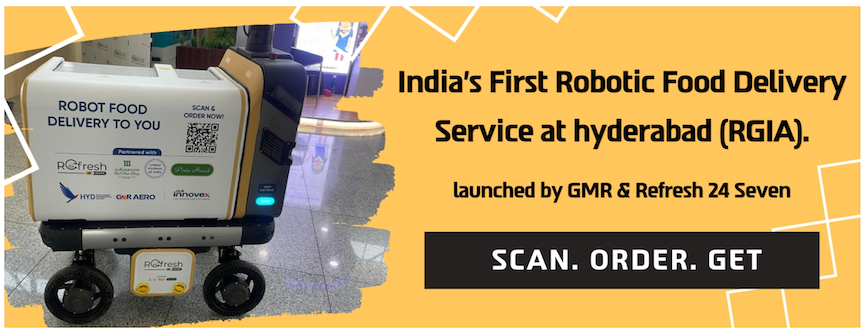
- Hyderabad’s Rajiv Gandhi International Airport has launched India’s first food-delivery robot, allowing passengers to order via QR codes and receive meals or drinks within minutes, marking a major step in robotic airport services.
- Global airports are increasingly adopting robots for food delivery, cleaning, security, and passenger assistance, with the market projected to grow from $565 million in 2020 to $2.56 billion by 2030, led by the Asia-Pacific region.
- Singapore’s Changi Airport showcases the future with its Robotic Middleware Framework (RMF), a central system that coordinates multiple robots across operations—setting the benchmark for integrated, intelligent airport ecosystems.

Airports are often stressful—queues at security, long walks to gates, and the eternal dilemma of whether to grab a quick bite. Hyderabad’s Rajiv Gandhi International Airport (RGIA) has come up with a futuristic fix: India’s first food-delivery robot.
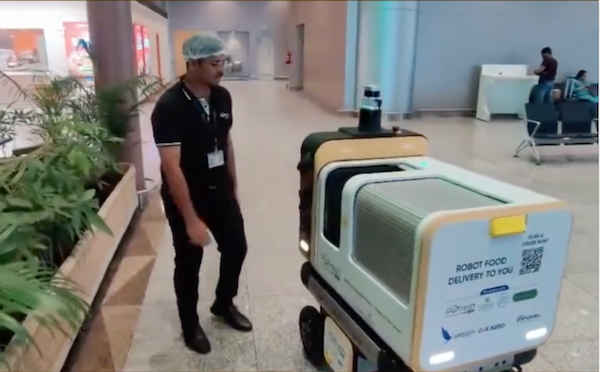
Unveiled on September 21, 2025, this AI-powered helper is serving passengers at select gates.
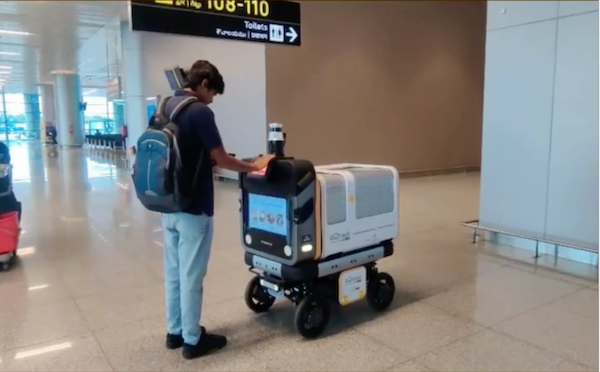
Travellers can scan a QR code, order from outlets such as Pista House or Minerva Coffee Shop, and track the robot as it navigates through the terminal. Meals arrive in about 15 minutes, drinks in less than 10.
The robot isn’t just efficient—it’s polite. Equipped with AI navigation, a 12-hour battery, and remote-control backup, it delivers food while announcing: “Please excuse me, I have a delivery to make.” Selfies with the machine are already becoming as common as boarding passes.
For Hyderabad, it’s more than a novelty—it’s a pilot project that demonstrates how robots can transform passenger services. The Hyderabad rollout reflects a larger global trend: airports are increasingly using robots to handle tasks that are repetitive, time-sensitive, or operationally heavy.
The global airport robots market, valued at $565 million in 2020, is projected to reach $2.56 billion by 2030, according to Allied Analytics, a growth rate of nearly 18% per year. Asia-Pacific leads adoption, followed by North America and Europe.
Drivers for growth are clear. Robots bring round-the-clock availability. They are safe since there is hardly any human exposure in risky zones. As for the passenger experience, it offers faster service and smoother navigation. Robots bring workload relief, freeing staff to focus on higher-value tasks.
Already, robots are delivering food in Incheon and Cincinnati, disinfecting terminals in Doha and Hyderabad, guiding passengers in Halifax, and patrolling perimeters in Japan and Denmark. These deployments are useful, but the problem is that each robot performs its own task, unlike humans, who can multitask. However, that’s where Singapore has taken the lead.
At Singapore’s Changi Airport, robots work together. With four terminals, 100 airlines, and 7,000 weekly flights, issues and maintenance needs arise unpredictably.
Instead of leaving robots to wander, Changi has built a Robotic Middleware Framework (RMF)—a kind of central system for machines.
Developed from Singapore’s national Open-RMF initiative, the system enables the coordination of robots from different manufacturers—such as floor scrubbers, carpet vacuums, and more—on a single unified platform.
Currently, human cleaning staff log issues into the system. Soon, sensors, cameras, and live operational data will allow the RMF to detect problems automatically.
The “brain” then assigns the nearest, best-suited robot to each task in real time.
The RMF has provided the airport staff a means to dream big and move fast, according to Alphonsus Tay from Changi Airport Group’s Robotics Lab.
The system even syncs with flight operations: for example, delaying cleaning when check-in counters are crowded to avoid disruption. In effect, Changi has created a robot conductor, orchestrating fleets like an airport symphony—ensuring tasks are done quickly, smoothly, and without interfering with passengers.
Beyond Hyderabad and Changi, here’s how airports are experimenting with automation:
Food & Retail Delivery
- Incheon, South Korea: “Air Dilly” delivers meals; “Air Porter” carries bags.
- Cincinnati/Northern Kentucky, USA: Ottobots ferry food and retail orders.
Passenger Assistance
- Hangzhou, China: Humanoid Information Robots.
- Halifax, Canada: “Wall-E with a map” guides travellers.
- Munich, Germany: “Josie Pepper” handled wayfinding.
Security & Ground Ops
- Kansai, Japan: Secom Robot X2 patrols terminals.
- Denmark: Boston Dynamics’ “Spot” robot checks fences.
- Spain’s Castellón Airport: robots tested for debris clearing and aircraft pushback.
These examples show the breadth of robot potential—but none yet match the system-level integration that Changi is pioneering.
Despite fears, robots are not about job cuts. A US Airport Cooperative Research Program report emphasises that robots are most effective when they complement staff—taking over repetitive, physically demanding, or high-risk tasks while leaving complex decision-making and passenger care to humans.
Hyderabad has already signalled this balance. GMR’s Robotics Centre of Excellence, launched in collaboration with IIT Bombay’s SINE, Peppermint Robotics, and Flo Mobility, is focused on testing real-world use cases where robots support rather than replace staff.
Hyderabad’s food-delivery robot may feel like a novelty, but it marks India’s first serious step toward robotic airports. Changi’s RMF shows what the future could look like: airports as intelligent ecosystems, where humans and fleets of machines work in harmony.
If forecasts hold true, the next time you fly, it won’t just be your meal that arrives on wheels. Your luggage, navigation, cleaning, and even your security checks might all be quietly choreographed by robots—making one of the world’s most stressful environments a little more seamless.
Also Read: Adani Digital Labs Unveils Major Innovations to Elevate Airport and Travel Experience