













Longest Non-Stop Flight in the World: The Ultimate Test of Endurance in Aviation

Key Takeaways:
- Singapore Airlines’ Flight SQ23 currently holds the record for the world’s longest non-stop commercial flight (Singapore to New York), covering 9,537 miles in about 18 hours 40 minutes using the Airbus A350-900ULR.
- Ultra-long-haul flights demonstrate major advancements in aviation technology, passenger comfort, and fuel efficiency, redefining global air travel.
- Future projects like Qantas Project Sunrise aim to exceed 20-hour non-stop flights, setting new milestones in aviation and global connectivity.
Longest Non Stop Flight in the World
Air travel has revolutionized how we connect across continents. Over the decades, airlines have competed to offer passengers not just the best comfort but also the longest non-stop flights journeys that push the limits of aircraft technology, human endurance, and global connectivity. Today, ultra-long-haul flights link cities separated by thousands of miles, making it possible to travel across the globe without a single layover.
But what exactly is the longest non-stop flight in the world, and why do airlines continue to pursue these record-breaking routes? Let’s take a closer look.
The Current Longest Non-Stop Flight in the World
As of 2025, the title of the world’s longest non-stop commercial flight belongs to:
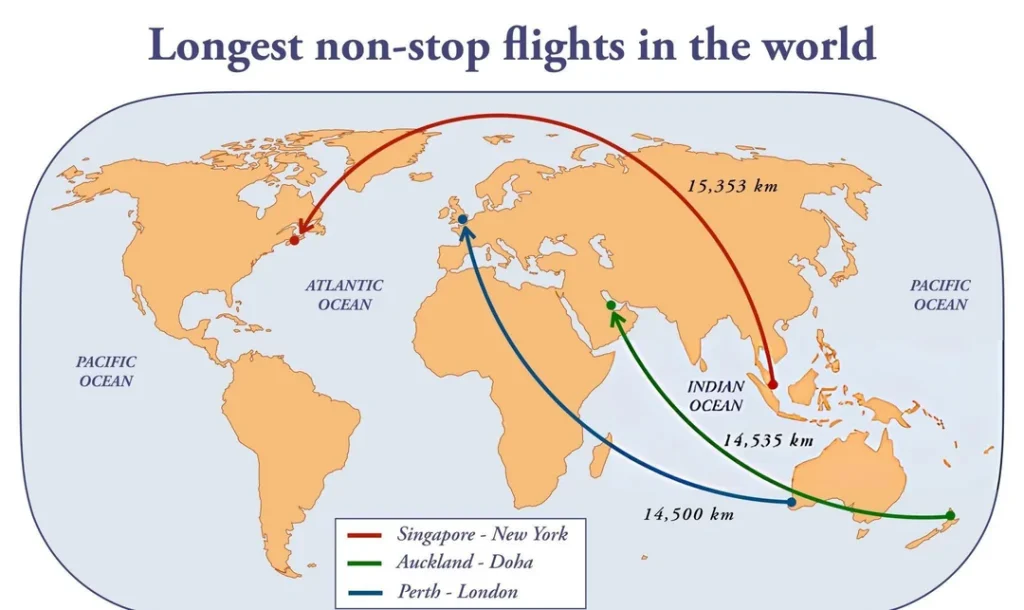
Singapore Airlines Flight SQ23
- Route: Singapore Changi Airport (SIN) → New York John F. Kennedy International Airport (JFK)
- Distance: ~9,537 miles (15,349 km)
- Flight Time: Around 18 hours 40 minutes
- Aircraft: Airbus A350-900ULR (Ultra Long Range)
This remarkable journey covers almost halfway around the Earth in a single flight. Launched in 2018, it surpassed previous records and remains a benchmark for ultra-long-haul travel.
Why This Flight Stands Out
- Ultra-Long-Range Aircraft
- The Airbus A350-900ULR was specially designed for such missions, with additional fuel capacity and improved efficiency.
- It can fly over 20 hours non-stop, depending on weight and weather conditions.
- The Airbus A350-900ULR was specially designed for such missions, with additional fuel capacity and improved efficiency.
- Passenger Comfort
- Since long flights can be physically demanding, Singapore Airlines configured the cabin with only two classes—Business and Premium Economy.
- No standard economy seating ensures more legroom, healthier cabin pressure, and better humidity levels to reduce jet lag.
- Since long flights can be physically demanding, Singapore Airlines configured the cabin with only two classes—Business and Premium Economy.
- Operational Excellence
- Flying such long routes requires precise fuel planning, optimized flight paths, and real-time weather adjustments.
- Crews are specially trained for fatigue management and in-flight care.
- Flying such long routes requires precise fuel planning, optimized flight paths, and real-time weather adjustments.
History of the Longest Flights
The pursuit of ultra-long-haul flights has evolved with advancements in aviation:
- 1930s–1950s: Long flights often required multiple stops due to fuel limitations.
- 1970s–1980s: Aircraft like the Boeing 747 opened the era of long-range commercial flights.
- 2000s: Airbus A340-500 and Boeing 777-200LR began pushing past 17-hour flights.
- 2010s–2020s: With fuel-efficient aircraft like the Airbus A350 and Boeing 787 Dreamliner, ultra-long-haul flights became commercially viable again.
Singapore Airlines originally operated a similar route with the A340-500 from 2004 to 2013. However, it was discontinued due to high fuel costs, only to return stronger in 2018 with the A350-900ULR.
Other Ultra-Long-Haul Flights in the World
While Singapore–New York is the current champion, several other flights are close contenders:
- Singapore Airlines SQ21: Newark (EWR) – Singapore (SIN)
- Distance: 9,534 miles
- Flight Time: ~18h 30m
- Qantas QF9: Perth (PER) – London (LHR)
- Distance: 9,010 miles
- Flight Time: ~17h 15m
- First direct link between Australia and Europe.
- Emirates EK449: Auckland (AKL) – Dubai (DXB)
- Distance: 8,824 miles
- Flight Time: ~17h 10m
- Qatar Airways QR921: Auckland (AKL) – Doha (DOH)
- Distance: 9,032 miles
- Flight Time: ~17h 50m
These routes highlight how airlines in Asia, the Middle East, and Oceania dominate ultra-long-haul travel, thanks to their geographical hubs and modern fleets.
The Human Side of Ultra-Long Flights
Flying nearly 19 hours non-stop is not just about technology—it’s also about the human experience.
Challenges for Passengers:
- Jet Lag: Crossing multiple time zones makes body clocks harder to adjust.
- Health Risks: Prolonged sitting increases the risk of deep vein thrombosis (DVT).
- Mental Fatigue: Spending such long hours confined in a cabin can be draining.
Comfort Strategies:
- Airlines design special meal schedules to help passengers adapt to destination time zones.
- Modern aircraft have higher humidity levels and lower cabin altitudes, reducing fatigue.
- Passengers are encouraged to stretch, hydrate, and move around frequently.
Future of Longest Flights
Aviation is not stopping here. Airlines and manufacturers are working on even longer routes and advanced aircraft:
Qantas Project Sunrise
- Planned direct flights from Sydney to London and Sydney to New York.
- Flight times could exceed 19–20 hours non-stop, setting a new world record.
- Airbus A350-1000 aircraft have been selected for this ambitious project.
Technological Innovations
- Sustainable Aviation Fuel (SAF): Essential to make ultra-long-haul flights environmentally viable.
- Lighter Materials & Engines: Further fuel efficiency improvements will extend ranges.
- Cabin Design: Future cabins may include sleeping pods, exercise areas, and wellness zones.
Why Ultra-Long-Haul Flights Matter
Ultra-long-haul flights are more than records; they reshape global travel:
- Direct Connectivity: Linking city pairs that were previously unreachable without layovers.
- Business Advantage: Saves time for executives who need to maximize productivity.
- National Pride: Airlines use these routes as a showcase of technological capability.
- Passenger Experience: The challenge of making long flights comfortable has raised overall service standards.
Conclusion
The longest non-stop flight in the world, Singapore to New York represents the pinnacle of modern aviation. Covering over 9,500 miles in nearly 19 hours, it combines technological innovation with passenger-centric design. While it pushes the boundaries of endurance, it also redefines convenience by eliminating stopovers and connecting two of the world’s most important cities directly.
Looking ahead, projects like Qantas Project Sunrise promise to extend flight times beyond 20 hours, bringing us even closer to true global connectivity. These record-breaking flights are not just about distance they are about human ambition, resilience, and the unending desire to make the world more connected.