




Wings of Opportunity: Deutsche Aircraft Puts India at the Centre of Its D328eco Play

- At the New Delhi summit, Deutsche Aircraft presented a long-term industrial and operational plan that positions India as an essential partner in engineering, manufacturing, electrical integration, training and support for the D328eco programme.
- The company highlighted the need for a modern 40-seat aircraft in India’s commuter and regional network, emphasising the D328eco’s performance in hot-and-high conditions, short runways and low-density routes, along with its lower operating costs and advanced systems.
- Key aircraft structures and systems, including the rear fuselage, cabin management system and electrical wiring, are already under development in India through competitive global tenders. With certification targeted for 2027, Deutsche Aircraft expects India to play a significant role in both operations and the long-term growth of the programme.
Germany’s Deutsche Aircraft did not land in New Delhi last week to make another hopeful pitch to Indian airlines. The tone was markedly different. Backed by a focused message, a maturing supply chain in India, and clear commitments from its partners Cyient, Dynamatic Technologies and SASMOS HET, the company presented something far more serious: a long-term industrial and operational blueprint for India’s next regional aircraft ecosystem.
At the Wings of Opportunity Summit, held on 5 November at JW Marriott Aerocity, Deutsche Aircraft CEO Nico Neumann spoke less like someone selling a 40-seater turboprop and more like a manufacturer mapping out a decade-long strategic alignment with India. The subtext was unmistakable — India is not just a potential customer; it is expected to be a full participant in the development, production, operation and support of the D328eco programme.
The summit brought policy-makers, industry and investors into one room to discuss how regional connectivity, manufacturing and sustainability can move in step as India’s aviation demand accelerates.
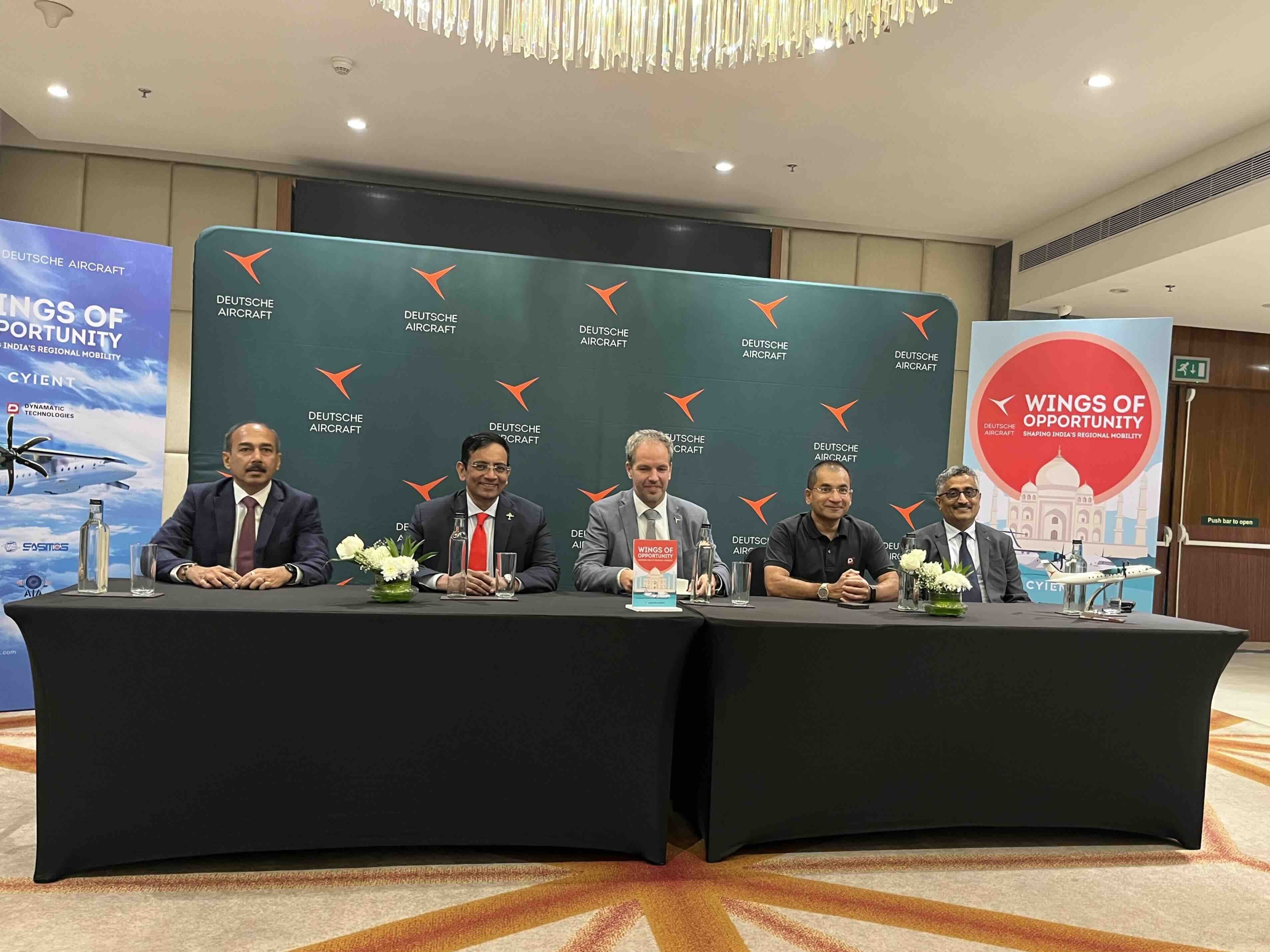
At the media briefing the following day, CEO Nico Neumann was joined by Srinivasan Dwarakanath, Director General of Aerospace India Association; Udayant Malhoutra, CEO of Dynamatic Technologies; H.G. Chandrashekar, CMD of SASMOS HET; and Kaushal Jadia, CTO at Cyient’s DLM business. Together, they outlined an aircraft programme already deeply connected with Indian capability, and now preparing for Indian operators.
India’s 40-Seat Gap in the UDAN Map
India is now the world’s third-largest domestic aviation market, with more than 220 million passengers in 2024. The government’s UDAN scheme has opened up Tier II and III cities, but the aircraft flying many of these routes tell a different story: ageing small turboprops and fragmented fleets of refurbished aircraft that struggle with India’s hot-and-high, short-runway realities.

Aerospace India Association’s Dwaraka explained that India’s network can be viewed in three layers: trunk routes served by narrowbodies, regional routes flown by 70-seaters, and a commuter segment connecting tier-3 to tier-2 cities. It is this commuter segment, he said, that has lacked a modern, purpose-built aircraft.
“We have a modern 40-seater aircraft here. There is nothing like this today in the world,” adding that India alone could need around 1,500 commuter aircraft over the next 20 years if current growth continues.
The D328eco is the platform Deutsche Aircraft wants to position into that gap. Built on the Dornier 328 heritage but extensively updated, it is a 40-seat turboprop with high-altitude and hot-weather performance, short take-off and landing capability, 100% SAF compatibility, a Garmin digital cockpit, and an optimal 100–300 NM operating range, a band that covers about 90% of India’s regional flights.
For Indian airlines, the key claim is economic: Deutsche Aircraft says the D328eco has a break-even load factor of about 55% on low-density routes, giving operators room to build frequency rather than chase full loads on every rotation.
Neumann made the economics straightforward: older commuter aircraft may be cheaper to buy, but their fuel bills, maintenance costs and parts issues can outweigh the initial savings.
“With an old aircraft, you have a higher fuel bill and higher maintenance cost,” Neumann highlighted, pointing out that the D328eco’s latest-generation turboprop engines offer around 40% lower fuel burn than comparable jets and 20% higher on-wing time, cutting maintenance downtime. “The best fuel is the fuel you don’t need to burn.”
German Aircraft, Indian Backbone
If economics are one part of the D328eco story, the industrial base is the other. The aircraft may be German-designed, but significant parts of its structure and systems are already being built in India.

At the structural level, Dynamatic Technologies is building the rear fuselage on a dedicated line in Bengaluru.
This is not a token workshare: the rear fuselage is a major, complex section that anchors loads and houses critical systems.
“It’s a German aircraft, but it’s more made in India today than many aircraft that call themselves ‘Made in India’,” Malhoutra said, “Major sections of the fuselage are made by us in Bangalore, and we are involved right from prototyping and engineering.”

Photo: Deutsche Aircraft
On the systems side, Cyient is responsible for a significant slice of the design engineering and electronics. Its teams are working on structural design, digital modelling, and a modern cabin management system (CMS) that will be fully designed, certified and manufactured out of India.
“This is the first aircraft of this size which will have a modern cabin management system,” explained Jadia, “To my knowledge, we are among the first Indian companies outside the traditional airframer ecosystem to completely design, certify, qualify and manufacture a CMS.”
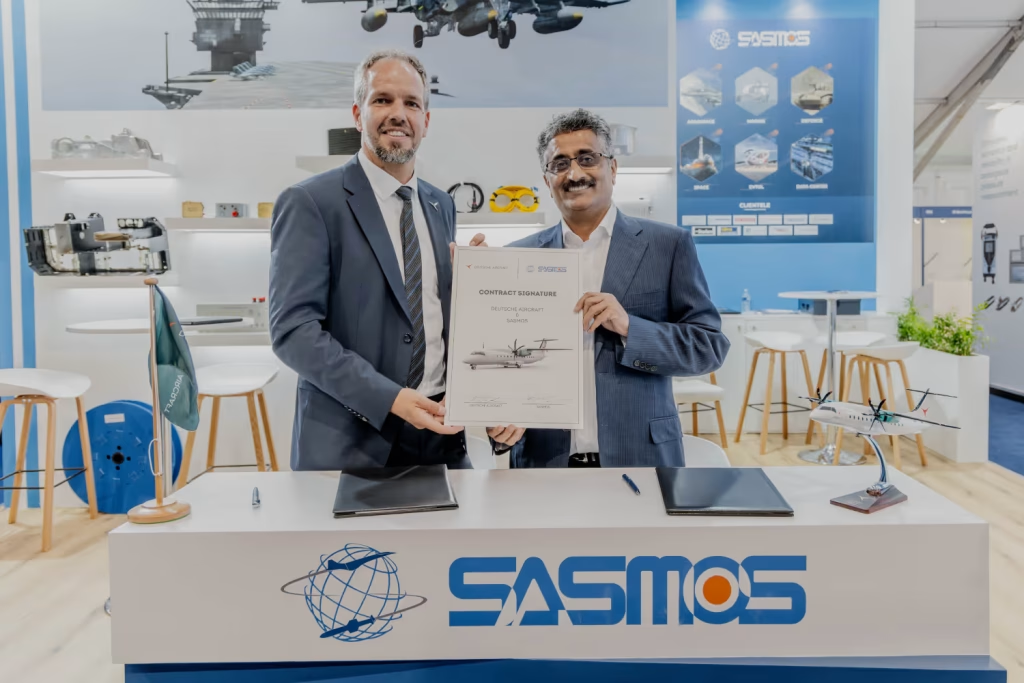
The third leg of the Indian backbone is SASMOS HET, which is supplying the Electrical Wiring Interconnection System (EWIS) and integrating flight-critical electrical and electronic subsystems.
“This is design-to-manufacturing, not just manufacturing,” highlighted Chandrashekar, “We have already done end-to-end wiring from India for more than 550 flying aircraft worldwide. This programme takes Indian capability to the next level – from build-to-print to full design-to-build integration.”
Importantly, Neumann stressed that these work packages were awarded after global tenders, not carved out as offsets.
“We looked worldwide,” Neumann pointed out, “Every selection had to be able to compete globally. Price matters, skills matter, risk-sharing matters, and then there is chemistry. This is not a partnership for one programme, it is a partnership for the next 50 years.”
Building an Ecosystem Before a Final Assembly Line
A recurring point in New Delhi was the order of priorities. Neumann was explicit that Deutsche Aircraft is not starting with a final assembly line and working backwards.
He described a six-step roadmap that the company actually drew up four years ago when the D328eco programme was launched: start with engineering, aerostructures, wiring and cabin systems in India, then build training, aftermarket and maintenance capability, and only then move towards a final assembly line once the ecosystem is in place.

“It’s an aircraft made for India,” Neumann said, “but the ecosystem has to be built the right way.” That message resonated with Indian partners, who contrasted it with previous models in which final assembly arrived early and more comprehensive design and systems work stayed offshore.
The Wings of Opportunity summit the previous day reflected that ecosystem-first approach. Over one day, discussions were organised around five themes:
- Regional Connectivity – how to open up new town pairs and relieve pressure on congested hubs.
- Sustainable Aviation – keeping growth and carbon impact on different curves, via efficient design and SAF.
- Fleet Modernisation – moving beyond patchwork fleets of ageing turboprops.
- Collaborative Manufacturing – building Indo–German supply chains rather than transactional vendor lists.
- Investment Opportunities – financing infrastructure, innovation and new regional operators.
What emerged was a shared understanding that regional connectivity, high-value manufacturing and decarbonisation can either reinforce each other, or stall together, depending on how programmes like the D328eco are executed.
Training, Services and the Long Game
One area Neumann repeatedly came back to was training. For him, pilot training and mechanical training are non-negotiable prerequisites, not afterthoughts.
“Pilot training, mechanical training, aftermarket concepts, maintenance concepts – these are prerequisites before we talk about a final assembly line,” Neumann emphasised, “For safety and reliability, mechanical training is as important as pilot training.”
Deutsche Aircraft already has an engineering simulator running for the D328eco and is working towards a full-flight simulator that will be ready six months before entry into service.
The plan, Neumann said, is to establish a service and training centre in India, covering both pilots and mechanics, under an EASA-compliant quality system.

That focus on lifecycle support is mirrored in the suppliers’ comments.
A Deutsche Aircraft marketing executive put it simply: you sell the first aircraft because of its features, and you sell the second because you are able to maintain the aircraft and provide the right services. That, he outlined, is what matters most, which is why the company is placing strong emphasis on pilot training and mechanical training.
Neumann also mentioned that the platform can support missions beyond commuter flying, including medical evacuation, corporate shuttles, border support and search-and-rescue, but clarified that the commercial market remains the primary anchor.
Timelines, Competition and the Road Ahead
On timelines, the Neuman confirmed that type certification is targeted for end-2027, with the first test aircraft already coming together and initial test flights planned for 2026. The Leipzig final assembly line will start with around eight aircraft in the first year, rising to 48 aircraft per year by the third year, in line with supplier capacity.
The D328eco’s closest competitor in size is the ATR 42, but Neumann was careful not to pitch it as a like-for-like fight. He pointed to the D328eco’s higher cruising speed (324 knots), higher operating altitude (up to FL300), strong short-field performance and SAF-ready engines as differentiators that carve out a distinct niche in the 40-seat segment.

Photo: Deutsche Aircraft
On the commercial side, he shared the sales funnel now spans more than 70 active campaigns and over 500 aircraft, with “slightly over 100” Letters of Intent in place as the programme moves from the MoU phase towards firm purchase agreements, a transition he expects to accelerate once the aircraft enters flight testing.
For India, the implications run on two tracks. On one hand, the country is being asked to consider a new-build 40-seater as the backbone of its commuter network, rather than relying on older, imported turboprops. On the other hand, its aerospace industry is being invited into the core of a European regional aircraft programme, with ownership of structures, systems and electrical integration, and a clear path into training and support.
In New Delhi, there was no guarantee that Indian carriers will sign up in large numbers. But Deutsche Aircraft’s message was unambiguous: the D328eco’s future in India will not be limited to the flightline. It will be written in design offices, shop floors and training centres as well.