












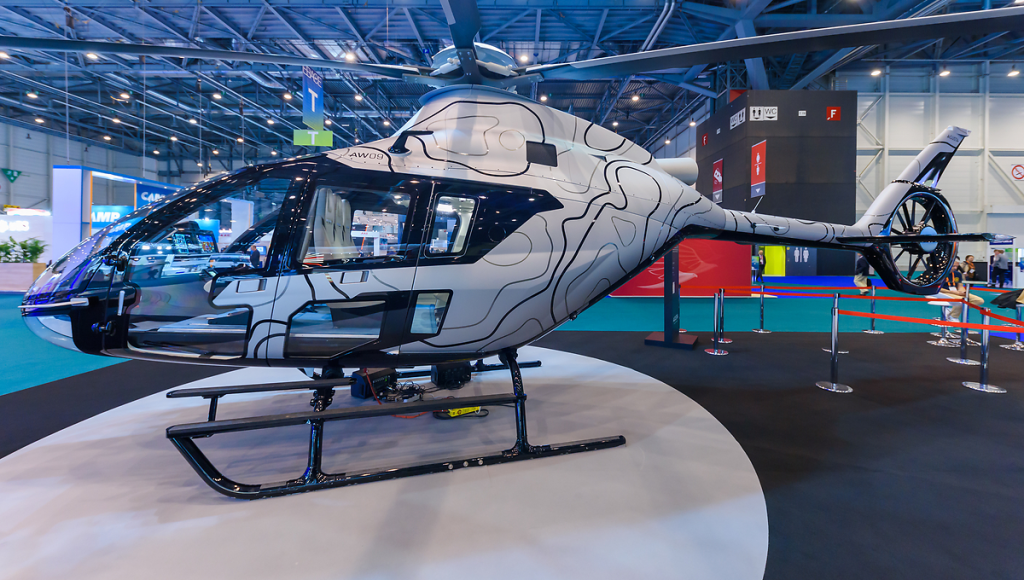
AgustaWestland AW09
Unveiled as a concept at the 2024 edition of European Business Aviation Convention & Exhibition (EBACE, the annual event that brings together the business aviation community to showcase aircraft, technologies, and services, fostering networking and innovation in the industry) in Geneva during May 28-30, 2024, the AgustaWestland AW09 is the next-generation light utility helicopter (LUH) developed by Leonardo, a global leader in rotorcraft innovation. Introduced as a clean-sheet design, this single-engine helicopter with its advanced technology, unmatched flexibility, and exceptional comfort, meets the diverse needs of law enforcement, emergency medical services (EMS), oil and gas industry (OGI) support, and VIP transport. Its debut marks a significant expansion of the Agusta-branded product range, reflecting Leonardo’s commitment to pushing boundaries in aviation.
The aircraft features a fuel-efficient design that minimises environmental impact, though specific details on sustainable aviation fuel (SAF) compatibility are still in the conceptual phase. Its emphasis on redundancy and safety systems suggests a forward-thinking approach, potentially reducing maintenance demands and operational costs. As a prototype with only one unit produced to date, the AW09’s real-world performance data is limited, but its design promises to challenge the dominance of competitors like Bell and Airbus Helicopters and set new standards in the light helicopter category.
Cabin Experience
The aircraft’s cabin offers the largest volume in its class, accommodating up to eight passengers. Itrivals the comfort of larger twin-engine models by providing the most generous legroom among single-engine helicopters, though its usable length, width, and height are still in the conceptual stage (pending final specifications). It can be easily reconfigured into multiple seat layouts, from executive configurations to utility setups, supported by unobstructed side accessibility and a unique rear access door.
With 100 percent fresh air replenishment facilitated by a powerful air conditioning and heating system, the cabin prioritises passenger well-being, ensuring a comfortable climate regardless of external conditions. Low vibration levels, enhanced by effective soundproofing, contribute to a quiet environment, while the large windows—among the best in its category—offer excellent visibility, scenic views and a psychological sense of openness. The interior design promises luxurious finishes, with options for VIP-corporate layouts showcased at EBACE 2024, including bespoke paint schemes.
The aircraft offers state-of-the-art connectivity and entertainment options, potentially including integrated media systems similar to those in Leonardo’s AW169, allowing passengers to control lighting, temperature, and entertainment via intuitive interfaces. Its in-flight accessible compartment is designed to handle substantial cargo, catering to the diverse missions the aircraft is intended to support, from medical evacuations to corporate travel.
Technology (Engines and Avionics)
The aircraft’s five-blade full composite rotor system ensures superior manoeuvrability and a smooth flight experience, while the shrouded tail rotor reduces noise levels, addressing environmental and community concerns. The airframe’s unique bird-strike resistance enhances safety, a critical feature for utility operations.
The aircraft features a state-of-the-art glass cockpit equipped with the Garmin G3000H integrated flight deck, designed to boost situational awareness with its connected features and intuitive interface. This avionics suite includes redundancy across all main systems, complying with the latest and most demanding safety standards. The G3000H’s capabilities—seen in other Garmin-equipped aircraft—suggest advanced navigation, weather radar, and potential integration with synthetic vision systems, reducing pilot workload and enhancing operational efficiency.
The aircraft’s design emphasises crashworthiness, with seats rated to withstand hard landings, and a modular cabin that can be stripped for cargo or special mission equipment. This flexibility, combined with its safety certifications, positions it as a robust contender in the LUH market, a testament to Leonardo’s engineering prowess.
Performance
With a cruising speed of 140 knots (260 km/h) and a range of 430 nautical miles (800 km), a maximum take-off weight (MTOW) of 6,284 pounds and a sling load capacity of up to 3,300 pounds, the aircraft is engineered for versatility across diverse missions. Its steep-approach certification, a feature highlighted in Leonardo’s marketing, enables operations at challenging locations.
Capable of climbing to altitudes suitable for its class—likely around 15,000-20,000 feet—the aircraft can operate above adverse weather, offering smoother flights. It balances speed, range, and altitude, with the aim to compete with established models like the Bell 429 or Airbus H125. The helicopter’s ability to access congested areas, supported by Category A Performance Class 1 certification (even in one-engine inoperative conditions), underscores its potential for urban and offshore operations.
The aircraft’s performance claims, based on simulations and mock-ups, are outstanding. Leonardo’s track record with models like the AW139 suggests a promising future for the model.
Specifications
| Category | Metric | Imperial |
| Length | TBD | TBD |
| Rotor Diameter | TBD | TBD |
| Height | TBD | TBD |
| Cabin Length (usable) | TBD | TBD |
| Cabin Width | TBD | TBD |
| Cabin Height | TBD | TBD |
| Cabin Zones | Up to 2 (conceptual) | |
| Passenger Capacity | Up to 8 | |
| Max Take-off Weight | 2,851 kg | 6,284 lb |
| Max Range | 800 km | 430 nm |
| Cruising Speed | 260 km/h | 140 kts |
| Max Speed | TBD | TBD |
| Take-off Distance | TBD | TBD |
| Landing Distance | TBD | TBD |
| Max Operating Altitude | TBD | TBD |
| Engines | TBD (single-engine) | TBD |
| Sling Load Capacity | 1,497 kg | 3,300 lb |
Note: Specifications are based on conceptual data and subject to change upon certification.
Key Takeaways
With its blend of precision engineering, performance capability, and pampering comfort, the aircraft emerges as a pioneering force in the single-engine helicopter market, challenging competitors like the Bell 429 and Airbus H125. Its spacious, adaptable cabin and advanced safety features make it a versatile option for corporate transport, emergency services, and utility roles. The aircraft’s potential to access challenging airports and its focus on low noise and vibration position it as a leader in urban and offshore missions.
The aircraft benefits from Leonardo’s extensive rotorcraft expertise, promising reliability and innovation. Its VIP-corporate configurations and multi-mission flexibility appeal to private owners, charter operators, and government clients. The AW09 is set to redefine expectations in the light utility helicopter segment, offering a luxurious and efficient alternative for global aviation needs.