













- Air India and Singapore Airlines have signed a framework agreement that sets the groundwork for a potential joint business, subject to regulatory approvals and definitive agreements.
- The move builds on an already extensive codeshare network and signals a shift towards closer coordination across schedules, connectivity, corporate travel and loyalty programmes.
- Rather than immediate changes, the agreement outlines a longer-term strategy aimed at improving seamless travel and strengthening both airlines’ competitive positioning across India, Singapore and beyond.
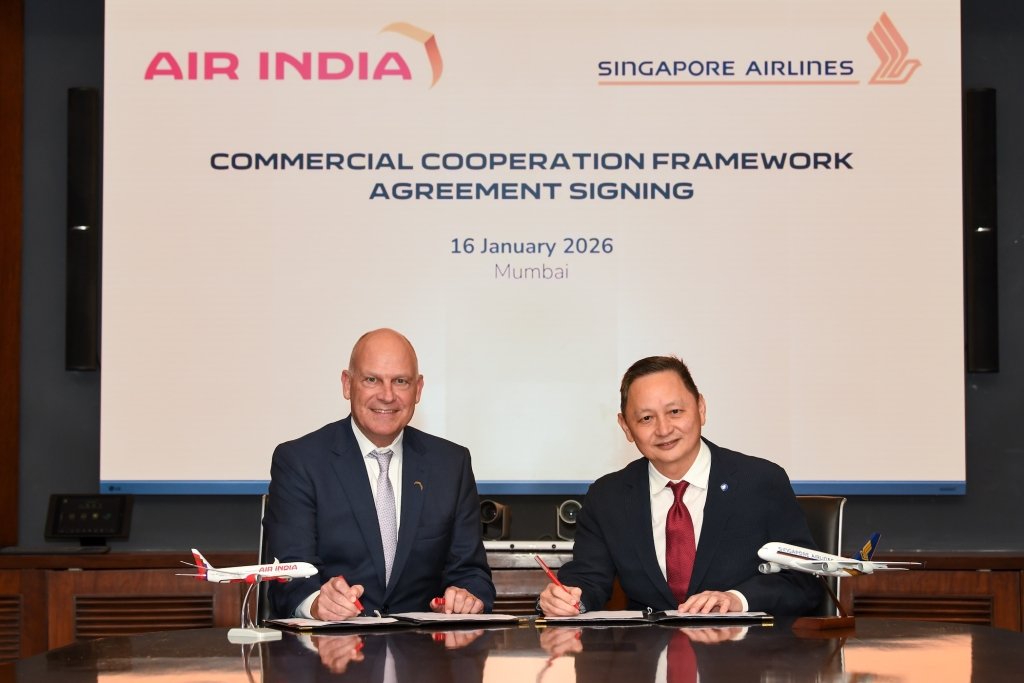
Air India and Singapore Airlines have taken a formal step towards strengthening their long-standing partnership, signing a commercial cooperation framework agreement that sets the stage for a potential joint business arrangement between the two carriers.
The agreement was signed in Mumbai on 16 January 2026 by Air India Chief Executive Officer and Managing Director Campbell Wilson and Singapore Airlines Chief Executive Officer Goh Choon Phong. Both airlines said the next phase of cooperation will be subject to regulatory approvals and the signing of definitive joint business agreements.
For Air India, the move signals a continuation of its post-privatisation strategy of rebuilding international relevance through a combination of fleet renewal and strengthened strategic alliances. For Singapore Airlines, it reinforces its long-term engagement with the Indian market, one of the fastest-growing air travel regions globally.
From codeshare to structured cooperation
The two carriers already share an extensive codeshare relationship, covering 61 destinations across 20 countries and territories. This network was significantly expanded in October 2024, when Air India and Singapore Airlines added 51 international and domestic destinations across their combined networks.
The newly signed framework goes beyond route-by-route cooperation. It lays the groundwork for closer alignment across areas such as schedule coordination, network planning, and customer experience, elements that typically sit at the core of joint business arrangements between global airlines.
While no immediate changes to routes or capacity have been announced, both airlines have indicated that the intent is to enable more seamless connections and additional routing options for passengers travelling between Singapore and India, as well as onward to other markets.
Focus on connectivity, corporates and loyalty
A key element of the framework is the stated ambition to enable customers to book journeys across both airlines as a single, integrated experience. This would be supported by closer coordination of flight schedules, aimed at improving connection times and overall travel convenience.
The new framework describes several areas the carriers want to work towards:
- A more unified journey for customers, including the ability to book across both airlines under a single itinerary, with “seamless connections” and more route options.
- Closer coordination of flight schedules between Air India and SIA to improve convenience.
- Corporate travel alignment, including potential cross-participation in corporate travel programmes, aimed at improving offerings for business travellers.
- Frequent-flyer enhancements are another area identified for potential enhancement. Air India’s Maharaja Club and Singapore Airlines’ KrisFlyer currently offer reciprocal benefits under the Star Alliance framework. Under the new cooperation model, the airlines will explore options to extend privileges beyond existing alliance-level arrangements, though specific changes have not yet been detailed.
For Air India customers, the codeshare access includes a wide spread of Singapore Airlines destinations across the Asia-Pacific region—among them Adelaide, Auckland, Brisbane, Cairns, Cebu, Danang, Darwin, Denpasar (Bali), Fukuoka, Hanoi, Ho Chi Minh City, Jakarta, Kuala Lumpur, Manila, Melbourne, Nagoya, Osaka, Penang, Perth, Phnom Penh, Seoul, Siem Reap, Surabaya, Sydney, Tokyo (Haneda and Narita), and others.
For Singapore Airlines customers, the existing arrangement includes codeshare access on Air India’s international services to destinations such as Amsterdam, Bengaluru, Birmingham, Colombo, Copenhagen, Delhi, Frankfurt, Jeddah, London (Gatwick and Heathrow), Milan, Mumbai, Paris and Riyadh.
The domestic element is also extensive. Singapore Airlines codeshares on Air India’s domestic flights across multiple city pairs, including routes linking Delhi and Mumbai with major metros and regional centres.
Domestic codeshare links include, Delhi–Amritsar, Delhi–Bengaluru, Delhi–Hyderabad, Delhi–Kochi, Delhi–Mumbai, Delhi–Port Blair, Delhi–Thiruvananthapuram, and Mumbai–Ahmedabad, Mumbai–Bengaluru, Mumbai–Chennai, Mumbai–Goa, Mumbai–Hyderabad, Mumbai–Kolkata, Mumbai–Thiruvananthapuram, and others, alongside Chennai–Bengaluru/Coimbatore and Bengaluru–Chennai/Hyderabad.
By placing this framework agreement on top of an already expanded codeshare footprint, the two airlines are signalling that the next phase is intended to be more than destination access. Their stated goal is to develop a closer, more coordinated proposition that makes it easier for passengers to move across both networks with less friction and more choice.
For now, the announcement represents intent and direction rather than execution. It reflects a shared view between Air India and Singapore Airlines that closer cooperation can unlock long-term value, provided it is built gradually and within regulatory boundaries.
From an industry perspective, this move also reflects broader shifts in airline strategy: legacy carriers are increasingly seeking closer commercial ties to compete with large network carriers and low-cost rivals, while preserving flexibility to adapt to market dynamics and regulatory environments.
In essence, the agreement gives both Air India and Singapore Airlines a structured pathway to experiment with closer coordination—a step that may define future aviation partnerships in South and Southeast Asia.
Also Read: From Distance to Duration: How Air India’s 787-9 and IndiGo’s A321XLR Are Redesigning Cabins