








Airbus Reports Strong 2025 Results as Engine Supply Shapes 2026 Delivery Plans

- Airbus delivered 793 commercial aircraft in 2025, lifting revenue to €73.4 billion and backlog to 8,754 aircraft.
- For 2026, the company issued guidance for around 870 commercial aircraft deliveries as Pratt & Whitney engine constraints affect A320 production ramp-up plans.
- It kept its widebody production plans unchanged and said A350 demand exceeds near-term output.
Commercial aircraft manufacturing has entered a phase where demand is no longer the constraint. The pressure point now lies in conversion—how reliably production systems translate backlog into delivered aircraft, and how often a single missing component—increasingly, engine availability—determines whether an aircraft can be delivered on schedule. Airbus’ 2025 results reflect that reality: underlying demand across its portfolio remains strong, while supply-side constraints continue to reshape the pace and predictability of output.
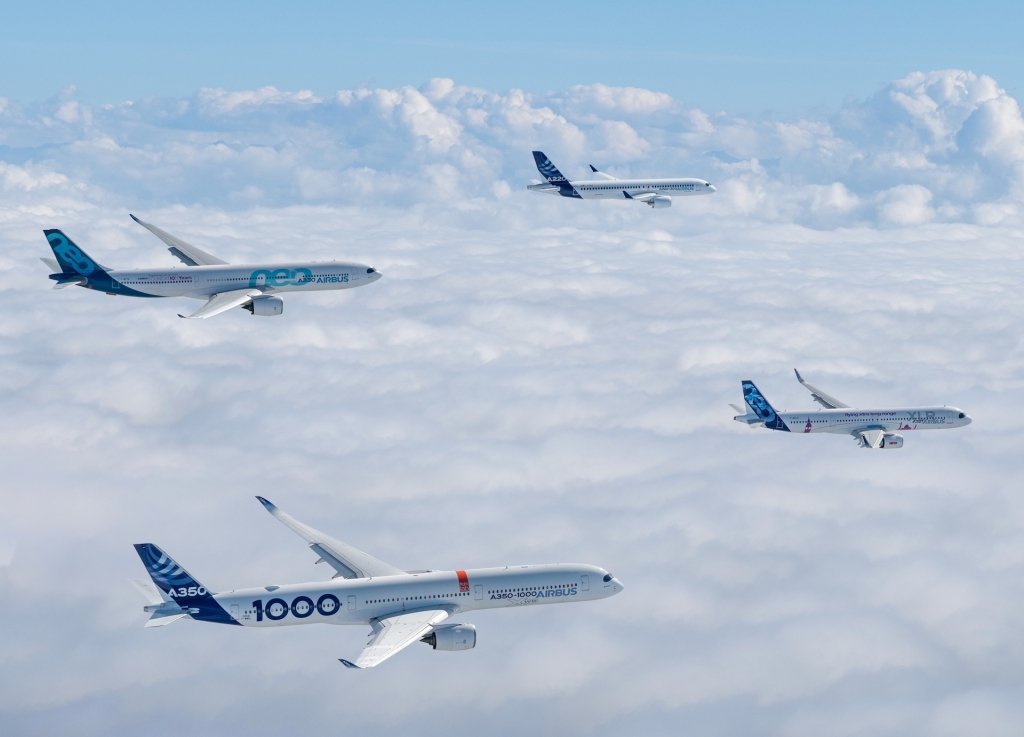
In 2025, Airbus delivered 793 commercial aircraft, up from 766 in 2024. The total comprised 93 A220s, 607 A320 Family aircraft, 36 A330s and 57 A350s. Gross commercial orders totalled 1,000 aircraft, translating into 889 net orders after cancellations, taking the year-end backlog to a record 8,754 aircraft.
Operating earnings improved year-on-year, supported by higher deliveries, a more favourable hedge rate and lower research and development expenses, while the impact of trade tariffs partly offset gains. Airbus reported €73.4 billion in consolidated revenue for the year.
Deliveries and Backlog
The single-aisle A320 Family continued to account for the bulk of deliveries, with 607 aircraft, reflecting where demand and backlog remain concentrated. Airbus indicated that production is continuing to tilt toward higher-capacity A321 variants, including the XLR.
On the widebody side, Airbus delivered 57 A350s and 36 A330s in 2025. Airbus continues to target 12 A350 aircraft per month by 2028 and five A330 aircraft per month by 2029.
Airbus recorded strong A350 order momentum and indicated that demand currently exceeds near-term production availability, creating pressure for additional capacity once production reaches 12 aircraft per month.
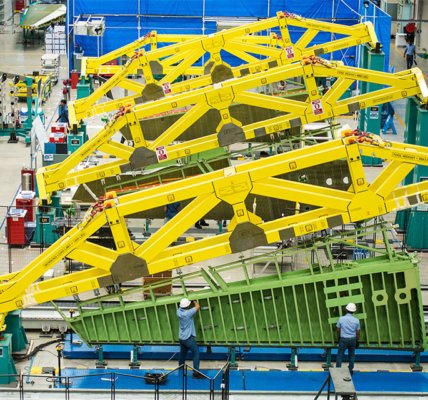
Late in the year, technical issues on the A320 programme, including fuselage panel quality concerns, tightened the delivery window and added pressure on year-end deliveries. The company stressed that resolution to the required quality standard took precedence over delivery flexibility in the final weeks of the year.

Engine Supply and A320 Production Outlook
Engine availability, particularly from Pratt & Whitney on the A320neo-family ecosystem, is influencing Airbus’ 2026 production planning.
Airbus stated that Pratt & Whitney has not committed to previously agreed engine delivery volumes, affecting the company’s 2026 delivery outlook and single-aisle production trajectory. Airbus confirmed that the matter has entered a formal contractual process under the terms of its agreement with Pratt & Whitney.
Airbus now expects to reach a production rate of 70-75 A320 Family aircraft per month by the end of 2027, stabilising at 75 thereafter.
Airbus attributed the shortfall to engine capacity being stretched between new production and the in-service retrofit workload linked to geared turbofan inspections and durability constraints, including inspection and retrofit work related to the metal powder contamination issue. Airbus said the solution requires expanded industrial capacity rather than reallocating constrained output between production and in-service requirements.

For 2026, Airbus issued guidance for around 870 commercial aircraft deliveries.
It said the outlook assumes no additional disruption to global trade, the world economy, air traffic, supply chains, internal operations, or its ability to deliver products and services, and excludes the impact of any future acquisitions or divestments while incorporating currently applicable tariffs.
On the A220 programme, Airbus reaffirmed that the ramp-up remains paced by Spirit AeroSystems work-package integration and supply-demand balancing. It now targets 13 A220 aircraft per month in 2028. Airbus indicated that programme stabilisation and industrial readiness are guiding the pace alongside volume.
Product Planning and Future Programmes
Alongside production-rate updates, Airbus outlined several forward-looking product and technology signals on the civil side.
For the A350, Airbus said it would like to move beyond the current production plan over time, while keeping the near-term focus on executing the ramp-up to 12 aircraft per month by 2028. Industrial studies are underway to assess the feasibility of increasing output beyond the current plan.
Airbus confirmed that a stretched A350 remains under study, describing it as a natural evolution of the platform, with timing dependent on customer requirements and programme workload, including the A350 freighter. Airbus confirmed that a stretched A220 remains under active evaluation, the concept remains active, but timing has not been set amid current industrial priorities on the programme
Photo: Airbus
Within the A320 family, Airbus said it does not plan to introduce a new aircraft larger than the A321 inside the existing programme, instead allowing the production mix within the family to continue shifting toward A321 variants as demand trends support that move.
Airbus also indicated that certain performance-driven operations historically served by the A319 are expected to transition toward the A320 as demand for the smaller variant narrows
For the next-generation single-aisle aircraft, Airbus maintained its ambition of a programme targeted for the second half of the next decade, with an intended 25–30% fuel-burn improvement versus current aircraft. It indicated that technology development continues across major building blocks and that programme decisions later this decade remain aligned with an intent to launch around 2030. On SAF, Airbus said progress remains slower than expected, pointing to pricing differentials, supply constraints and fragmented global regulatory frameworks that continue to limit broader scale-up.
Airbus also reiterated plans to use the A380 as a flying testbed for an open-rotor engine demonstration, without providing a schedule.
With a record backlog and firm demand, Airbus now faces a year in which production stability—particularly in engines—will determine how much of that demand converts into delivered aircraft.
Also Read: Not Boeing, Not Airbus: Why Adani’s Embraer Bet Is About Power, Not Planes