










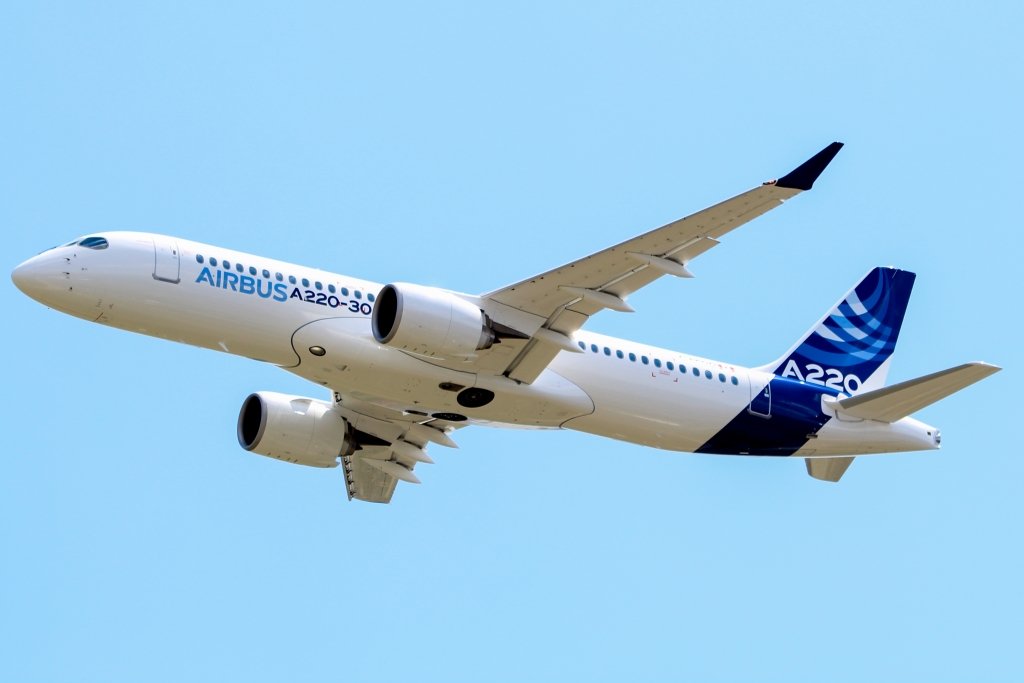
Airbus A220-300
Airbus A220-300 is meticulously engineered to address the 120-160 seat market within Airbus’ commercial aircraft line-up. This variant combines efficiency, comfort, and performance, focusing on maximising passenger satisfaction while ensuring exceptional operational efficiency. Featuring a spacious cabin, ample overhead storage, and large windows, the A220-300 offers a flight experience comparable to widebody jets.
In tandem with its sibling, the A220-100, this aircraft delivers notable environmental benefits, reduced fuel consumption, and low noise levels. Its new-generation engines make it an ideal choice for urban and noise-sensitive airports, ensuring a quiet, comfortable journey for passengers and energy-efficient operations for airlines. A220-300 reflects Airbus’ commitment to sustainability, aligning with global efforts to reduce the aviation industry’s environmental footprint.
Cabin Features
A220-300 boasts a roomy cabin design, expansive windows, and spacious overhead bins. Designed to emulate the feel of a widebody aircraft, it offers wide seats and generous personal space, ensuring a superior travel experience. The overhead bins, the largest in their class, can accommodate significant amounts of carry-on luggage. Extra-large windows, with more than one per row, provide optimal viewing and an abundance of natural light, creating a pleasant and open atmosphere. The seats, over 18 inches wide, offer a spacious seating arrangement. The remarkably quiet cabins, thanks to newly designed engines, enhance the overall passenger experience. Additionally, the lower deck cargo hold is designed for maximum efficiency, allowing for high usable volume and effective stacking.
Like its smaller sibling, A220-300’s configurable cabin features two flex zones, allowing operators to customise modular cabin elements such as stowage areas and partitions to meet specific needs. The cabin management system allows crew members intuitive control over the aircraft’s interior environment, including entertainment offerings and mood lighting. Passengers can enjoy the latest in in-flight entertainment systems, with high-definition screens and a variety of content options to suit all tastes.
Technology: Engine and Avionics
A220-300 incorporates advanced materials and state-of-the-art technology to enhance efficiency and performance. The extensive use of composites in the wings, empennage, and rear fuselage reduces weight and increases corrosion resistance. These materials constitute over 40 per cent of the aircraft’s primary structure, leading to significant weight savings and improved fuel efficiency. This results in a reduction of up to 25 per cent in CO2 emissions and up to 50 per cent in NOx emissions compared to previous-generation aircraft.
Both A220-300 and the shorter-fuselage A220-100 share 99 per cent commonality and use the same family of engines, enabling operators to fly both versions with significant cost savings. Flight crews with the same pilot type rating and cabin personnel assigned to both aircraft types experience a seamless transition between A220-100 and A220-300, greatly reducing complexity and training costs for airlines.
Engine Type
A220-300 is powered by the Pratt & Whitney PurePower PW1500G geared turbofan engines, specifically designed for the A220 family. These engines offer a 25 per cent lower fuel burn per seat compared to previous-generation aircraft and a 50 per cent reduction in NOx emissions. The high bypass ratio of 12:1, among the highest of any turbofan engine globally, contributes to the aircraft’s low noise levels, making it an excellent choice for noise-sensitive airports. These engines not only provide exceptional fuel efficiency but also contribute to the aircraft’s impressive range and performance, enabling airlines to operate more economically and environmentally friendly.
Avionics
A220-300’s advanced avionics system enhances pilot situational awareness and reduces workload. The cockpit features large, high-resolution displays that provide critical flight information at a glance. The avionics suite includes advanced navigation and communication systems, ensuring safe and efficient operations. The aircraft is equipped with the latest safety features, including an enhanced flight management system and automated systems that assist in managing flight operations. The cockpit layout is designed with ergonomics in mind, reducing pilot fatigue and improving overall flight safety.
Additional Technological Advancements
The aircraft benefits from a best-in-class Health Management System (HMS), designed to be Big Data ready. This system provides real-time supervision of the aircraft systems, enabling efficient management of unscheduled maintenance and proactive maintenance through trend analysis. A220-300 also features advanced predictive maintenance capabilities, utilising data analytics to predict and address potential issues before they impact operations. This not only improves reliability but also reduces maintenance costs and downtime.
Performance
A220-300 stands out with its impressive performance capabilities, offering a range of up to 3,450 nautical miles (6,390 km). This allows the aircraft to handle both regional and longer-range missions with ease, making it a versatile addition to any airline fleet. Its superior range capability, comparable to that of larger single-aisle aircraft, enables airlines to serve more destinations while maintaining fuel efficiency and lower operating costs per trip. The aircraft’s performance is further enhanced by its ability to operate in challenging environments, such as airports with short runways or high altitudes.
One of the standout features of A220-300 is its ability to perform both steep approach and long-range operations, unlocking new route opportunities for airlines. Its performance capabilities make it suitable for operations at challenging airports, including those with hot-and-high conditions or space constraints such as London City Airport. The aircraft’s ability to operate in diverse conditions makes it a valuable asset for airlines seeking to expand their route networks.
The aircraft’s performance is further enhanced by its recent achievement of 180-minute extended operations (ETOPS) certification. This certification allows A220 customers to start new direct, non-limiting routings over water or in remote or underserved regions, providing greater operational flexibility. This capability opens up new route possibilities and enables airlines to offer more direct flights, improving connectivity for passengers.
Specifications
- Overall length: 38.7 m
- Cabin length: 27.5 m
- Fuselage max diameter: 3.5 m
- Max cabin width: 3.28 m
- Wingspan: 35.1 m
- Height: 11.5 m
Capacity
- Max seating: 160
- Typical seating (2-class): 120-150
- Cargo water volume: 31.6 m³
Performance
- Range: 6,297 km
- Mmo: M0.82
- Max ramp weight: 71.2 tonnes
- Max take-off weight: 70.9 tonnes
- Max landing weight: 61.0 tonnes
- Max zero fuel weight: 58.0 tonnes
- Max fuel capacity: 21,508 litres
Takeaways
A220-300 has been well-received by airlines worldwide, with numerous carriers integrating the aircraft into their fleets. For instance, Delta Air Lines, one of the major operators of the A220-300, has praised its fuel efficiency and passenger comfort, highlighting how it fits perfectly into their domestic and international routes. Swiss International Air Lines has also lauded the aircraft for its performance in challenging conditions.
The aircraft has set new standards in the 120-160 seat market, making it a highly competitive choice for airlines aiming to optimise operations and enhance passenger satisfaction. As the larger member of the A220 Family, A220-300 is perfectly tailored for the 120-160 seat market. It represents a fusion of performance and technology, enabling airlines to connect distant points on continents and serve route sectors that were previously unprofitable or impossible to perform. Its advanced technology, superior comfort, and environmental efficiency make it a standout in its class, poised to shape the future of regional and mid-range air travel.