














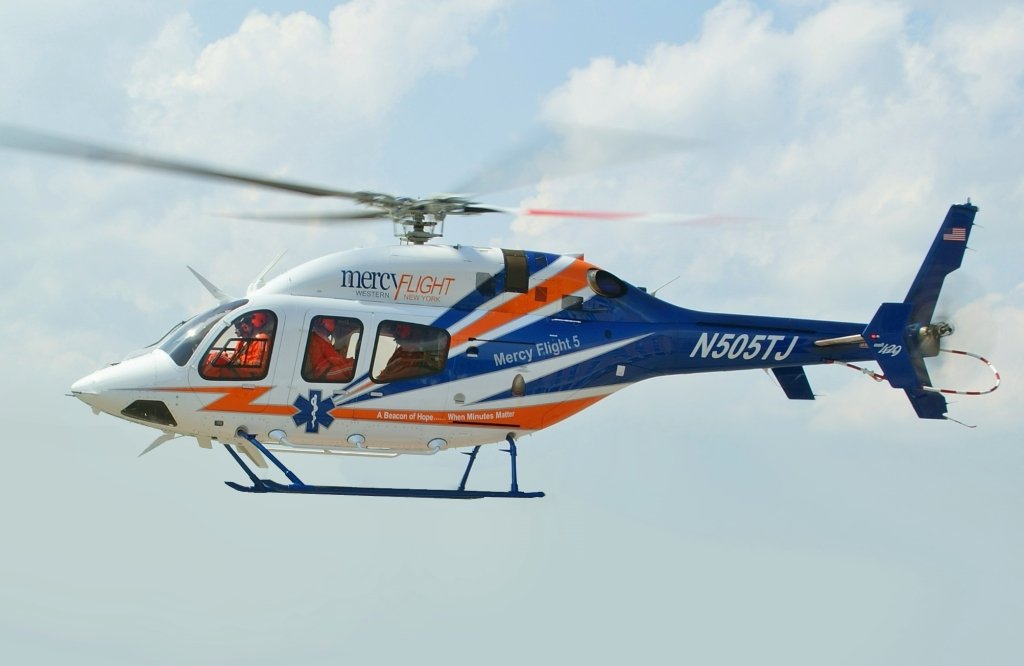
Bell 429
The Bell 429, developed by Bell Textron Inc., a subsidiary of Textron Inc. (NYSE: TXT), is celebrated for its performance, technology, and versatility in the light twin-engine helicopter market. The aircraft has been designed to meet the demanding needs of a wide range of missions—from emergency medical services (EMS) and search and rescue (SAR) to law enforcement and corporate transport.
Advanced avionics, a spacious cabin, and superior manoeuvrability make the Bell 429 a standout in its class, providing a blend of speed, range, and payload capacity that few other helicopters can match. The aircraft’s state-of-the-art technologies and design innovations are backed by Bell’s extensive support network, ensuring that operators have access to comprehensive maintenance, training, and operational services. With over 500 units delivered worldwide and certifications in over 70 countries, the aircraft has proven itself as a reliable and efficient platform across various sectors. Its compliance with the latest safety standards, including Instrument Flight Rules (IFR) capabilities and single-pilot operations, make it a versatile and safe choice for a broad spectrum of missions.
Cabin Experience
One of the defining features of this aircraft is its spacious and adaptable cabin. With seating for up to seven passengers and a crew of two, it offers a comfortable and ergonomic environment that can be easily reconfigured to suit a variety of mission profiles. The flat floor and large rear clamshell doors enable quick and efficient loading and unloading of cargo or passengers, making it particularly well-suited for EMS and SAR operations where time is of the essence. The aircraft also features an optional retractable landing gear, which enhances accessibility during medical emergencies and other critical missions, allowing for rapid patient transfer in confined spaces.
The cabin’s design prioritizes passenger comfort, featuring large windows that provide excellent visibility and natural light, enhancing situational awareness for both the crew and passengers. The noise-reducing technologies integrated into the design ensure a quieter cabin, allowing for better communication and a more pleasant flight experience, even on longer missions. The aircraft’s cabin is also equipped with climate control systems, ensuring passenger comfort in a variety of weather conditions, whether flying in extreme heat or cold.
For corporate and VIP transport, the aircraft can be outfitted with a variety of luxury interior options, offering an executive transport experience that combines functionality with elegance. These configurations can include leather seating, premium sound systems, and custom lighting, catering to the specific needs of high-end clientele. The cabin’s versatility is further highlighted by its ability to be quickly reconfigured from a corporate layout to an EMS setup, demonstrating the aircraft’s adaptability to meet diverse operational requirements such as advanced medical gear for EMS missions or specialised surveillance tools for law enforcement operations.
Performance
The aircraft is powered by twin Pratt & Whitney Canada PW207D1 engines, each delivering 820 shaft horsepower (shp). This robust powerplant allows the Bell 429 to achieve impressive performance metrics, including a maximum cruise speed of 150 knots (278 km/h) and a range of up to 411 nautical miles (761 kilometres). These capabilities make this aircraft one of the fastest and most efficient helicopters in its class, capable of covering significant distances quickly and with reduced fuel consumption. The helicopter’s performance is further enhanced by its ability to perform Category A operations, ensuring that it can continue flight even in the event of an engine failure, a critical feature for safety-conscious operators.
The helicopter’s performance is further enhanced by its four-blade rotor system, which provides a smooth and stable ride, even in turbulent conditions. Its hover performance is equally impressive, with a hover ceiling out of ground effect (OGE) of 11,000 feet (3,353 meters), allowing it to operate effectively in high-altitude environments and confined areas. Its rotor system is designed for low vibration levels, enhancing passenger comfort and reducing wear on the aircraft, contributing to lower operating costs over time.
The aircraft’s agility and responsiveness are complemented by its advanced flight control system, which reduces pilot workload and enhance safety. Its ability to perform well in a wide range of conditions makes it a versatile tool for missions that require quick and precise manoeuvring, such as law enforcement operations or aerial inspections. Its flight control system includes an optional autopilot feature, which provides additional stability and control, allowing for smoother operations during complex missions.
Technology (Engine & Avionics)
The helicopter’s twin Pratt & Whitney Canada PW207D1 engines are known for their reliability and efficiency, providing the power needed for high-performance operations while keeping maintenance costs low. These engines are also equipped with Full Authority Digital Engine Control (FADEC) system, which optimises engine performance and improve fuel efficiency, contributing to the overall operational economy of the aircraft. The FADEC system also enhances safety by automatically adjusting engine performance in response to changing flight conditions, reducing the risk of human error.
The cockpit is equipped with the Bell BasiX-Pro™ Integrated Avionics System, which includes four 10.4-inch high-resolution LCD displays that provide critical flight information at a glance, allowing pilots to maintain focus on their mission. The BasiX-Pro™ system integrates all of the aircraft’s navigation, communication, and flight control systems, ensuring that pilots have access to the information when they need it. The avionics suite is also compatible with night vision goggles (NVG), expanding the aircraft’s operational capabilities to include night-time missions in challenging environments.
The helicopter is equipped with dual-channel GPS, VHF/UHF communication systems, and a Traffic Collision Avoidance System (TCAS), which enhances safety by providing real-time information on nearby aircraft. It is also compatible with a variety of mission-specific avionics packages, making it a flexible platform that can be customised to meet the unique needs of different operators. The aircraft also includes a synthetic vision system (SVS), which provides pilots with a 3D representation of the terrain, enhancing situational awareness in low-visibility conditions and further contributing to the aircraft’s safety profile.
The avionics also include an Integrated Health and Usage Monitoring System (IHUMS), which continuously monitors the health of the helicopter’s critical systems, providing real-time data that can be used to predict maintenance needs and prevent potential issues. This system enhances reliability and safety, giving operators peace of mind knowing that their aircraft is operating at peak performance. The IHUMS also supports Bell’s global customer service network, enabling proactive maintenance and reducing downtime, which is crucial for operators engaged in critical missions such as EMS and SAR.
Specifications
| Specification | Details |
|---|---|
| Dimensions | |
| Length | 41 ft 8 in (12.70 m) |
| Height | 13 ft 3 in (4.04 m) |
| Main Rotor Diameter | 36 ft (10.97 m) |
| Cabin Interior | |
| Volume | 204 cu ft (5.78 m³) |
| Maximum Occupants | 7 + 2 crew |
| Weights | |
| Maximum Gross Weight | 7,000 lb (3,175 kg) |
| Empty Weight | 4,465 lb (2,025 kg) |
| Useful Load | 2,535 lb (1,150 kg) |
| Performance | |
| Maximum Cruise Speed | 150 kt (278 km/h) |
| Maximum Range | 411 nm (761 km) |
| Service Ceiling | 20,000 ft (6,096 m) |
| Maximum Climb Rate | 1,575 fpm (480 mpm) |
| Hover Ceiling IGE | 13,500 ft (4,115 m) |
| Hover Ceiling OGE | 11,000 ft (3,353 m) |
| Powerplant | |
| Manufacturer | Pratt & Whitney Canada |
| Model | PW207D1 |
| Power Output | 820 shp (611 kW) |
Takeaways
The Bell 429 continues to set the standard for light twin-engine helicopters. Whether used for EMS, SAR, law enforcement, or corporate transport, the aircraft delivers exceptional performance, reliability, and safety. The helicopter’s advanced avionics and robust engines provide pilots with the tools they need to operate effectively in even the most challenging environments. The spacious and adaptable cabin ensures that the aircraft can be configured to meet a wide range of mission requirements, from transporting patients in need of urgent care to conducting complex search and rescue operations in difficult terrain. No wonder that the aircraft has been selected by numerous global operators, including government agencies, corporate entities, and EMS providers. Whether flying in the heart of a bustling city or the remote reaches of the wilderness, the Bell 429 sets new benchmarks in helicopter design and performance.