












- Delhi’s Indira Gandhi International Airport leads India by passenger traffic, handling over 79 million flyers in FY 2024–25.
- Hyderabad’s Rajiv Gandhi International Airport is India’s largest by land area, spread across 5,500 acres and expanding rapidly.
- Upcoming Noida and Navi Mumbai International Airports will redefine capacity, aiming to serve more than 100 million passengers each in the coming decades.

Biggest Airports in India
Airports are the gateways to a nation’s growth. They connect people, goods, and cultures while shaping trade, tourism, and investment. India, one of the world’s fastest-growing aviation markets, is also home to some of the largest and busiest airports globally. But when we ask, “Which is the biggest airport in India?” the answer depends on how we define “biggest”.
By land area, the largest is Rajiv Gandhi International Airport, Hyderabad. By passenger traffic, the busiest is Indira Gandhi International Airport, Delhi. Both stand as symbols of India’s aviation ambition, supported by a network of other large airports across the country.
Largest by Area: Rajiv Gandhi International Airport, Hyderabad
The Rajiv Gandhi International Airport (RGIA), Hyderabad, spreads across 5,500 acres, making it India’s biggest in terms of land area. Opened in March 2008, it replaced the congested Begumpet Airport and was designed with growth in mind.
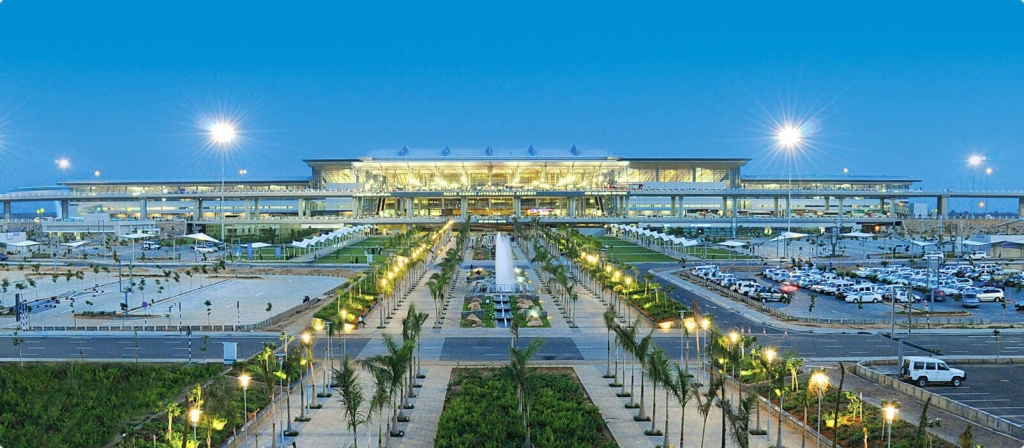
RGIA combines modern architecture with eco-friendly features and has the flexibility to expand further as passenger numbers climb. Today, it can handle around 25 million passengers annually, but expansion projects underway will allow it to grow much bigger.
Hyderabad’s airport has also become a major hub for India’s booming pharmaceutical exports, with state-of-the-art cargo facilities serving markets across the Middle East, Southeast Asia, and Europe.

Highlights:
- RGIA’s expanded integrated passenger terminal now spans roughly 379,000 square metres and carries a LEED Platinum sustainability rating.
- RGIA’s current developed capacity has been lifted toward 40 million passengers per annum, with long-term plans that envisage an eventual scale of around 100 million.
- RGIA handled 180,914 metric tonnes of cargo in calendar year 2024, reflecting strong growth led by pharmaceuticals.
- GMR Hyderabad International Airport Limited (GHIAL) has indicated that a second runway and an additional terminal will be considered as annual traffic approaches 45 million passengers.
Busiest by Passengers: Indira Gandhi International Airport, Delhi
If Hyderabad is the biggest in area, Indira Gandhi International Airport (IGI), Delhi, is the busiest by traffic. In FY 2024–25, IGI handled more than 79 million passengers, making it not only India’s largest by volume but also the ninth-busiest airport in the world.

Spread over 5,106 acres, IGI has three main terminals—T1 for domestic low-cost flights, T2 for mixed operations, and T3, one of the largest terminals globally. Together, they process over 1,200 flights daily, connecting Delhi to more than 150 destinations worldwide.
IGI is also fast emerging as an international transfer hub. In 2024, international connections through Delhi rose by 244%, driven by Air India’s long-haul expansion and IndiGo’s growing global network. Future upgrades—including a fourth runway and expanded capacity at T3—are expected to push the airport beyond the 100-million-passenger mark.
Highlights:
- IGI’s overall designed capacity has crossed the 100-million-passengers-per-annum threshold, placing Delhi among the world’s largest hubs by capability.
- Terminal 3 is being reconfigured by converting a domestic pier to international use, which is expected to lift its international capacity from 20 million to 30 million passengers annually.
- Terminal 2 has been under repair, with reopening timed ahead of the festive travel period in 2025, supporting smoother peak operations.
- IGI’s cargo complex has re-established annual throughput around the one-million-tonne mark, reinforcing Delhi’s lead as South Asia’s busiest airfreight gateway.
Other Major Airports by Area
India has several other large airports, though smaller than Hyderabad’s:
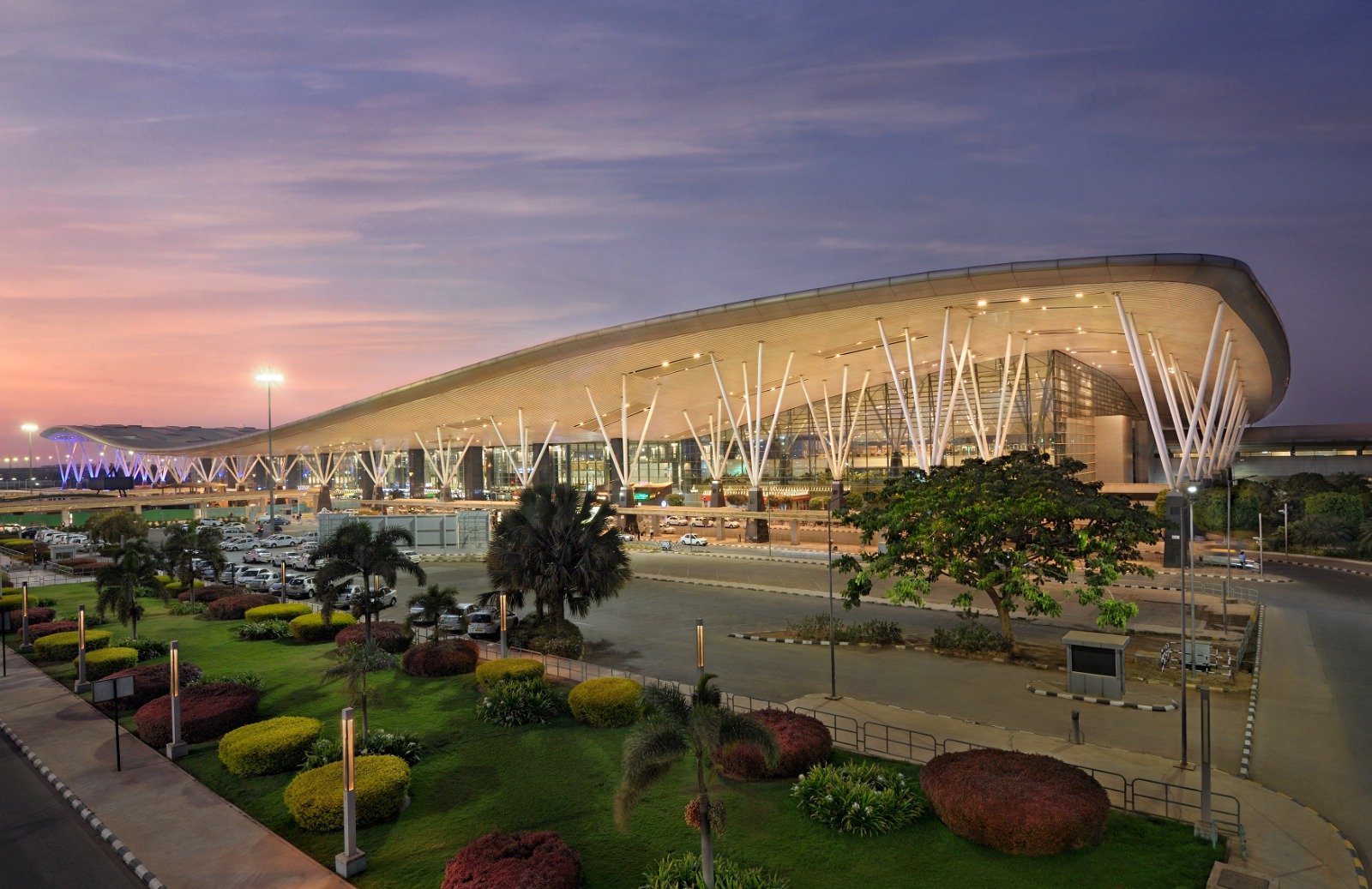
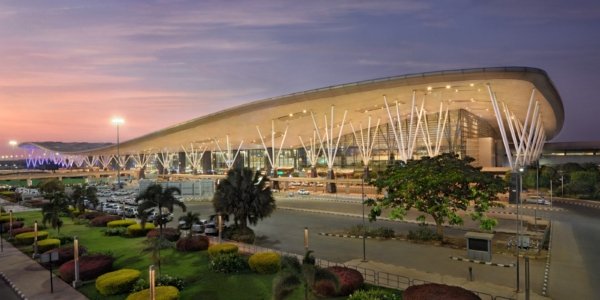
- Kempegowda International Airport, Bengaluru: Around 4,000 acres, featuring the new “Terminal in a Garden” (T2). Kempegowda International Airport (Bengaluru) closed FY2024–25 at roughly 41.88 million passengers and set a new cargo high of about 502,480 metric tonnes.
- Manohar International Airport, Goa: 2,100 acres, Manohar International Airport (Goa, Mopa) operates an IGBC Platinum-rated terminal and has been progressively ramping up its route network since opening in 2023.
- Netaji Subhas Chandra Bose International Airport, Kolkata: 1,600 acres, eastern India’s main hub. Netaji Subhas Chandra Bose International Airport (Kolkata) marked its centenary in December 2024, alongside plans for capacity augmentation.
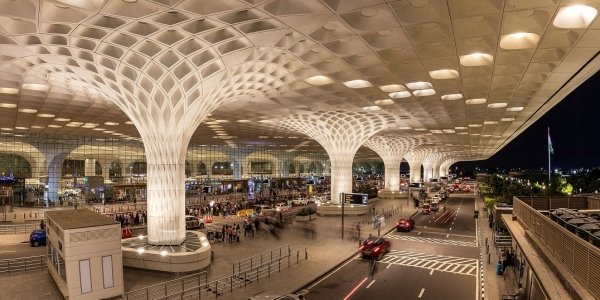
- Chhatrapati Shivaji Maharaj International Airport, Mumbai: 1,500 acres, one of the world’s busiest single-runway airports. Chhatrapati Shivaji Maharaj International Airport (Mumbai) reported 55.12 million passengers in FY2024–25 and has initiated Terminal-1 redevelopment to raise capacity and ease peak loads on T2.
- Cochin International Airport, Kochi: 1,300 acres, the world’s first fully solar-powered airport. Cochin International Airport (CIAL) operates on approximately 50 MWp of airport-owned solar generation, maintaining its fully solar-powered status while expanding terminal infrastructure.


Large land banks give airports like Hyderabad and Bengaluru an edge—they can keep adding new runways, terminals, and cargo zones as demand rises.
Other Busiest Airports by Passenger Numbers
Apart from Delhi, several other Indian airports see massive passenger volumes:
- Chhatrapati Shivaji Maharaj International Airport, Mumbai: Mumbai’s annual passenger traffic stood at over 55 million passengers annually in FY2024–25, sustaining its position as India’s second-busiest airport.
- Kempegowda International Airport, Bengaluru: Bengaluru handled 41.88 million passengers in FY2024–25 and continued to rank among the fastest-growing hubs in Asia.
- Rajiv Gandhi International Airport, Hyderabad: Hyderabad achieved FY2024–25 near the 29 million passenger mark, reflecting post-expansion growth momentum.
- Chennai International Airport: Chennai’s Phase II modernisation targets an integrated terminal capacity of 22.5 million passengers per annum.
- Netaji Subhas Chandra Bose International Airport, Kolkata: Kolkata remained above 21 million annual passengers.
- Cochin International Airport, Kochi: Cochin maintained steady double-digit international growth, handling 13 million passengers, the busiest in Kerala.
Together, these airports form India’s backbone for both domestic and international travel, handling two-thirds of the country’s total air traffic.
Cargo Powerhouses
Passenger volumes are only part of the story. India’s largest airports are also freight powerhouses.
- Delhi IGI: Delhi sustained annual cargo throughput at or above 1 million tonnes of cargo annually across FY2023–24 and FY2024–25, keeping IGI as South Asia’s leading cargo hub.
- Mumbai CSMIA: Manages over 800,000 tonnes, serving as a gateway for pharmaceuticals and textiles. Mumbai supported strong belly-hold cargo flows alongside freighter uplift, benefiting from network expansion on regional routes.
- Bengaluru KIA: Bengaluru established a new all-time high of roughly 502,480 metric tonnes of cargo in FY2024–25, underpinned by perishables and electronics.
- Hyderabad RGIA: Specializes in pharmaceutical exports, from vaccines to APIs. Hyderabad handled 180,914 metric tonnes of cargo in calendar 2024, driven by pharma and temperature-controlled logistics.
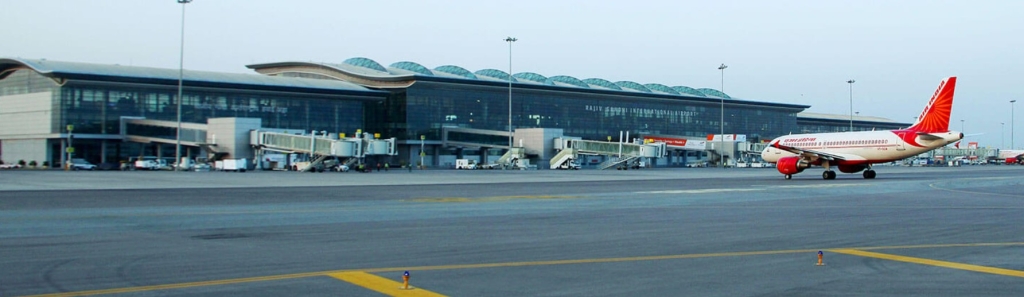
Cargo makes these airports vital for India’s global trade network, ensuring exports move quickly and reliably.
Upcoming Megaprojects
India’s two biggest aviation projects are nearing launch:
- Noida International Airport (Jewar): Spanning 7,200 acres, this will be India’s largest when complete. Phase one, opening in October 2025, will handle 12 million passengers, with long-term plans for 70 million annually. It will also feature multiple runways and a dedicated cargo hub.
- Navi Mumbai International Airport: Expected to share traffic with Mumbai’s congested CSMIA, it will eventually handle 60 million passengers annually.
- Mumbai’s Terminal-1 redevelopment (coordinated with Navi Mumbai’s ramp-up) is intended to balance capacity across the metro region through the second half of the decade.
These projects are critical to easing pressure on existing hubs and preparing for India’s projected surge in air travel.


Why “Biggest” Matters
India’s medium-term policy trajectory emphasise network expansion via greenfield projects and UDAN connectivity, with a long-range ambition of 350 airports by the 2040s and near-term additions over the next five years. Low-carbon operations are emerging as a differentiator, with Delhi and Hyderabad publishing efficiency upgrades and Cochin operating on ~50 MWp of airport-owned solar power. When we talk about the biggest airports, we mean more than size or numbers. These airports are economic engines:
- They generate thousands of direct and indirect jobs.
- They boost tourism, trade, and investment.
- They position India as a global aviation hub.
According to CAPA India, the country’s airport sector is projected to see 35% pre-tax profit growth in FY 2025, while the Ministry of Civil Aviation has set a target of 350 airports by 2030 to serve 600–700 million flyers annually.
The Road Ahead

India’s biggest airports are more than transport points—they are lifelines of growth. Indira Gandhi International Airport, Delhi, leads the nation by passenger traffic and global ranking, while Rajiv Gandhi International Airport, Hyderabad, tops the chart by area and expansion potential.
Airports in Mumbai, Bengaluru, Chennai, Kolkata, and Kochi complete the picture, ensuring that India’s aviation map is robust and diverse.
With Noida International and Navi Mumbai International set to open soon, the definition of “biggest” will keep evolving. What is clear is that India’s airports will continue to play a decisive role in the country’s transformation into one of the world’s top aviation markets.