








- Largest Passenger Aircraft: The Airbus A380 is the world’s biggest passenger plane, capable of carrying up to 853 passengers in an all-economy setup.
- Engineering Marvel: Its double-deck design, massive wingspan, and powerful engines required special airport modifications and represent a milestone in aviation engineering.
- Passenger Comfort & Global Impact: The A380 offers unmatched comfort with lounges, bars, and spacious cabins, but its high operating costs and limited airport compatibility have reduced its widespread use.
Biggest Plane in the World
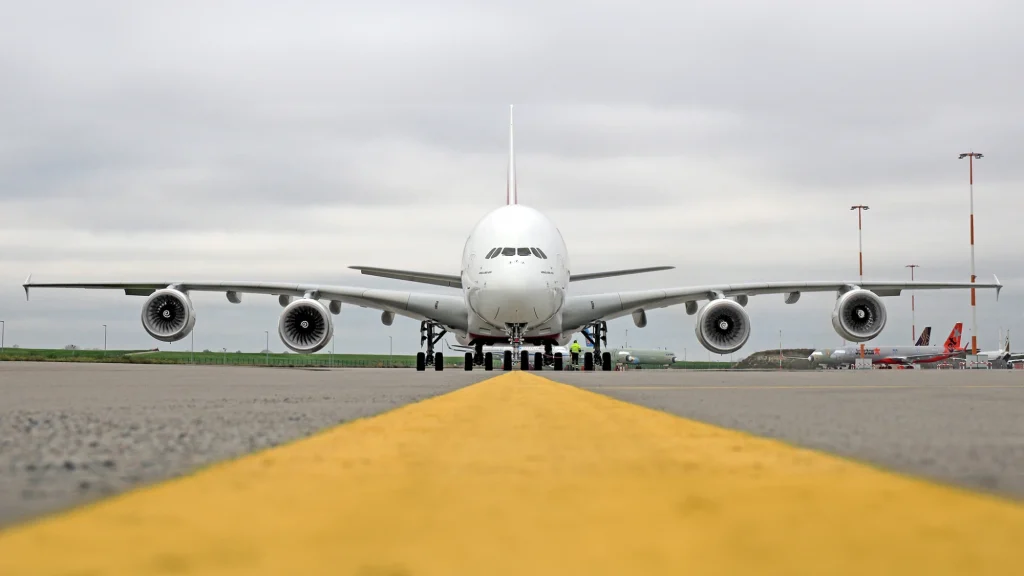
Air travel has always fascinated people, and the quest for larger, more efficient aircraft has led to some incredible engineering achievements. Among all passenger airplanes, the Airbus A380 holds the title of the biggest plane in the world. This massive aircraft has set new standards for size, capacity, and passenger comfort.
Overview of the Airbus A380

The Airbus A380 is a double-deck, wide-body, four-engine airplane designed for long-haul international flights. It was first introduced in 2005 and quickly became famous for its size and capacity. With a length of 72.7 meters (238 feet), a wingspan of 79.8 meters (261 feet), and a height of 24.1 meters (79 feet), the A380 dwarfs nearly all other commercial airplanes.
The plane’s design allows it to carry a huge number of passengers. In a typical three-class configuration (first, business, and economy), the A380 can seat around 525 passengers. In an all-economy configuration, it can carry up to 853 passengers, making it perfect for extremely busy routes like London to Dubai or New York to Singapore.
Speed and Range
Despite its enormous size, the A380 is impressively fast and efficient. It has a cruising speed of 900 km/h (560 mph) and a maximum speed of 1,020 km/h (634 mph). Its range of 15,200 kilometers (9,445 miles) allows it to fly non-stop on ultra-long-haul flights, connecting major cities around the world without needing a refueling stop.
Engineering Marvel
Building the A380 was a huge challenge for Airbus engineers. Its double-deck design required stronger materials and advanced aerodynamics. The plane uses four Rolls-Royce Trent 900 or Engine Alliance GP7200 engines to provide the power needed for takeoff, cruising, and landing. The wings are so large that airports had to make special adjustments, such as wider taxiways and reinforced runways, to accommodate the A380 safely.
Inside, the plane offers unmatched comfort for passengers. Wide seats, spacious cabins, larger windows, and quieter engines make long flights more pleasant. Many airlines even added lounges, bars, and showers for first-class passengers, making the A380 a flying hotel in the sky.
Global Impact
The Airbus A380 has transformed air travel by allowing airlines to carry more passengers on busy routes while reducing congestion at airports. However, its size also brought challenges. Fewer airports can accommodate it, and operating such a large aircraft is expensive, which is why some airlines have started using smaller, more fuel-efficient planes for long-haul flights instead.
Conclusion
The Airbus A380 remains the largest passenger airplane in the world, both in terms of size and passenger capacity. Its impressive design, engineering, and comfort make it an icon of modern aviation. While future developments may bring even faster or more efficient aircraft, the A380’s record for size is likely to remain unmatched for years to come.
Flying on an A380 is more than just transportation; it is an experience of scale, comfort, and innovation that reflects the pinnacle of human engineering in aviation.