











Table of contents
Cessna SkyCourier (Passenger)
The Cessna SkyCourier Passenger variant is designed for regional and commuter air transport, offering seating for up to 19 passengers in a single configuration. Launched alongside the freighter model, the SkyCourier targets regional airlines that require a balance between payload, efficiency, and operational flexibility. As a twin-engine turboprop, this aircraft is optimised for short-haul routes, providing operators with an affordable yet durable platform that can handle challenging environments.
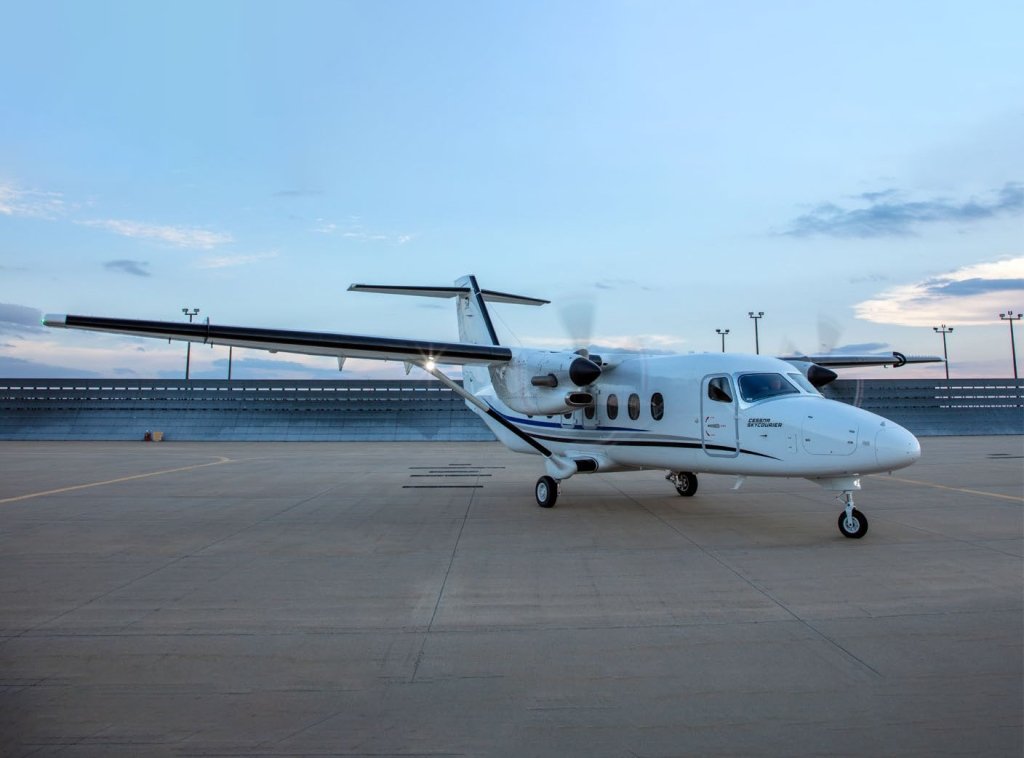
The Cessna SkyCourier is designed as a high-wing aircraft, with a robust structure and wide doors aimed at simplifying operations and maximising reliability. The aircraft is 55 feet 1 inch in length, with a wingspan of 72 feet 3 inches, and a height of 20 feet 8 inches. This structural design provides ample ground clearance, making it suitable for rougher airstrips. Fixed landing gear reduces mechanical complexity and maintenance costs.
For passengers, the high-wing layout provides excellent visibility and stability during flight. The aircraft has been optimised for regional routes, allowing operators to use it in airports with shorter runways or limited infrastructure, typical in remote or underdeveloped areas. Its rugged design ensures durability in environments where other aircraft might struggle, making it suitable for both commercial routes and charter operations.
Cabin Experience
The aircraft’s cabin dimensions provide a height of 5 feet 11 inches and a width of 6 feet 5 inches, offering sufficient space for a comfortable regional flight experience. While primarily targeted at short-haul commuter operations, the interior can be customised to meet specific operator needs, with flexibility in seating arrangements and configurations.
This variant is especially useful for regional operators looking to replace or supplement their existing turboprop fleets, offering enhanced cargo and passenger capacity compared to competitors like the De Havilland Twin Otter. The spacious cabin can also be reconfigured for special missions or VIP transport, providing versatility beyond regular passenger transport.
Technology (Engine and Avionics)
The aircraft is powered by two Pratt & Whitney PT6A-65SC engines, each delivering 1,100 shaft horsepower. This gives the aircraft the power it needs to operate effectively in a wide range of environments, from small, remote airstrips to busy regional hubs. The four-blade McCauley propellers are designed to provide optimal thrust, contributing to the SkyCourier’s short takeoff and landing capabilities.
The aircraft’s engines provide reliable performance, with an impressive range and a balance between speed and efficiency, making it suitable for regional routes.
The aircraft boasts Garmin G1000 NXi avionics suite that offers enhanced situational awareness for pilots, thanks to split-screen functionality, synthetic vision, and high-resolution displays, providing pilots with all necessary information at a glance. The avionics package reduces pilot workload, enhancing operational safety, especially during complex regional flights.
Besides the above features, the SkyCourier’s avionics include real-time diagnostics, which allow operators to monitor the aircraft’s systems for any potential issues. It improves reliability and reduces downtime for maintenance. This diagnostic capability comes handy for operators looking to maintain tight flight schedules, especially in areas where maintenance facilities are limited. The aircraft’s focus on serviceability, with easy access points for inspections and maintenance, reduces downtime. The design also integrates quick-release seats and overhead bins in the passenger variant, simplifying operations. The aircraft received FAA certification in 2022 and has been delivered to customers globally, including regions like the Philippines and Latin America.
Performance
With a maximum cruise speed of 210 knots (389 km/h) and a maximum range of 920 nautical miles (1,704 km), the aircraft offers flexibility for regional routes. These performance metrics make SkyCourier suitable for passenger as well as cargo transport. Capable of covering longer distances with fewer fuel stops, the aircraft can carry a maximum payload of 5,000 lbs, which includes passengers and luggage. This way, operators find a cost-effective way to maximise revenue per flight.
The aircraft’s simple design, including fixed landing gear and manual braking, enhances its reliability and reduces the complexity of maintenance. For operators in regions with less-developed airport infrastructure, this simplicity provides a key advantage. The aircraft’s fuel efficiency and low operating costs also make it a competitive option for airlines looking to cut costs on regional routes.
Specifications
| Feature | Value |
| Length | 55 ft 9 in (17.02 m) |
| Height | 21 ft 4 in (6.5 m) |
| Wingspan | 72 ft 3 in (22.02 m) |
| Wing Area | 441 sq ft (40.97 sq m) |
| Cabin Length | 23 ft 4 in (7.11 m) |
| Cabin Width | 6 ft 5 in (1.96 m) |
| Cabin Height | 5 ft 11 in (1.8 m) |
| Passenger Capacity | Up to 19 passengers |
| Maximum Payload | 5,000 lbs (2,268 kg) |
| Max Ramp Weight | 19,260 lbs (8,736 kg) |
| Max Takeoff Weight | 19,000 lbs (8,618 kg) |
| Max Landing Weight | 18,600 lbs (8,437 kg) |
| Fuel Capacity | 4,826 lbs (2,189 kg) / 720 gal (2,725 L) |
| Basic Empty Weight | 11,275 lbs (5,115 kg) |
| Useful Load | 7,985 lbs (3,623 kg) |
| Maximum Cruise Speed | 210 ktas (389 km/h) |
| Max Range | 920 nm (1,704 km) |
| Takeoff Distance | 3,300 ft (1,006 m) |
| Landing Distance | 2,860 ft (872 m) |
| Maximum Operating Altitude | 25,000 ft (7,620 m) |
| Engines | 2 x Pratt & Whitney PT6A-65SC |
| Engine Power | 1,100 shp each (820 kW) |
| Propeller | McCauley 4-blade aluminium |
Takeaways
The Cessna SkyCourier, produced by Textron Aviation, stands out as a versatile twin-engine, high-wing utility turboprop designed for both cargo and passenger applications. Launched initially for FedEx Express, the SkyCourier has been designed with efficiency, featuring advanced manufacturing techniques such as monolithic machining, which reduces the number of parts and simplifies assembly. This contributes to tighter tolerances and enhanced durability.
The aircraft has drawn significant interest from regional airlines and charter operators. Its seating capacity of 19 passengers, modern avionics and better operational efficiency position it as a good alternative to smaller commuter jets and older turboprops. The combination of a large cabin, low operating costs, and robust performance characteristics make it attractive to operators in areas such as Southeast Asia, Africa, and remote parts of North America, where smaller aircraft are often the only feasible option.
Another key feature of the SkyCourier is its adaptability to different mission profiles. While its primary role is passenger transport, the aircraft can also be converted into a cargo configuration or used for mixed-use operations, offering additional revenue opportunities for operators. Whether used for scheduled passenger services or charter operations, the SkyCourier provides a flexible and cost-effective solution for short-haul routes. FedEx’s initial order of 50 aircraft, with an option for 50 more, highlights the demand for such a utility-focused design.