














- Design Philosophy & Cockpit Layout: Airbus emphasizes automation, fly-by-wire technology, and uniform cockpits with side-stick controls, while Boeing focuses on pilot control, traditional yokes, and flexibility across aircraft families.
- Aircraft Families & Innovations: Airbus is known for models like the A320, A350, and A380 with wider cabins and eco-efficient designs, while Boeing is famous for the 737, 777, and 787 Dreamliner, prioritizing fuel efficiency, range, and passenger comfort with features like larger windows.
- Market & Strategy: Airbus has gained strong global market share with modern technology and diverse aircraft sizes, while Boeing remains dominant in the U.S. and long-haul markets, leveraging its legacy aircraft and pilot-centric approach.
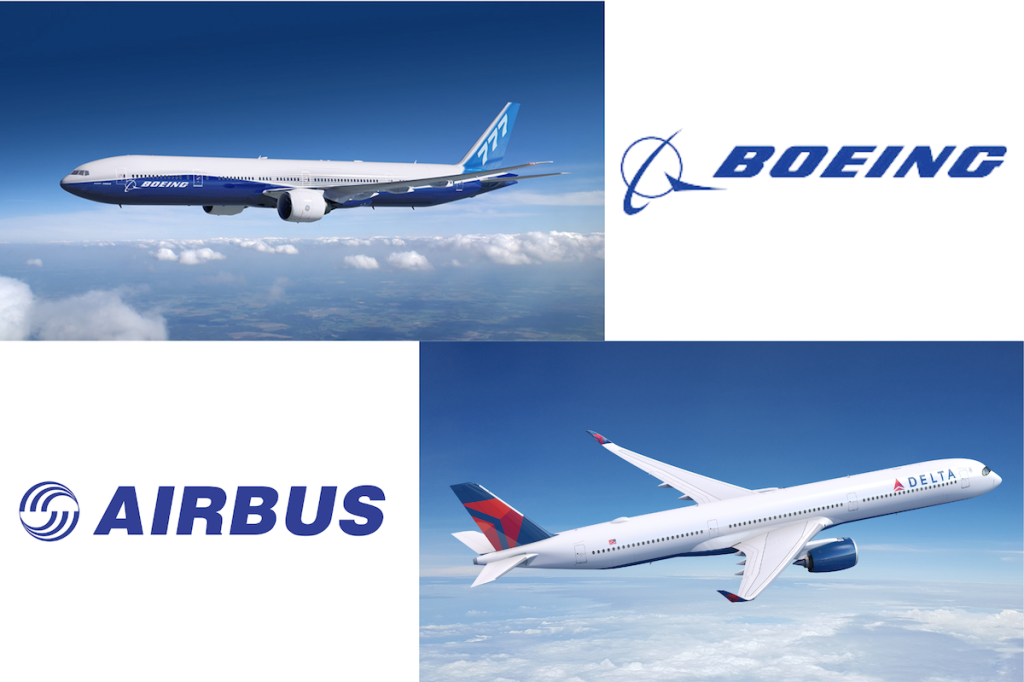
Difference Between Airbus and Boeing
Airbus and Boeing are two of the biggest names in the aviation industry, dominating the commercial aircraft market globally. Both companies have their unique technologies, design philosophies, and business strategies, which make them distinct from each other. For anyone interested in aviation, understanding the difference between Airbus and Boeing is crucial.
Company Background
Boeing is an American aerospace giant founded in 1916 in Seattle, Washington. Over the years, Boeing has grown into one of the world’s leading aircraft manufacturers, producing commercial airplanes, military aircraft, satellites, and defense systems. Boeing’s commercial aircraft division has long been known for models like the 737, 747, 777, and 787.
Airbus, on the other hand, is a European multinational corporation founded in 1970. Its headquarters is in Toulouse, France. Airbus was created as a collaboration between several European aerospace companies to compete with American manufacturers like Boeing. Over the decades, Airbus has become a global leader, famous for models such as the A320, A330, A350, and the iconic double-decker A380.
Aircraft Design Philosophy
One of the key differences between Airbus and Boeing lies in design philosophy.
- Airbus focuses heavily on automation and fly-by-wire technology. Fly-by-wire means the pilot’s inputs are transmitted electronically rather than mechanically. Airbus aircraft often include built-in protections to prevent the plane from exceeding certain limits, such as bank angle or speed. This makes Airbus planes easier to fly, especially for new pilots, as the system can correct human errors.
- Boeing follows a more traditional approach, giving pilots more direct control of the aircraft. While modern Boeing planes like the 787 also use fly-by-wire systems, Boeing emphasizes the “pilot-in-command” philosophy. Pilots have more flexibility to handle unusual situations, making Boeing aircraft feel more manual and responsive to experienced flyers.
Cockpit Differences
The cockpit layout between Airbus and Boeing planes is quite distinct:
- Airbus cockpits are designed to be uniform across different models. For example, the layout of the A320 cockpit is similar to that of the A330 or A350. This allows pilots to transition between aircraft models with minimal additional training. Airbus cockpits have side-stick controllers instead of traditional yokes, giving a modern and sleek feel.
- Boeing cockpits use a conventional control yoke and have a design that varies between aircraft families. The consistency is less than Airbus, so pilots may require more training when switching between models. Boeing emphasizes intuitive control and feedback, allowing pilots to “feel” the aircraft’s behavior.
Aircraft Families and Popular Models
Both companies have multiple aircraft families that cater to different market segments:
- Airbus:
- A220: Small narrow-body jets for regional flights.
- A320 Family: Most popular narrow-body aircraft for short to medium-haul flights.
- A330/A350: Wide-body aircraft for medium to long-haul international flights.
- A380: The world’s largest passenger aircraft, famous for its double-decker design.
- Boeing:
- 737: The most popular narrow-body aircraft in the world, used for domestic and short-haul flights.
- 747: Iconic jumbo jet, known as the “Queen of the Skies.”
- 767/777: Wide-body aircraft for long-haul flights.
- 787 Dreamliner: Modern, fuel-efficient long-haul plane with composite materials.
Flight Experience
Passenger experience can differ between Airbus and Boeing aircraft due to cabin design and engineering choices:
- Airbus often focuses on wider cabins for similar seat configurations, giving passengers a slightly more spacious feel. The A350 and A380 are known for quiet cabins and smooth airflow.
- Boeing prioritizes aerodynamics and efficiency, often leading to slightly narrower seats but longer range capabilities. The 787 Dreamliner is praised for better humidity and larger windows, improving passenger comfort on long flights.
Technological Innovations
Both Airbus and Boeing are pioneers in aircraft technology, but their approaches differ:
- Airbus innovations include fly-by-wire systems, advanced autopilot, and extensive cockpit automation. The A350 features composite materials to reduce weight and improve fuel efficiency. Airbus also leads in the concept of “eco-efficiency,” using quieter engines and aerodynamic designs.
- Boeing innovations include composite fuselage technology in the 787, efficient engines, and high operational flexibility. Boeing also emphasizes pilot-centric controls and fuel-efficient designs that optimize long-haul performance.
Safety and Reliability
Both Airbus and Boeing have excellent safety records, but design philosophies can influence pilot interaction during emergencies:
- Airbus systems prevent pilots from exceeding operational limits, which can help avoid accidents caused by human error.
- Boeing systems give pilots more control, which can be advantageous in unique or unforeseen scenarios but requires highly skilled pilots.
Market Strategy
- Airbus focuses on a broad range of aircraft sizes and has gained strong market shares in Europe, Asia, and the Middle East. They are often seen as the more modern and “technologically advanced” manufacturer.
- Boeing has historically dominated the U.S. market and global airlines due to its legacy aircraft like the 737 and 747. Boeing emphasizes long-range and high-capacity planes for international carriers.
Fuel Efficiency and Cost
Both companies are committed to fuel efficiency, which is a major concern for airlines today:
- Airbus planes like the A350 and A320neo are designed for lower fuel burn and reduced emissions. The use of composite materials and aerodynamic winglets improves efficiency.
- Boeing planes like the 787 Dreamliner and 737 MAX feature similar innovations, including lighter materials and optimized engines. Airlines often compare operating costs closely between the two before placing orders.
Conclusion
In summary, Airbus and Boeing differ in several key areas: design philosophy, cockpit layout, technological innovation, and passenger experience. Airbus emphasizes automation, uniformity, and modern technology, while Boeing emphasizes pilot control, operational flexibility, and legacy efficiency.
For passengers, the difference might be subtle, mostly affecting comfort and cabin experience. For pilots and airlines, the differences are more pronounced, influencing training, operational efficiency, and safety protocols. Both companies continue to innovate, compete, and shape the future of aviation. Choosing between Airbus and Boeing often comes down to airline preference, route requirements, and financial considerations.