











Table of contents
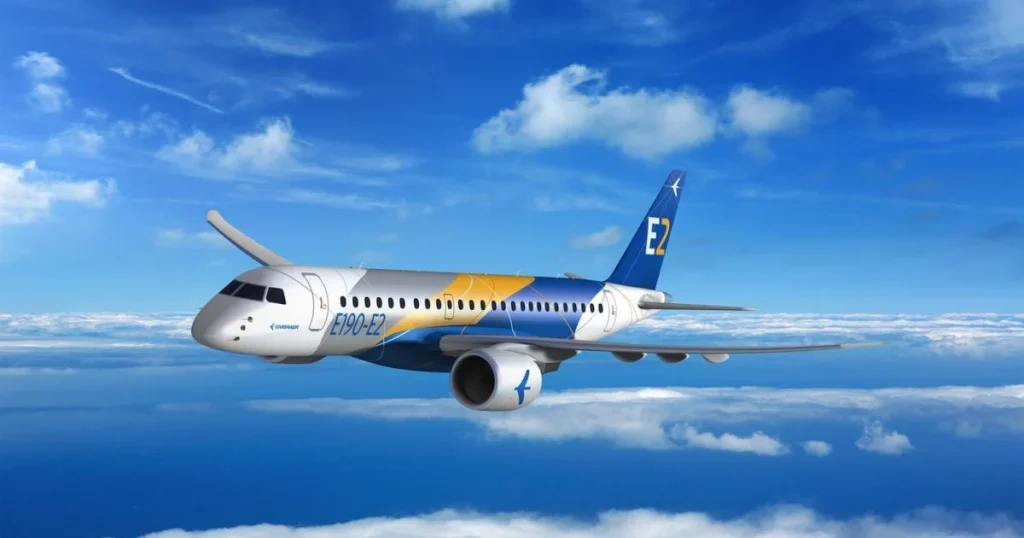
Embraer E190-E2
The Embraer E195-E2, the largest and most advanced aircraft in Embraer’s E-Jets E2 family, has been designed to cater to the unique demands of short- to medium-haul markets. Building on the success of the original E190, this next-generation aircraft offers enhanced performance, unmatched fuel efficiency, and an elevated passenger experience.
The Embraer E195-E2 has two seating configurations depending on the airline’s needs and the cabin layout. It can accommodate 97 to 114 passengers in a typical two-class layout or up to 120 to 146 passengers in an all-economy class configuration. This variability allows airlines to optimise the aircraft for regional or short-haul routes with different passenger demands. The aircraft fits perfectly between regional jets and larger narrow-body aircraft, creating a lucrative niche for airlines looking to optimise underutilised or developing routes.
The E190-E2 incorporates cutting-edge advancements, including Pratt & Whitney’s PW1900G geared turbofan engines and a redesigned wing with a higher aspect ratio. These features contribute to a 17.3% reduction in fuel consumption compared to its predecessor, positioning the aircraft as one of the most cost-efficient and eco-friendly options in its class. The aircraft also meets stringent environmental regulations, including ICAO Stage 4 and Chapter 14 noise standards, making it an attractive choice for airlines operating in noise-sensitive regions.
Beyond its operational efficiencies, the aircraft plays a pivotal role in Embraer’s commitment to sustainability. It boasts a lower carbon footprint, which aligns with the aviation industry’s long-term goal of achieving net-zero emissions. With its sleek design, impressive economics, and versatile range capabilities, the E190-E2 is a cornerstone of the future of regional aviation.
Cabin Experience
The aircraft’s cabin layout retains Embraer’s signature 2-2 seating configuration, which eliminates the dreaded middle seat, ensuring a more pleasant journey. The seats themselves are wider and ergonomically designed, offering improved legroom and overall comfort.
The cabin also incorporates advanced noise insulation technology, reducing ambient sound by up to 50% compared to earlier models. This enhancement creates a quieter and more relaxing atmosphere, catering to passenger preferences for a serene travel experience. Large windows flood the cabin with natural light, while modern LED lighting systems can be customised to create specific moods for different phases of flight, such as boarding, cruising, or landing.
Storage capacity is another highlight of the E190-E2. Overhead bins are spacious enough to accommodate carry-on bags for all passengers, addressing a common pain point for travellers. The aircraft also supports state-of-the-art in-flight entertainment (IFE) systems and connectivity solutions, including Wi-Fi, enabling passengers to browse, stream, or work seamlessly during their journey.
Technology and Avionics
The technological advancements in the E190-E2 are among the most notable in the regional aviation segment. Powered by Pratt & Whitney’s PW1900G geared turbofan engines, the aircraft achieves outstanding fuel efficiency and lower noise emissions. These engines also feature reduced maintenance requirements, contributing to lower operating costs for airlines.
The E190-E2 features a full fly-by-wire flight control system, which enhances operational safety and optimises fuel usage. By reducing the pilot’s workload and improving flight stability, this technology allows for smoother operations, even in challenging conditions.
The cockpit is equipped with advanced avionics, including large, full-colour high-resolution displays and integrated synthetic vision systems. These features provide pilots with enhanced situational awareness and contribute to safer, more efficient operations. Furthermore, the aircraft includes real-time health monitoring systems, enabling predictive maintenance and minimising operational disruptions.
Performance
With a maximum range of 2,850 nautical miles (5,278 km), the aircraft can connect distant cities and open up new market opportunities for airlines. Its ability to operate on challenging airports further extends its operational versatility, making it an ideal choice for regional markets, secondary airports, and underserved destinations.
The E190-E2 is designed to excel on thinner routes where larger aircraft would be uneconomical. It offers a competitive cost per seat mile, enabling airlines to maintain profitability even on low-demand routes. The aircraft also boasts superior take-off and landing performance, allowing it to access airports with shorter runways or strict noise restrictions.
The 17.3% reduction in fuel consumption compared to the original E190 translates into lower carbon emissions, aligning with global efforts to combat climate change. The aircraft’s compliance with ICAO’s strictest noise standards also reduces its environmental impact, making it an excellent option for regions with stringent noise regulations.
Airlines operating the E190-E2 benefit not only from reduced fuel costs but also from the positive public perception associated with eco-friendly aviation practices. The aircraft’s efficient design supports the aviation industry’s sustainability goals while ensuring long-term economic viability for operators.
Specifications
| Category | Details |
|---|---|
| Maximum Take-off Weight (MTOW) | 56,400 kg (124,123 lb) |
| Maximum Landing Weight (MLW) | 49,890 kg (109,987 lb) |
| Maximum Payload | 13,415 kg (29,574 lb) |
| Maximum Usable Fuel | 13,020 kg (28,700 lb) |
| Seating Capacity | 97–114 passengers |
| Maximum Range | 2,850 nm (5,278 km) |
| Maximum Cruise Speed | Mach 0.82 |
| Take-off Field Length | 1,800 m (5,906 ft) |
| Service Ceiling | 41,000 ft |
| Noise Levels | ICAO Chapter 14 / Stage 4 compliant |
| Wingspan | 33.7 m (110.6 ft) |
| Overall Length | 36.24 m (118.9 ft) |
| Height | 10.95 m (35.9 ft) |
Takeaways
The E190-E2 faces competition from aircraft such as the Airbus A220-100 and the Mitsubishi SpaceJet. However, its unique combination of fuel efficiency, operational flexibility, and passenger-centric design has allowed it to carve out a strong foothold in the market. Airlines like KLM Cityhopper and Helvetic Airways have embraced the E190-E2 for its ability to serve regional and crossover markets efficiently.
The aircraft’s adaptability also extends to diverse operating environments, from high-altitude airports in Latin America to noise-sensitive hubs in Europe. This versatility, combined with its lower operating costs, positions the E190-E2 as a preferred choice for airlines seeking to balance profitability with sustainability.
With its blend of advanced technology, exceptional performance, and a focus on passenger comfort, the E190-E2 continues to win the trust of airlines and passengers alike. Its ability to connect underserved markets, meet environmental standards, and reduce operating costs makes it a vital asset for the future of aviation.