








- India’s business jet market is accelerating, with a strong and growing preference for mid-size and large jets among HNWIs and corporate buyers.
- Backed by rising wealth and improving infrastructure, India is becoming Asia-Pacific’s fastest-growing business aviation market, with demand centered on larger, long-range aircraft.
India’s business aviation and aircraft charter market is booming with demand for business jets, general aviation and charter aviation firms exhibiting healthy growth. As per Mordor Intelligence’s Asia-Pacific Business Jet Market report, ‘Growth Trends and Forecasts Up to 2030,’ “India’s business jets sector is projected to grow at approximately 11 per cent annually from 2024 to 2029, making it the fastest-growing market in the region.”
According to various estimates, the private business jet fleet in India is said to account for approximately 150 aircraft and this could grow to approximately 200 aircraft by 20230. “The market is characterized by a strong preference for large jets, which account for half of the current operational business jet fleet. The emergence of new charter service providers and the expansion of existing operators have contributed to market dynamism,” the forecast stated.
According to an individual associated with India’s business aviation industry, the business aviation sector is expected to continue to grow in the coming years and will be aided by improvements in the operating infrastructure, with dedicated business aviation facilities and FBO services. According to a report from People Research on India’s Consumer Economy (PRICE), the number of ‘super rich’ households in India is forecast to rise by five times to 9.1 million households by 2030.
HNWIs are considered to be those individuals who have over USD 1 million in liquid financial assets, while UHNWIs are considered to be those with a net worth of at least USD 30 million. “From 2017 to 2022, there was a surge of around 90% in the HNWI population in the region. In 2022, the number of HNWIs in Asia-Pacific increased by 2% compared to 2020, as per Mordor Intelligence. A report from Asian Sky Group (ASG) found that only 6% of Indian respondents believed economic conditions would worsen in the third quarter of 2023.
These individuals are driving the demand in India for Large Jet, Light Jet and Mid-Size Jets. According to a Middle East-based provider of business aviation services, there is rising demand from prospective buyers in India, with midsize and large aircraft types the most popular. ASG data showed that in 2022, India’s business jet fleet grew by 7%. India’s well-heeled elite have traditionally preferred large and mid-size business jets. Popular models in the large business jet category include the Gulfstream’s G500/550/650/650ER series, Bombardier’s Global 6000/7500 Express, Challenger 604/605/650, and Dassault Aviation’s Falcon series.
Gulfstream
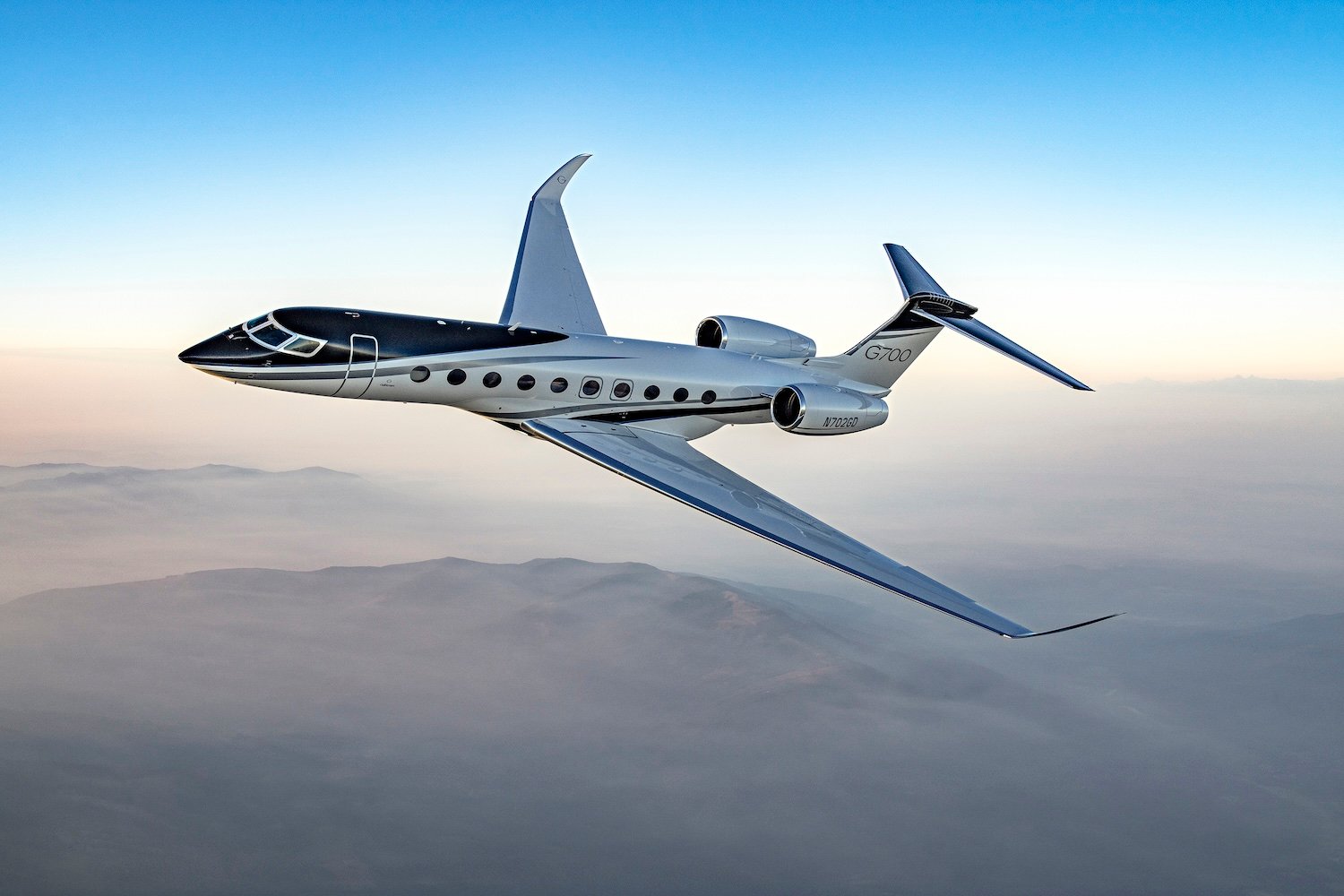
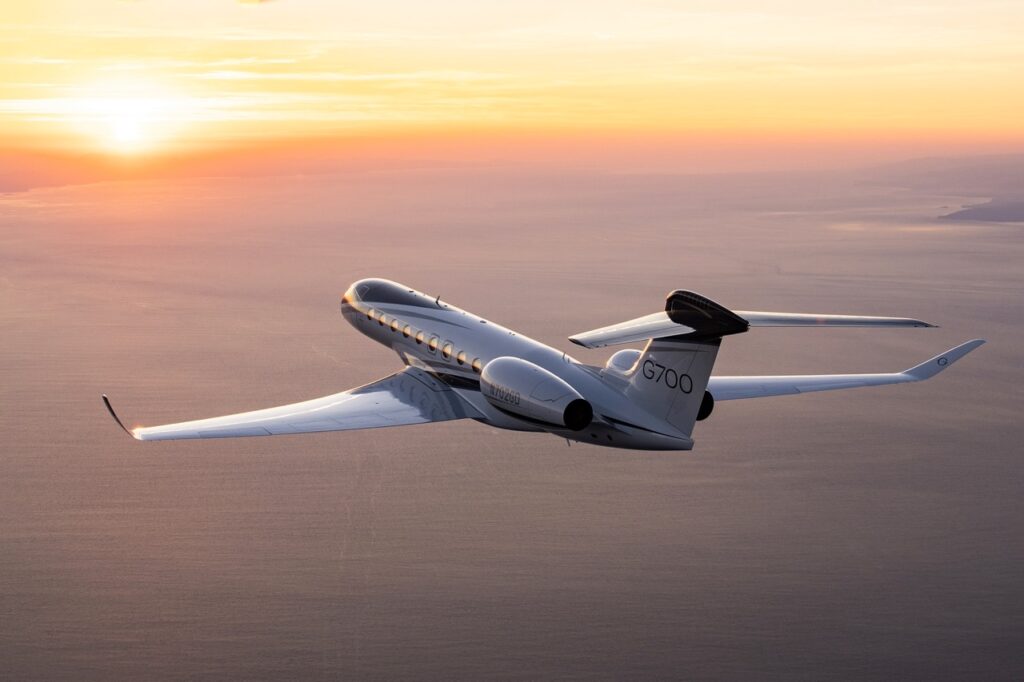
Gulfstream Aerospace Corp’s latest and most impressive business jet is the new Gulfstream G800, which is the longest-range Gulfstream aircraft ever designed. The G800 is capable of flying 14,816 km at Mach 0.85 and 12,964 km at Mach 0.90. The G800 is leveraging and building on the extensive flight test programme of Gulfstream’s newly certified Gulfstream G700. In December 2024, Gulfstream announced the maiden flight of the first G800 dedicated to testing the cabin interior. This first outfitted G800 took flight on reached an altitude of 46,000 feet/14,021 meters and a top speed of Mach 0.91 on its maiden flight. Flight testing of this aircraft will validate Gulfstream’s cabin design and performance of the industry’s longest-range aircraft, focusing on the complete passenger experience to ensure interior comfort and reliability. “The G800 flight test program is making great progress, reaffirming our confidence in the flexibility, durability and reliability this aircraft will provide,” said Mark Burns, president, Gulfstream. “With its vast range of innovative customization options, the ultralong-range G800 is a true testament to our industry-leading completions and interior and industrial design teams and their commitment to bespoke artistry.” There are two other prototype G800s currently in flight test.
The G800 introduces a new ultra galley with an abundance of counter, refrigeration, accessory and storage space; a beverage maker and cooking appliance array; and a dedicated crew compartment. It can be configured in up to four living areas and accommodate up to 19 passengers with sleeping for up to 10. The G800 also has 16 Gulfstream Panoramic Oval Windows, which are the largest in the industry.
Gulfstream announced the 300th customer delivery in the Gulfstream G500 and Gulfstream G600 fleet, in November, last year. “Delivering 300 aircraft is a clear indication of a strong interest in the G500 and G600 around the world,” said Mark Burns, president, Gulfstream. “Thanks to investments from our parent company, General Dynamics, these aircraft continue to achieve new milestones as customer demand remains steadfast. The advanced efficiencies established by this program have provided us with the flexibility to expand our production line, supporting the success of our next-generation fleet well into the future.”
In June 2024, Gulfstream announced that the G500 and G600 each had surpassed 100,000 flight hours, a reflection of strong customer demand. Both aircraft have also received U.S. Federal Aviation Administration (FAA) certification for steep-approach operations, allowing the G500/600 access to even more airports, including some that are the world’s most challenging. The G500 and G600 were designed by Gulfstream to increase manufacturing efficiencies by establishing commonalities throughout Gulfstream’s next-generation fleet. These advances also led to the incorporation of the same award-winning flight deck on the Gulfstream G700, Gulfstream G800 and Gulfstream G400.
Both the G500 and G600 can seat up to 19 passengers, however, the former can fly 9,816 k at Mach 0.85 (or 8,334 km at Mach 0.90); while the latter can fly 12,223 km at Mach 0.85 (or 10,371 km at Mach 0.90). Both aircraft feature a maximum operating speed of Mach 0.925.
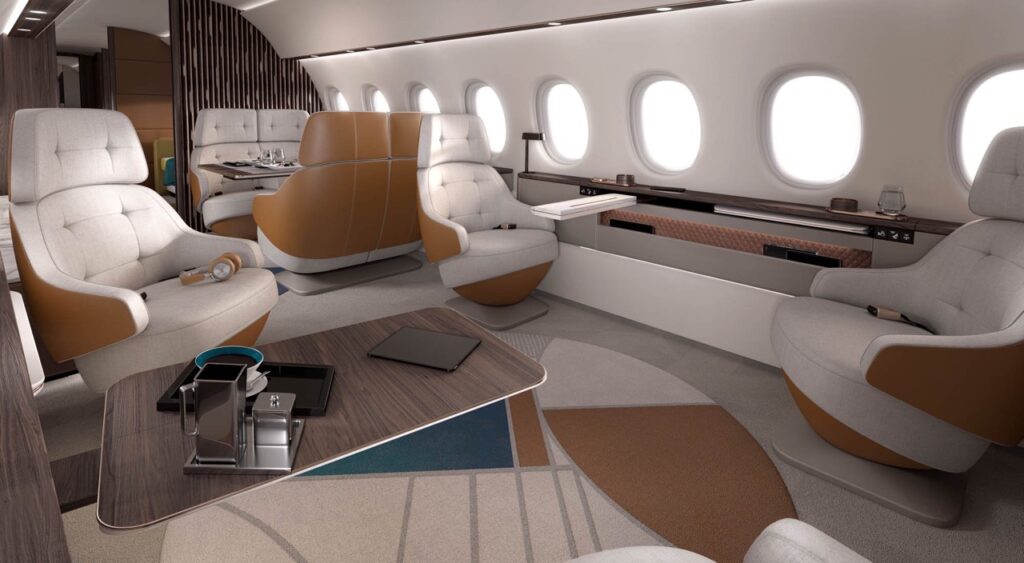
Dassault Falcon
Dassault Falcon business jets delivered 34 business jets globally in 2024 as compared to 26 in 2023, signalling healthy growth. The airframer had an order backlog for 79 aircraft as of the end of last year. There are over 2,100 Falcons flying today, a testament to their reliability and ruggedness. The latest business jet from the airframer is the ultra-long-range, ultra-widebody Falcon 10X which is slated for certification in 2027 and will be the largest purpose-built business jet in the industry
Final assembly of the Falcon 10X commenced in 2024 at Dassault’s final assembly facility in Bordeaux-Mérignac. The aircraft will be powered by Rolls Royce Pearl 10X engines, the latest, largest and most powerful version of the Pearl family, delivering over 18,000 pounds of thrust. The aircraft’s flight deck will provide several new safety features, including touchscreens, a single-lever Smart Throttle, and an automatic recovery mode.The 10X features an entirely new fuselage with 38 extra-large windows, that are nearly 50 percent larger than those on the Falcon 8X. The Falcon 10X will have a range of 13,890 km at a speed of Mach 0.85 and be able to attain a top speed of Mach 0.925. It will be able to fly nonstop from New York to Shanghai, Los Angeles to Sydney, Hong Kong to New York or Paris to Santiago.
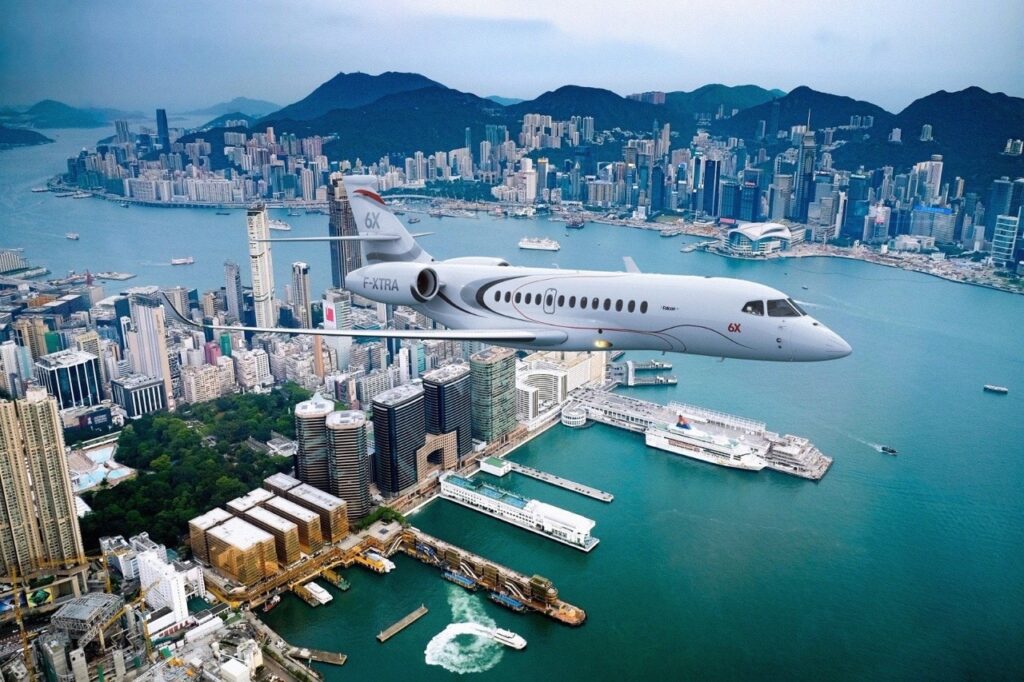
Dassault’s new Falcon 6X long-range twinjet was shown for the first time in the region, at the 2024 Singapore Airshow. The Falcon 6X features the largest cabin cross-section of any purpose-built business jet and entered service into service in 2023. “Operators who have flown the 6X as it has made its way around the globe, praise the unparalleled quietness, comfort and spaciousness of the cabin,” said Dassault Aviation Chairman and CEO Eric Trappier. ”The 6X also retains the peerless handling, versatility and short-field capability typical of all our Falcons.”
With extendable leading-edge slats and trailing-edge flaps on the wings, the 6X’s approach speed can be as low as 110 KIAS (204 km/h) with 8 passengers, 3 crew, SL, NBAA IFR reserves, even on non-standard steep approaches up to 6 degrees. The Falcon 6X which has a range of over 10,000 km can land at small or challenging airports like Saanen-Gstaad, Switzerland, whose runway is only 3,400 feet long. The aircraft features an advanced version of Dassault’s pioneering digital flight control system first introduced on the Falcon 7X and further refined on the Falcon 8X. The aircraft is powered by new-generation Pratt & Whitney PW812D engines. The 6X will also be the first Falcon equipped with the FalconScan advanced diagnostics system, which monitors and reports on 100,000 maintenance parameters.
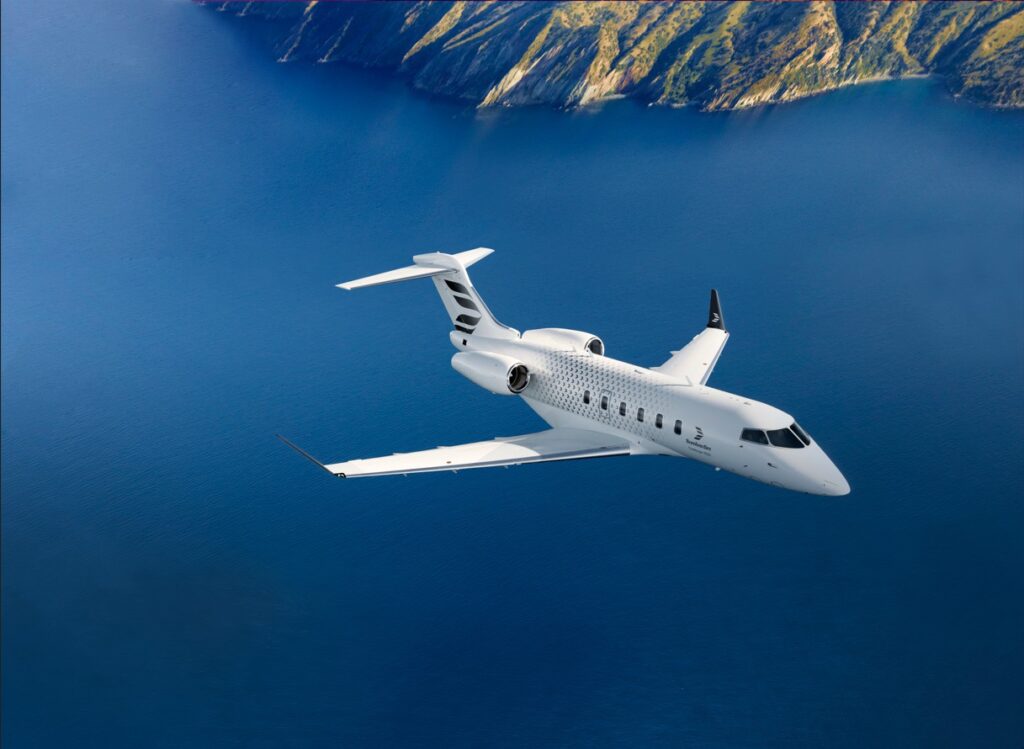
Bombardier
Canada’s Bombardier has exhibited double-digit year-on-year growth over the last four years and is expected to have delivered between 150 to 155 aircraft in 2024. The airframer has several ultra-long-range business jet offerings and its flagship Global 8000 is the fastest and longest-range purpose-built business aircraft in history. Unveiled in May 2022, It is the first business jet to go supersonic in testing and is the fastest civil aircraft since the Anglo-French Concorde. The Global 8000 has a top speed of Mach .94 and an ultra-high-speed cruise of Mach .92. The Global 8000 is on track to enter into service in the second half of 2025.
Bombardier is offering the performance enhancements on the Global 8000 as a retrofit for Global 7500 operators, once the former enters service in 2025. Bombardier announced last year, that it had delivered the 200th Global 7500 to a customer in December. “Simply put, the Global 7500 aircraft is assembled with the best manufacturing process and technological advancements in business aviation – and we are so excited and honoured to reach the 200-delivery mark of this transformative aircraft,” said David Murray, Executive Vice President, Manufacturing, IT and Bombardier Operational Excellence System.
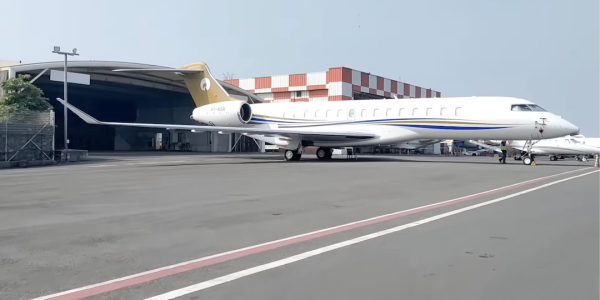
The Global 7500 entered service in December 2018 and has a top speed of Mach 0.925 and a range of 14,260 km. The business jet has made record-breaking flights, including flying from Tokyo to Hong Kong in just 3 hours and 40 minutes; New Delhi to Tokyo in just 7 hours; and Los Angeles to Auckland in 11 hours and 55 minutes.
Bombardier has also delivered over 100 Challenger 3500 aircraft, since the type entered service in 2022, becoming the fastest super-midsize business jet to reach 100 deliveries in history. “The entire Bombardier team is proud that our super midsized jets have been the category’s best-sellers for more than a decade. Our customers continue to benefit from the comfort of the widest-in-class cabin and the peace of mind provided by exceptional dispatch reliability of 99.8%. Passengers know that they can fly confidently on the Challenger 3500 aircraft, enjoying a spacious and refined cabin, while the aircraft consistently performs at the highest standards,” said, Jean-Christophe Gallagher, Executive Vice President, Aircraft Sales and Bombardier Defense.”
Growth Market
The growth of HNWIs in India is expected to continue in the years to come, driving demand for business jets. As Indian businesses and corporate houses grow in scale, the demand for business jets and charter aviation is only expected to grow. The growth of the airport infrastructure to cater for business jet operations will also stimulate growth. For the foreign business jet OEMs, India remains an attractive market with expected sales of 15-20 new business jets annually, till the end of the decade.