















Global Norms, Creditor Rights and Cheaper Leases: Inside India’s New Aviation Finance Law


India’s new Protection of Interests in Aircraft Objects Act, 2025 aligns domestic law with the Cape Town Convention, strengthening creditor rights, DGCA’s regulatory role, and enforcement of repossession. The reform is expected to cut financing costs, boost investor confidence in structures like JOLCOs and EETCs, support GIFT City’s growth, and open fresh opportunities for both established and regional airlines—though its success will hinge on effective implementation and clarity in overlapping laws, explains Ankita Kumar, Partner, Shardul Amarchand Mangaldas & Co. in conversation with Nidhi Sharma.
The new legislation domestically enforces the Cape Town Convention and Aircraft Protocol. In your view, how will this shape India’s alignment with global best practices in aviation financing and leasing in the near term?
The Protection of Interests in Aircraft Objects Act, 2025, gives effect to India’s ratification of the Cape Town Convention and its Aircraft Protocol and is therefore a significant step towards aligning Indian law with globally recognised standards for aircraft financing and leasing. The Act establishes a uniform legal framework for the creation, registration, and enforcement of international interests in aircraft objects, mirroring the mechanisms found in leading aviation jurisdictions.
Globally aircraft financing and leasing transactions are usually structured as asset backed financing, i.e., the aircraft asset itself becomes the security for the financing transaction, and the financiers will usually not rely on other assets and the balance sheet of the lessee or operator for security against such financing. Given this structure, it is essential to have certainty about the enforcement of such security in the event of a default in payments, and therefore swift and hassle-free repossession and export of the aircraft becomes imperative.
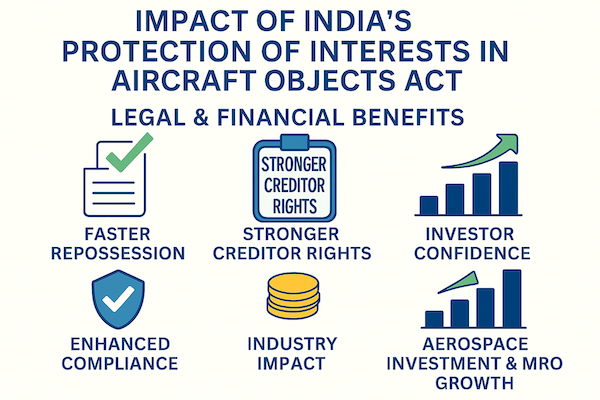
The Cape Town Convention and Aircraft Protocol provide creditors and lessors with clear, predictable remedies in the event of debtor default or insolvency, including expedited repossession, deregistration, and export of aircraft.
Prior to the enactment of the act, the absence of a dedicated statutory framework to align Indian laws with international norms (and specifically the Cape Town Convention) resulted in increased enforcement risk for stakeholders, specifically creditors and lessors, resulting in several regulatory roadblocks in the repossession and export of the aircraft asset in the event of default in payments or insolvency of the lessee.
This resulted in limiting the investor and lessor confidence in transacting with Indian operators. Therefore, the introduction of the Act, once fully implemented through appropriate rules and regulations, will directly facilitate increased access to international financing and leasing arrangements on commercially favourable terms.
How pivotal is the DGCA’s expanded role as the Registry Authority in strengthening the reliability of asset registration and the enforcement of international interests?
Even prior to the introduction of the Act, the Directorate General of Civil Aviation (DGCA) has always been entrusted, as the civil aviation authority of India, with the responsibility to perform several critical functions in respect of registration and deregistration of aircraft and processing requests in relation to Irrevocable Deregistration and Export Request Authorisations (IDERA) from lessors and creditors. Under the Act, the DGCA is further empowered to issue directions for the implementation of the provisions of the Convention and Protocol.
This regulatory discretion is particularly significant, given that the effective operationalisation of the Act may require the resolution of issues arising from the practical complexities of aircraft financing and leasing transactions. While the current framework comprising the Aircraft Rules, 1937, and certain directions and circulars by the DGCA did include mechanisms to give effect to deregistration and export related provisions of the Convention and Protocol, they were largely proved ineffective in protecting lessors’ interests during the recent CIRP process of Go Airlines.
It is expected that the updated rules will provide a more comprehensive framework, detailing the process for registration, deregistration, export, and changes in ownership or lessor, and specifically incorporate provisions to align IDERA based repossession and export with international standards and the Convention. Further, it is expected that the rules would provide greater powers to the DGCA in giving effect to the provisions of the Act.
Given that one of the key goals is to bring down financing costs—currently inflated by 8–10 per cent due to legal ambiguities—based on your experience, how soon might we realistically see a reduction in aircraft leasing rates?
Lessors of aircraft will usually build in a “risk premium” over lease rentals to account for legal and enforcement risk in jurisdictions which are perceived as riskier in terms of repossession of the aircraft asset. Proper implementation of the Convention and Protocol by a jurisdiction specifically seeks to reduce such risk for aircraft leasing transactions therein.
Export credit agencies (such as the US Ex-Im Bank) and the OECD Aircraft Sector Understanding (ASU) provide for a “Cape Town discount”—a reduction of up to 10% in export credit insurance premiums or interest rates—when a jurisdiction has properly implemented the Convention and made certain creditor-friendly declarations. In case of the aircraft leasing market, the Aviation Working Group (AWG) and export credit agencies use compliance indices to assess a country’s adherence to the Convention; higher compliance scores are associated with lower risk and better financing terms.

The “Cape Town List” maintained by the OECD identifies jurisdictions eligible for the discount, incentivising proper implementation. Airlines in states that have adopted and properly implemented the Cape Town Convention and Protocol have demonstrably benefited from lower lease and finance costs.
Given the above, I do expect that the aircraft leasing industry in India will eventually benefit directly from the implementation of the Convention and Protocol. However, while some immediate improvement may be seen as investor confidence builds, an eventual reduction in leasing rates will depend on the practical application and implementation of the Act. A sustained period of smooth operation and positive case precedents may be required before the full benefits are reflected in pricing.
It should be noted that aircraft leasing rates are also influenced by a complex interplay of market, financial, technical, and operational factors. Lessee creditworthiness is also seen as a significant factor, and therefore the cost may vary significantly from airline to airline.
As investor interest in Indian carriers grows, to what extent do you think the Bill will enhance confidence among JOLCO financiers, EETC structures, and aircraft lessors, particularly through mechanisms enabled by GIFT City?
The ability to enforce rights swiftly, including repossession and deregistration, will certainly make Indian carriers more attractive to all kinds of global investors and lessors, potentially also opening up the Indian aviation industry/market to more complex structures, including capital market/retail investment options such as EETCs.
However, while the Act, once implemented, is likely to benefit all of India, including aircraft leasing transactions through GIFT City, the legal and regulatory framework of GIFT City for aircraft leasing and financing is currently in a developing stage, and we expect the regulatory regime to develop with time to support complex financing structures, similar to those adopted globally.
By allowing creditors to repossess aircraft within two months of default, how effectively does the Bill tackle the enforcement hurdles witnessed in high-profile cases like GoFirst?
The act adopts “Alternative A” of the protocol, which requires that in insolvency proceedings, the debtor (being the lessor) must provide possession of the aircraft object to the creditor within a maximum of two months, unless the default is cured. In effect, Alternative A provides a cure period of 2 months to the lessor to cure the default or return the aircraft before the creditor (being the lessor) enforces the remedies available to it, such as repossession through IDERA.
It is to be noted that prior to the implementation of the Act, the Ministry of Corporate Affairs issued a notification which excluded transactions, arrangements and agreements under the treaty from the scope of Section 14 of the Insolvency and Bankruptcy Code, 2016 (which provides for a temporary halt on certain actions against a corporate debtor during the pendency of moratorium) upon commencement of the corporate insolvency resolution process.
Therefore, the moratorium provisions of the IBC no longer apply to the aircraft leasing/financing transactions. The Act’s provision for a statutory time frame and the override of moratorium provisions under the IBC ensure that lessors’ rights are not frustrated by local insolvency processes and that the 2-month cure period under the Act provided to the lessor will operate outside the provisions of and not be affected by any IBC proceedings on the debtor.
Globally the experience with the implementation of Alternative A for airlines undergoing insolvency has resulted in more positive outcomes for both the debtor and the creditor. The existence of a clear, enforceable timetable for the return or retention of aircraft has facilitated orderly negotiations between airlines and their creditors during insolvency.
There is little incentive for creditors to take precipitous enforcement action before a bankruptcy filing, as the process is well-defined and reliable. For example, in the United States, contrary to concerns that such creditor-friendly provisions might hinder airline reorganisations, several airlines—including Continental, Delta, Northwest, US Airways, and United—have all successfully restructured under Chapter 11 while operating within the Alternative A framework.
The regime has not been an impediment to restructuring; rather, it has provided a stable platform for negotiations and fleet rationalisation. We hope that the Indian experience in the future, for cases like GoFirst, will be similar.
Since the Bill overrides conflicting domestic laws such as the IBC and designates High Courts as the jurisdictional authority, do you anticipate any legal friction or areas where further clarification might be required during its implementation?
While the Act expressly provides in its non-obstante clause that its provisions will prevail over conflicting laws, including the IBC, the very next clause provides that the provisions of the Act shall be in addition to, and not in derogation of, any other law for the time being in force. Usually, an Act will have either a non-obstante clause or a savings clause, and therefore, the intention of the legislature in this particular case appears to be unclear, and some friction may arise during interpretation.
Regardless of the non-obstante clause, we hope proactive measures will be taken to amend all existing enactments which currently conflict with the provisions of the Act, including the IBC, Companies Act and Customs laws and to swiftly promulgate new rules to implement the provisions of the Act, which will be key to minimising legal friction or interpretation issues in giving effect to the Convention in India.
Given that the Bill allows for detention by government authorities, how can operators and financiers effectively navigate these overlapping rights and mitigate associated risks?
Pursuant to the Act, the Act (or the Convention/Protocol) shall not affect the rights of the central government or any entity thereof, or any provider of public services in India, or any intergovernmental organisation, to arrest or detain an aircraft for payment of dues. Accordingly, a lessor’s rights to repossess aircraft may compete with a government entity’s rights to detain them for unpaid dues.
This particular provision itself may be subject to interpretation so as to ascertain which entities are covered in its ambit, and while this forms part of India’s declaration under the Convention and Protocol, we have witnessed cases where this provision acted as an impediment to the export of aircraft to lessors, as several entities claimed to be covered herein and refused to provide a non-objection to the DGCA for the export of aircraft due to unpaid dues related to specific aircraft.

While contractual provisions in the lease agreements for regular reporting may help mitigate the risk of detention, this is hardly likely to be of much help in a situation where an airline is undergoing insolvency proceedings.
We hope that the applicability of this provision will be adequately clarified in the forthcoming rules and a proper process will be introduced so that lessors do not have to be responsible for paying airlines’ operating expenses.
If not adequately addressed in rules, should this situation arise again, the lessors may have no option but to take the issue to courts in India.
What additional policy or tax reforms—such as clarity around SPVs or lifecycle obligations akin to EPR—do you see as crucial to fully support this Bill and position India as a leading aviation financing hub?
The enactment of the Act is essential to boost the confidence of aircraft financiers towards Indian aircraft operators, but it is only a starting point if the end goal is to transform India into an aviation financing hub. India competes with jurisdictions such as Ireland, which has extremely favourable tax regimes as well as a mature ecosystem specifically catering to the aircraft financing and leasing industry.
What works in India’s favour is the fact that currently it is the fastest growing aviation market with large order books for aircraft, and therefore the market for developing more sophisticated aviation financing products is already in place. IFSCA has made great progress in putting in place tax and regulatory frameworks to tap into GIFT City’s growing aviation finance market and is proactively looking to make further reforms to permit more complex aviation financing structures from IFSC.
However, it has in front of it the mammoth task of bringing all stakeholders, which include the regulators such as RBI and SEBI, as well as industry, which includes the airlines and financiers, on board and facilitating some big changes to laws in IFSC to allow for such complex structures or even to replicate the SPV, orphan trust and other financing structures that are frequently utilised globally in aircraft centric transactions. While this may take time, we are confident that India will make big strides in competing with global aviation financing hubs in due course.
In what ways do you see this legal reform opening up new opportunities for emerging airlines and regional carriers in India?
The implementation of this Act is likely to lower barriers to entry for emerging airlines and regional operators by making aircraft leasing more accessible and affordable. With reduced legal risks and improved access to international capital, new entrants can secure aircraft on more favourable terms, supporting fleet modernisation and expansion. The legal certainty provided by the Act is likely to encourage lessors to engage with smaller and regional operators, who were previously perceived as higher risk.
Based on your experience advising global banks and training aviation professionals, what key practical challenges and opportunities do you foresee in the implementation phase of this Act?
The enactment of the Act is only the first measure put in place to give effect to the Convention. Proper implementation of the Act through rules and regulations, smooth administration of such rules by the authorities during implementation and ensuring that all conflicting laws are also amended to remove inconsistencies will be key for rollout.