









- Hydrogen fuel offers a transformative path toward sustainable aviation, driven by its zero-emission potential.
- Leading aerospace companies like Airbus and Embraer are advancing the technology, though widespread deployment is still projected to be at least a decade away.
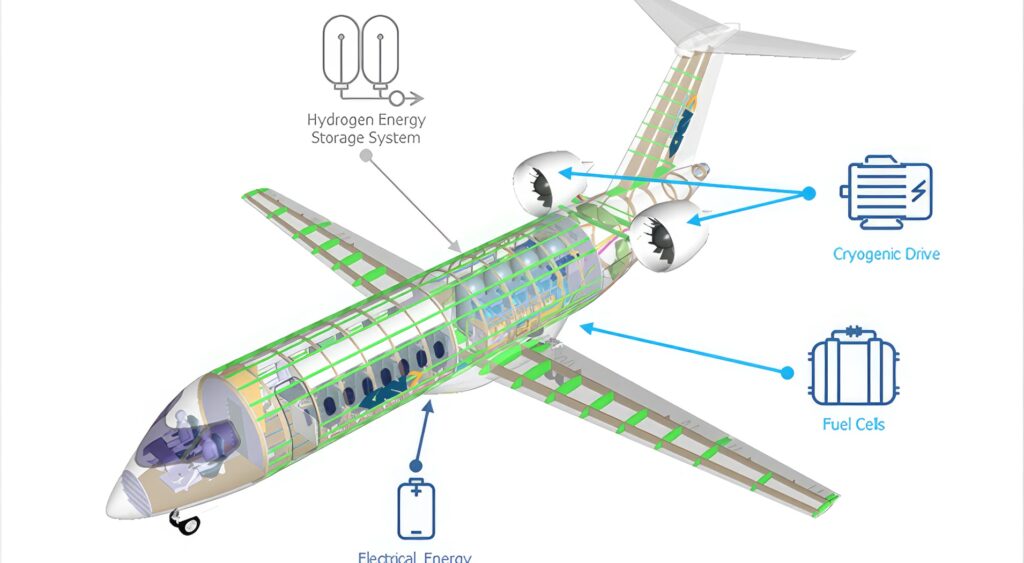
The use of Hydrogen sources of fuel and attendant propulsion technologies in aviation is now acknowledged as one of the most innovative and disruptive methods of meeting the aviation industry’s future sustainability goals. Fossil-based liquid fuel has been the primary energy source powering flight since the dawn of aviation. This is likely to remain the case for another decade for aircraft that can seat more than 20 passengers and cargo. However, with the aviation industry now heavily focussed on transitioning to renewable energy sources to reduce life cycle CO2 emissions, work on the development of hydrogen-powered aircraft of the future and its ecosystem is gathering pace. Hydrogen as on-board fuel or energy will allow for the complete elimination of CO2 emissions in flight and along the entire energy life-cycle if produced from renewable sources.
At the present moment, however, the aviation sector has no in-service experience with such aircraft as they have not yet been developed. Interestingly, over 96% of hydrogen produced today comes from fossil fuels—mostly natural gas. Hydrogen Combustion Aircraft powered by turbine engines using liquid hydrogen fuel have been proven feasible for regional, short-haul and long-haul aircraft. However, the integration of hydrogen as a fuel will be an extremely complex problem to solve, and hence, aircraft powered by hydrogen will have a very different design from aircraft as we know then today.
In December, last year, the European Union Aviation Safety Agency (EASA) hosted the first International workshop on the challenges and future processes for certifying aircraft powered by hydrogen, with the aim of developing a certification approach that has the support of the entire community. The use of hydrogen will also involve significant change to aircraft designs and hence a new certification approach is needed to ensure that these aircraft will meet the very high safety standards demanded from civilian aircraft. “The move to sustainable aviation is a global project necessitating a harmonised approach,” said EASA Certification Director Rachel Daeschler. “We all need to work together to ensure that the hydrogen-powered aircraft of the future, and its ecosystem, is safe as well as sustainable. To achieve that, we must make sure that knowledge is shared so that we fully understand all aspects.”
“I strongly believe that the use of hydrogen – both in synthetic fuels and as a primary power source for commercial aircraft – has the potential to significantly reduce aviation’s climate impact,” said Airbus CEO, Guillaume Faury.
International authorities, such as the Federal Aviation Administration (FAA), the Civil Aviation Authority of the United Kingdom (UK CAA), and the Japan Civil Aviation Bureau (JCAB), took part in the workshop along with industry experts. The participants at the workshop agreed that greater attention needed to be paid to the application of technologies in aviation and to the exploration of technology bricks, such as hydrogen storage, and to airworthiness considerations, like prevention of fire and explosions and other similar aspects.
Feasibility Challenge
Liquid hydrogen has a larger fuel volume and very cold temperatures; it requires over four times the volume for the same given energy as that of jet fuel used today and must be cooled to -253°C. There is also the difficult technical challenge that even at slightly higher temperatures, hydrogen will start to boil and undergo an explosive expansion, with a greater than thirty-fold increase in volume. These powerful pressure surges and strong vibrations that strain the piping will make the development of hydrogen fuel systems and lines a challenging endeavour. Hydrogen, however, has a specific energy-per-unit mass that is three times higher than traditional jet fuel and is generated from renewable energy through electrolysis; hydrogen emits no CO2 emissions. It can be used to create e-fuels, which are generated exclusively through renewable energy. “The transition to hydrogen will require decisive action from the entire aviation ecosystem, together with the support from government and industrial partners to rise up to the challenge to scale-up renewable energy and hydrogen for the sustainable future of the aviation industry,” an aviation industry observer shared with us.
Airbus Surging Ahead
The European airframer, Airbus is clear that hydrogen is one of the most promising decarbonisation technologies for aviation. The company has said that it considers its use as an important technology pathway to achieve its ambition to bring to market the world’s first hydrogen-powered commercial aircraft by 2035. As per Airbus estimates, hydrogen has the potential to reduce aviation’s CO2 emissions by up to 50%. “I strongly believe that the use of hydrogen – both in synthetic fuels and as a primary power source for commercial aircraft – has the potential to significantly reduce aviation’s climate impact,” said Airbus CEO, Guillaume Faury.
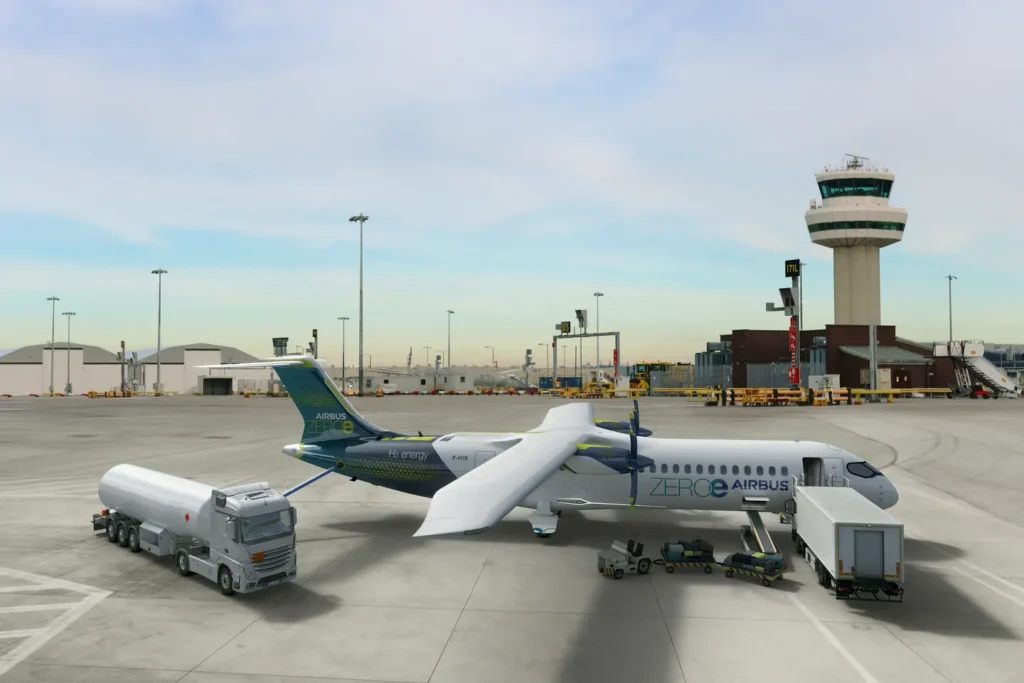
It was in September 2020 that Airbus revealed its concepts for the world’s first zero-emission commercial aircraft, which could potentially enter service by 2035. Three of the Airbus concepts (codenamed “ZEROe”) rely on hydrogen as a primary power source, while the fourth concept was fully electric, using hydrogen fuel cells and a propeller propulsion system. Airbus is working on a turbofan design, turboprop design and “blended-wing body” design. The latter is the most futuristic concept in which the wings merge with the main body of the aircraft. The range quoted for this design is 2,000+ nautical miles. The exceptionally wide fuselage not only creates space for up to 200 passengers but also provides for multiple options for hydrogen storage and distribution, and for cabin layout. Airbus’ turbofan design concept is targeted at transcontinental routes carrying between 120-200 passengers and will be powered by a modified gas-turbine engine running on hydrogen, instead of jet fuel. The liquid hydrogen will be stored and distributed via tanks located behind the rear pressure bulkhead. The turboprop design would be capable of travelling more than 1,000 nautical miles with up to 100 passengers. This will make it well suited for short-haul trips.
.“It was a huge moment for us because the architecture and design principles of the system are the same as those that we will see in the final design,” says Mathias Andriamisaina, Head of Testing and Demonstration on the ZEROe project.
Airbus has been making swift progress with its ZEROe concepts, and in late 2023, the ZEROe teams powered on for the first time, the future hydrogen-propulsion system designed for Airbus’ electric concept aircraft. “It was a huge moment for us because the architecture and design principles of the system are the same as those that we will see in the final design,” says Mathias Andriamisaina, Head of Testing and Demonstration on the ZEROe project. “The complete power channel was run at 1.2 megawatts, the power we aim to test on our A380 demonstrator.” The iron pod contains the hydrogen fuel cell systems and, the electric motors needed to spin a propeller, and the units that control and keep them cool.
While hydrogen fuel cells have huge potential to decarbonise aviation, when Airbus started the ZEROe programme, there was a challenge. None of the hydrogen fuel cells that then existed on the market provided the energy required to power an aircraft and stay acceptable from a weight standpoint. As a result, in October 2020, Airbus created Aerostack, a joint venture to develop hydrogen fuel cell stacks that would be at the heart of the electric propulsion system on a ZEROe aircraft.
Testing of this first version of the iron pod has continued throughout 2024 and the next step for Airbus after completion of testing is to optimise the size, mass and qualifications of the propulsion system to meet flight specifications. This is then planned to be installed on the ZEROe multimodal flight test platform, for which the aircraft to be used is Airbus’ first production A380. The maiden flight for the new fuel cell propulsion system on the A380 is currently scheduled for 2026.
The Airbus ZEROe team is also actively engaged with over 10 airlines for the joint study on the deployment of future hydrogen-powered aircraft. Airbus has also founded the Hydrogen Hubs at Airports network, to investigate the feasibility of hydrogen-powered aviation in terms of developing an ecosystem of decarbonised facilities, ground operations and transportation at airports around the globe. The Airbus’ hydrogen network currently includes approximately 215 airports and several energy providers and airlines as partners.
Embraer Targets Hydrogen High
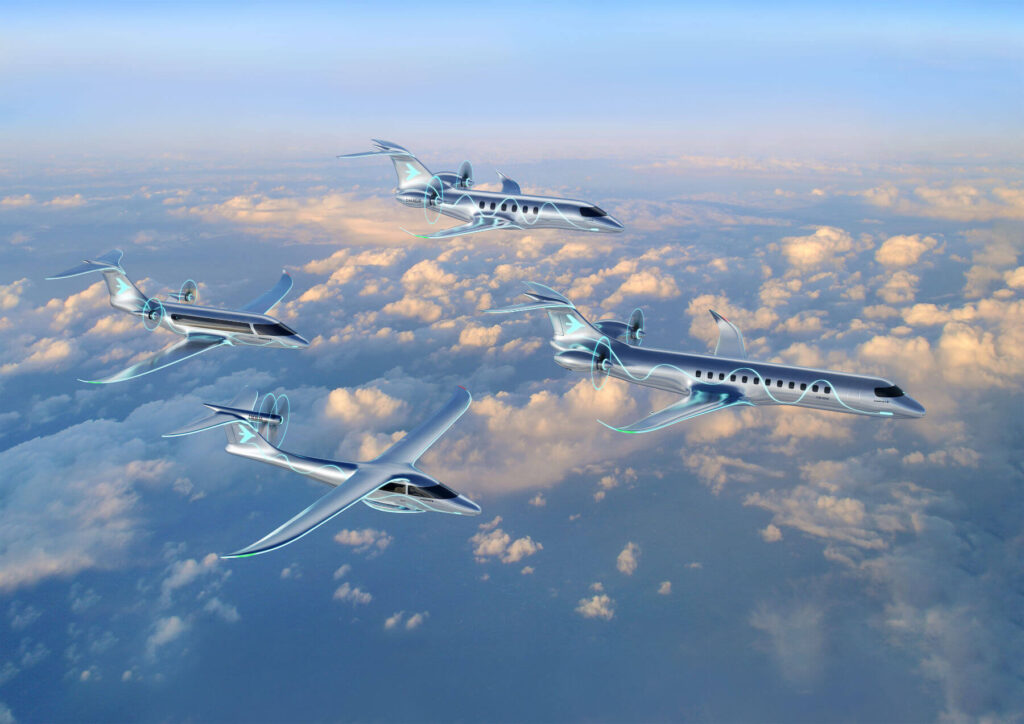
It was in November 2021 that Embraer unveiled its four aircraft, the Energia, a concept aircraft family that would make use of renewable energy propulsion technologies. The concept aircraft are a sign of Embraer’s growing ambition to grow into a full-size commercial aircraft manufacturer. “We will see a big transformation in our industry towards a more sustainable aviation. With 50 years’ experience in developing, certifying and supporting regional aircraft, Embraer is in a unique position to make viable the introduction of new disruptive green technologies,” said Arjan Meijer, President and CEO of Embraer Commercial Aviation. Embraer had announced at the 2023 at the Farnborough Airshow, that it had has expanded its Energia research to include 50 seater aircraft, an increase from the previous focus on 30 seats. The Brazilian airframer has also expanded its research to include Hydrogen Gas Turbine/Dual Fuel (GT/DF) approaches for its concept aircraft.
“We will see a big transformation in our industry towards a more sustainable aviation. With 50 years’ experience in developing, certifying and supporting regional aircraft, Embraer is in a unique position to make viable the introduction of new disruptive green technologies,” said Arjan Meijer, President and CEO of Embraer Commercial Aviation.
The Energia H2 Gas Turbine (E50-H2GT) is a concept future commercial jetliner that will feature hydrogen (or SAF / Jet A) turbine propulsion and is planned to achieve technology readiness by 2040. The aircraft will deliver a CO2 emissions reduction of up to 100%, seat 35 to 50 passengers and have rear-mounted engines. Embraer’s Energia H2 Fuel Cell (E19-H2FC) is a 19-seat aircraft with hydrogen electric propulsion and makes use of rear-mounted electric engines. This concept is slated to have usable commercial technology by 2035. The Energia Electric (E9-FE) will feature full electric propulsion, delivering zero CO2 emissions. This nine-seat aircraft concept features aft contra-rotating propellers. Technology readiness is slated for 2035. The nine-seater Energia Hybrid (E9-HE) will also feature rear-mounted hybrid-electric propulsion engines, delivering a 90% reduction in CO2 emissions. Technology readiness is planned for 2030. ‘We’re working right now to refine the first airplane concepts, the ones that can start reducing emissions sooner rather than later. Small aircraft are ideal on which to test and prove new propulsion technologies so that they can be scaled up to larger aircraft. That’s why our Energia family is such an important platform,’ said Luis Carlos Affonso, Embraer’s Sr. VP of Engineering, Technology and Corporate Strategy.
In June 2023, Embraer announced that it would collaborate with UK based GKN Aerospace on a potential hydrogen flight demonstrator. GKN Aerospace is developing a highly efficient liquid hydrogen propulsion system specifically designed for sub-regional aircraft under its flagship hydrogen exploration programme, H2Gear. It also has the potential for scalability in larger aircraft, as this system converts liquid hydrogen into electricity within a state-of-the-art fuel cell system. Embraer’s first hydrogen fuel cell demonstrator is planned for 2025, and the company’s eVTOL, a fully electric, zero-emissions vertical take-off and landing vehicle, is being developed to enter service in 2026.
Boeing Takes a Pause
Boeing, on the other hand, appears to have slowed down its research into Hydrogen propulsion, following early successes in the arena. Boeing is alone amongst the major airframers to have not launched a hydrogen powered commercial aircraft concept. Boeing’s Fuel Cell Demonstrator, a two-seat Dimona, was the first piloted airplane in history to use power generated solely by hydrogen fuel cells when it took to the air in 2008. The aircraft made three test flights in Spain. The Boeing demonstrator’s fuel cell/lithium-ion battery hybrid system is powered by an electric motor coupled to a conventional propeller. The fuel cell provided power for the entire cruise phase of the flight. The system drew from its lightweight lithium-ion batteries during take-off and climb, the flight segments that require the greatest amount of power. A fuel cell is an electrochemical device that converts hydrogen directly into electricity and heat without combustion and hence is emission-free and quieter than hydrocarbon fuel-powered engines. However, fuel cells are not envisioned as being capable of providing primary power for future commercial passenger airplanes, this technology, however, has greater utility in small manned and Unmanned Aerial Vehicles (UAV). In 2020, Insitu, a Boeing company, announced the completion of the maiden flight of its ScanEagle3 UAV powered by an all-electric, hydrogen-fuelled, Proton Exchange Membrane (PEM) fuel cell.
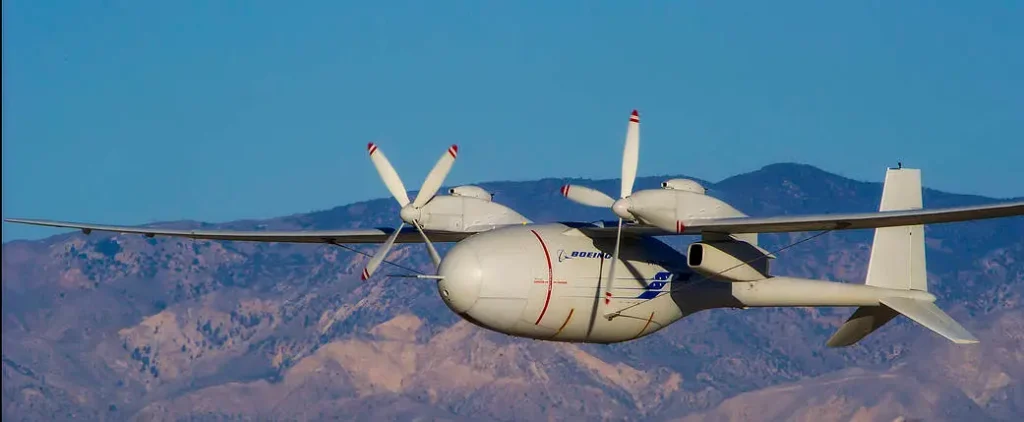
Four years later in 2012, Boeing’s eco Demonstrator program tested similar regenerative fuel cell technologies for onboard auxiliary power applications on a Next-Generation 737-800. It was also in the same year, that Boeing’s Phantom Eye high-altitude and long-endurance uncrewed aircraft flew several flights in California powered by liquid hydrogen. The Phantom Eye demonstrator is capable of carrying a 450-pound payload while operating for up to four days at altitudes of up to 65,000 feet. A second project in Spain in 2015 completed over 100 hydrogen flights on an uncrewed flight demonstrator. In an important milestone for the use of Hydrogen in aviation in 2021, Boeing announced that it had designed and manufactured a new type of composite cryogenic fuel tank, which was ready and safe for use in aerospace vehicles.

In April 2024, the airframer opened a Boeing Research & Technology (BR&T) Center in Japan that will focus on innovation to enable the commercial aviation industry to meet its goal of net zero carbon emissions by 2050. Boeing Research & Technology (BR&T) is the advanced central research and development organisation of The Boeing Company and provides innovative technologies that enable the development of future aerospace solutions while improving the cycle time, cost, quality and performance of existing Boeing products and services. “Japan is renowned for its strength in engineering and technology, and its dedication to reducing aviation’s impact on our planet aligns with our own,” said Boeing Chief Technology Officer Todd Citron. “We look forward to originating research in Nagoya that will benefit Japan and the world.”
‘We’re working right now to refine the first airplane concepts, the ones that can start reducing emissions sooner rather than later. Small aircraft are ideal on which to test and prove new propulsion technologies so that they can be scaled up to larger aircraft. That’s why our Energia family is such an important platform,’ said Luis Carlos Affonso, Embraer’s Sr. VP of Engineering, Technology and Corporate Strategy.
The focus areas at the BR&T Centre in Nagoya will include: Model-based engineering and manufacturing technology integration: Incorporating the latest digital simulation toolset into every aspect of design and production; Composites: Producing lightweight composites at a higher rate with less environmental impact and finding novel ways to recycle composite material; Sustainable aviation fuel (SAF): Further advancing Boeing’s global commitment to ensure its commercial airplanes will be compatible with 100% SAF by 2030, and supporting Japan in establishing a thriving local SAF ecosystem and a new Hydrogen technology integration project, which will explore the feasibility of integrating hydrogen fuel-cell systems into an airplane.