












- Developed in the UAE, Hili is a hybrid VTOL cargo aircraft designed specifically to move palletised freight between logistics hubs without relying on runways.
- The aircraft combines electric vertical lift with combustion-powered cruise, enabling regional range, faster turnarounds, and operations from space-constrained sites.
- Early interest from cargo operators reflects a focus on reliability, cost efficiency, and practical deployment rather than experimental or consumer-facing air mobility concepts.

Photo: Emirates SkyCargo
Hili is a location in Al Ain, within the Emirate of Abu Dhabi. Historically, it was a trading hub dating back three to four thousand years. Trade and commerce passed through this region long before modern logistics existed. Naming the aircraft Hili reflects an intention to reconnect modern transportation with the region’s historical role in trade.
That framing, as shared by the spokesperson during a recent interaction, is more than a historical reference. It sets the tone for what LODD AUTONOMOUS is attempting to do with its Hili programme, rethink how cargo moves between hubs, not at the consumer-facing end of logistics, but in the often-overlooked middle mile.
Where regional trade routes once connected ports and markets, Hili is being positioned as a modern aerial link between logistics hubs, autonomous, infrastructure-light, and designed to operate where traditional cargo systems slow down.
Unlike much of the attention-grabbing discourse around passenger eVTOLs and urban air taxis, Hili is deliberately practical. It is a cargo aircraft first and foremost, designed to solve a specific operational problem rather than showcase futuristic mobility. The problem, as articulated during the interaction, lies in the inefficiencies of middle-mile logistics, where cargo frequently sits idle, waiting to transition between trucks, aircraft, warehouses, and regional distribution points.
Photo: Gulf News
The middle mile is neither visible nor simple. It is a complex mesh of short-haul movements, regional transfers, and time-sensitive operations that rarely benefit from the scale efficiencies of long-haul freight or the automation advances seen in last-mile delivery.
Hili is designed to operate squarely in this space, carrying meaningful payloads over regional distances while bypassing many of the infrastructure constraints that define conventional cargo aviation.
Designed Around Cargo, Not the Other Way Around
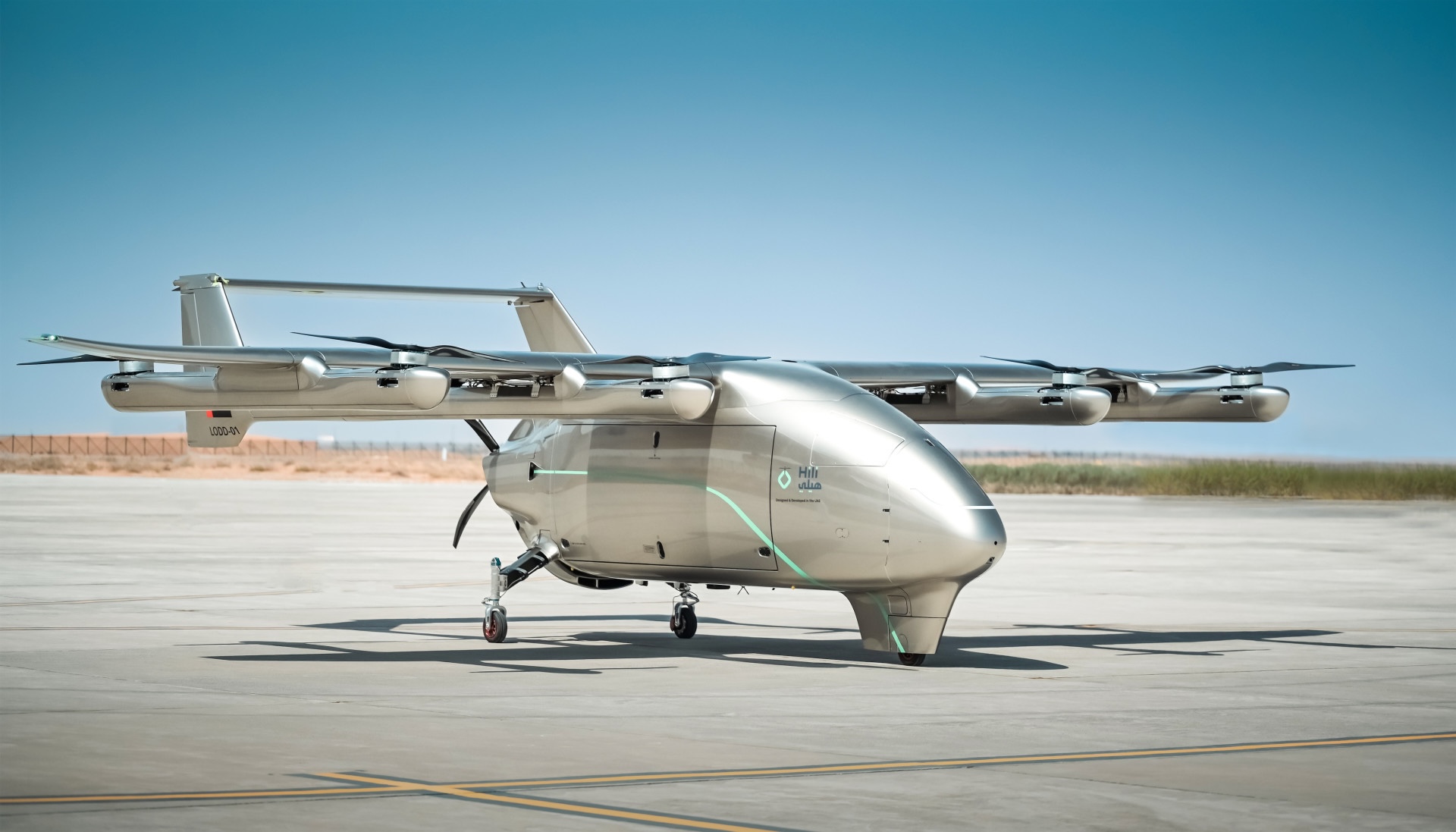
One of the most telling design choices behind Hili is that the cargo bay came first. The airframe, propulsion architecture, and operational concept were built around it, not the other way around. This is evident in the aircraft’s configuration: a cargo volume of 2.7 cubic metres, capable of accommodating two Euro-standard pallets, with a payload capacity of up to 250 kilograms.
That figure — 250 kilograms, may appear modest at first glance, especially when set against a maximum take-off weight in the 1.3–1.4 tonne class. But weight alone is a misleading metric in middle-mile cargo operations. Much of the cargo that moves regionally, particularly e-commerce shipments, parcels, and time-critical goods, is volume-constrained rather than weight-constrained. An aircraft that can be filled by volume before reaching its weight limit can still operate at high utilisation.

Equally important is how that cargo is handled. Hili’s twin-side door configuration allows loading and unloading using standard forklifts from either side, eliminating the need for specialised loadmasters or complex centre-of-gravity adjustments. This seemingly mundane detail has operational significance: it shortens ground time, lowers manpower requirements, and reduces dependency on skilled personnel, an often-overlooked bottleneck in regional logistics.
The propulsion architecture reflects a similarly pragmatic mindset. Hili uses a hybrid-electric configuration, with eight electric motors dedicated to vertical lift and a rear-mounted internal combustion engine providing forward thrust during cruise.
The logic is straightforward. Vertical lift is power-intensive but brief; cruise is sustained but comparatively efficient. Using electric propulsion for lift conserves fuel, while relying on a combustion engine for cruise delivers the range that current battery technology alone cannot yet support in this payload class.

This hybrid approach also enables in-flight battery recharging. During the cruise, the combustion engine recharges the batteries powering the vertical lift motors, allowing the aircraft to land, refuel, and depart again without waiting for ground-based charging. In operational terms, this significantly reduces turnaround times, an advantage that matters far more in cargo logistics than marginal efficiency gains on paper.
From an infrastructure perspective, Hili is intentionally designed to operate with minimal ground requirements. The aircraft requires an operating footprint of roughly 18 by 18 metres and does not depend on runways for normal operations. While conventional take-off and landing remains a contingency option, the aircraft is optimised for vertical operations, allowing it to function from logistics yards, remote facilities, or constrained sites that would otherwise be inaccessible to fixed-wing cargo aircraft.
Autonomy is treated with similar restraint. Hili follows a pilot-in-the-loop model, operated remotely from a ground control station. A single pilot can supervise multiple aircraft simultaneously, handling pre-flight procedures, monitoring operations, and intervening when necessary, including communication with air traffic control.
The aircraft flies autonomously under normal conditions, but human oversight remains central to the concept, a balance that aligns with regulatory realities rather than marketing ambitions.

A Cargo Aircraft with Broader Market Ambitions
From a performance standpoint, LODD position Hili with a standard range of approximately 300 kilometres, including reserves, a cruise speed of around 100 knots, and a maximum operating altitude of 14,000 feet. The aircraft is also designed to take off at high-density altitudes, up to about 8,200 feet, making it suitable for operations in regions where terrain and climate challenge conventional aircraft performance.
During the interaction, higher range figures, up to 700 kilometres, were referenced as part of the aircraft’s broader design envelope. Publicly available information suggests that such figures are configuration- and mission-dependent, reflecting trade-offs between payload, fuel volume, and operational profile rather than a fixed baseline capability. This distinction matters.
In early-stage aerospace programmes, the gap between design potential and certified performance is where credibility is either built or eroded. LODD’s official specifications take a conservative stance, while leaving room for future optimisation.

The commercial logic behind Hili is already attracting attention. Cargo operators are less concerned with experimentation and more focused on reliability, turnaround time, and cost efficiency.
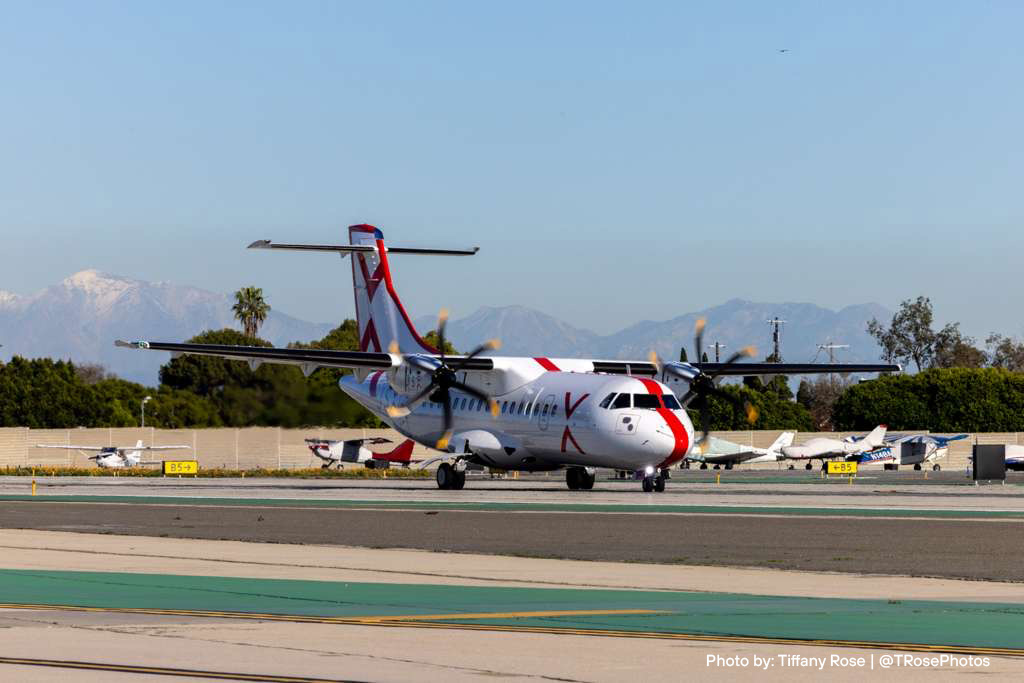
According to the discussion, early interest has come from major cargo players who see practical use cases rather than speculative ones. This includes Etihad Cargo & Emirates SkyCargo, which have publicly partnered with LODD to explore operational use cases for middle-mile cargo movement.
The appeal lies not in replacing existing widebody freighters or trucks, but in complementing them, moving cargo between hubs, bypassing congested infrastructure, and enabling point-to-point regional flows that are currently inefficient or uneconomical.
This is where markets like the Middle East and India come into focus. The Gulf’s role as a global cargo hub is well established, but even here, ground congestion and infrastructure concentration create bottlenecks.
In India, the challenge is magnified by rapid cargo growth, uneven airport infrastructure, and long surface transit times between tier-1 and tier-2 cities. An aircraft that can operate without runways, carry palletised cargo, and integrate into existing logistics chains could address gaps that neither trucks nor conventional aircraft can solve efficiently.
Manufacturing, at least in the near term, will remain centred in the UAE. The company has indicated its capacity to scale production significantly, with reports from Gulf-based media noting that it can manufacture up to 50 aircraft per month as demand builds.

Certification remains the primary constraint, with a multi-year roadmap that prioritises regulatory engagement alongside flight testing and experimental operations with selected partners.
In November 2025, Hili completed its first full-scale flight in Abu Dhabi, marking a key milestone in the programme’s development and validating its hybrid VTOL design.
The flight followed a 19-month development cycle from initial design to first flight, underscoring the pace at which the programme has moved.
What stands out in the Hili programme is not a single standout specification, but the coherence of its design philosophy. The aircraft has been shaped around a clear operational role. It is built to move cargo — reliably, repeatedly, and with minimal dependency on infrastructure that is already under strain. In that sense, the historical reference embedded in its name feels less symbolic and more literal.
Thousands of years ago, trade routes endured because they worked consistently over long periods of time. Hili is being developed with a similar emphasis on reliability in modern air logistics, an approach that could quietly reshape how cargo is moved — without fanfare, but with lasting impact.

Also Read: Honda’s eVTOL Plan: A Measured Path From Flight Tests to Service Readiness