





Honda’s eVTOL Plan: A Measured Path From Flight Tests to Service Readiness

- Honda’s eVTOL programme centres on a longer-range mission of around 400 km (250 miles), with a five-seat layout and a practical payload, backed by hybrid-electric propulsion rather than batteries alone.
- Subscale flight testing in California has focused on repeatable data, including stable transition into wing-borne flight and safe landing capability even with one lift rotor inoperative, as the design moves toward a production-ready freeze in the next 12–18 months.
- With a defined turbogenerator spec and airline-level reliability targets, the project is being positioned around certification realism, quieter operations, and the broader ecosystem, suppliers, rules and public acceptance catching up in parallel.

Honda has spent the last five years working on an electric vertical take-off and landing (eVTOL) aircraft with a clear idea of what it wants the product to do: fly farther than a short city hop, carry a usable payload, and operate in a way people can actually live with.
The programme has stayed largely out of the spotlight while the company validated the basics through flight testing, and it is now moving into the phase where concept learning turns into design lock-in. In conversation, Graeme Froggatt, Director of Programmes at Honda’s eVTOL programme, explained the thinking behind the aircraft’s hybrid approach, test milestones and service timeline.
At the centre of this approach is a simple constraint: today’s battery technology does not support the mission being targeted without forcing compromises on range and usefulness. The design aim is around 400 km (250 miles), with seating for four passengers and a pilot, plus meaningful baggage capacity. Within the programme, the “baggage test” is deliberately practical: it allows space for four sets of golf clubs and overnight bags — because if the aircraft can comfortably handle that, it can cover many of the day-to-day missions operators would want to sell.
That mission definition is also why the programme has leaned toward a hybrid-electric propulsion architecture. The aircraft remains electrically propelled — motors drive the rotors — but batteries alone are not expected to deliver the full mission range. Instead, the batteries handle the high-power vertical segment, and then a turbogenerator supports cruise by supplying power and/or recharging the battery. The generator could run on conventional fuel and, in time, potentially hydrogen. The point is to retain the benefits of electric propulsion while removing the range ceiling that comes with an all-battery design today.
The public-facing timeline is cautious but not vague. The current development work is expected to run roughly another 12 to 18 months, after which the programme aims to be in a position to finalise a production-ready design. That does not mean the aircraft is “done” in 12–18 months; it means the technology exploration and major configuration choices are intended to be mature enough to commit to a single design that can be taken forward with confidence. Availability is expected several years after the design is finalised, with a rough target window of five to six years.

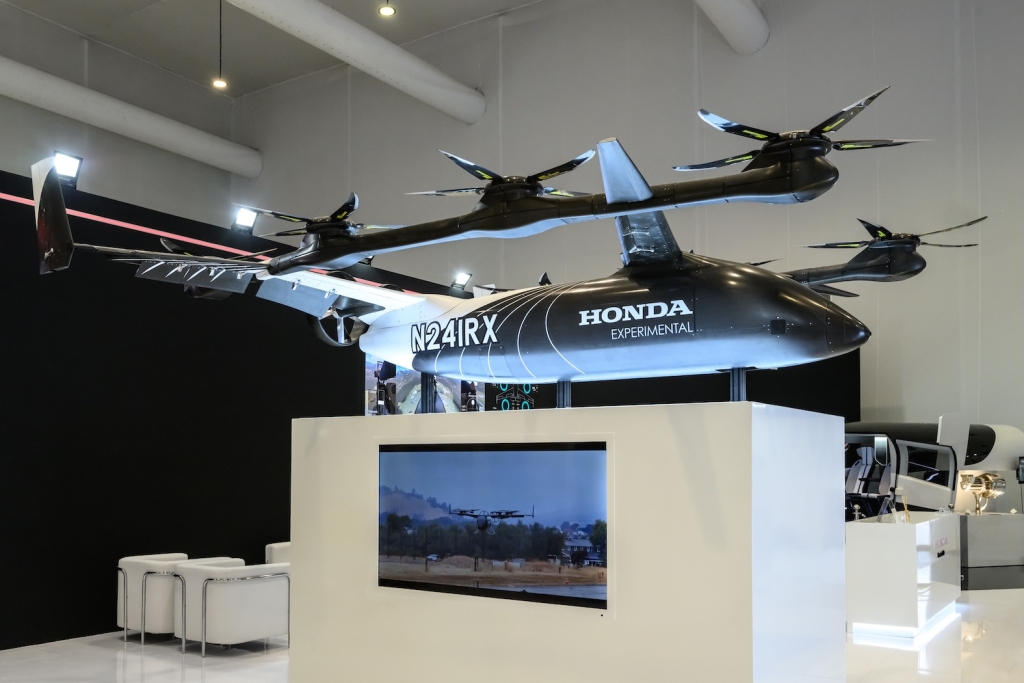
A full-scale cabin mock-up and a full-size airframe model have already been built to verify that the findings from the subscale version remain valid when applied to the actual size, packaging, and human factors of real aircraft operations.
But a mock-up is not a production design; it is a way to validate assumptions — layout, space, visibility, and overall cabin experience — while engineering work continues on the configuration, systems and certification path.
Hybrid power: what’s been tested
Flight learning has been built around a one-third-scale technology demonstrator operated at its development site in California. The programme flew three subscale demonstrators and completed the development it needed to do on that scaled vehicle. The value of that work is not a single headline flight; it is repeatability — collecting enough data to understand stability, controllability and transition behaviour in the most demanding part of the flight profile, where the aircraft moves from vertical lift into wing-borne flight.
The subscale flight tests have shown two key things: a stable transition from vertical to horizontal flight, and safe landing even with one lift rotor inoperative — both central to certification and public acceptance.

The scaled demonstrator’s published specifications also help explain what “one-third scale” means in practice. The model is roughly 4 metres in wingspan and about 5 metres in length, with vertical-lift propellers around 1 metre in diameter and a cruise ducted fan around 0.5 metres in diameter. The maximum take-off weight is listed as 150 kg.
Power is battery-based on the scaled model, and the flight control method includes remote control and autonomous flight along predefined waypoints — consistent with a technology demonstrator that is meant to test flight characteristics without placing a pilot onboard.
For the full-scale technology demonstrator, the specifications align with the target category: approximately 15 metres in wingspan and length, hybrid-electric propulsion, a passenger capacity of four or more, and a maximum range of 400 km.
The cabin mock-up reflects those assumptions and is positioned as an intercity aircraft, not just a short urban shuttle. The interior design is described as being guided by “human-centric thinking,” balancing comfort, quietness and safety while considering the needs of both pilot and passengers.

The turbogenerator is detailed beyond just conceptual ideas. The company has released specific target specifications for the unit:
- rated power: 250–300 kW
- DC voltage: below 900 V
- weight: under 100 kg
- specific fuel consumption: below 0.3 kg/kWh
- fuel: Jet A, with the capability to run on 100% sustainable aviation fuel
- size target: under 800 mm length and under 400 mm diameter
- additional feature: high-voltage start capability
- development status: achieved continuous and transient ground operation
The reason hybrid comes first is explained in plain terms. If you add batteries to extend range, you add weight, which then increases the power needed for take-off, which can turn into a spiral that defeats the original goal.
With current battery energy density, a 250-mile mission is not seen as realistic on batteries alone without major trade-offs. An all-battery future is not ruled out; the design intent is to keep the ability to shift if battery technology improves enough. For now, the hybrid is treated as the practical route to the mission being targeted.

In terms of configuration, the current prototype is characterised by a lift-and-cruise layout featuring eight vertical lift propulsors and two horizontal propellers designated for forward flight. After take-off, the aircraft transitions into wing-borne flight and the vertical propulsors shut down.
One reason wing-borne flight matters is efficiency, but another is contingency: in certain failure scenarios, the aircraft could perform a conventional landing if a suitable runway or strip is available. At the same time, the design is not locked. Other architectures are being evaluated, including tilt-rotor concepts, and current vehicles are treated as technology demonstrators rather than representatives of a final production aircraft.
Safety and public acceptance
What this programme is trying to avoid is building an aircraft that looks ready while the rest of the system remains unready. The argument from leadership is that this category will only work if safety, public acceptance and ecosystem build-out progress together.
Even in the United States — where certification discussions are advanced — there is still no mature way to operate these aircraft at scale. Early engagement with the Federal Aviation Administration (FAA) is underway on certification pathways, but the view is that large-scale market readiness will take time — years, not quarters.
The programme draws a clear line between ‘something that can fly’ and an aircraft that can operate under normal aviation rules. The reliability goal is framed around commercial airline expectations: failure probability on the order of 10^-9, meaning no more than once every one billion flight hours. It also notes the FAA’s reference point of 10^-8, no more than once every one hundred million flight hours.
The point is not to debate numbers for effect; it is to show how tight the margin becomes when you stack complex systems. The programme aims to limit model and system errors to 1–2%, as small deviations of 1% can accumulate into bigger issues. It strives for much higher accuracy in critical areas, around 0.1%, while ensuring the aircraft remains safe even if overall performance varies by about 5%.

Service requirements are being framed in practical terms: motors must deliver steady rated output, not brief peaks; batteries have to meet minimum performance even after ageing; and the aircraft should still be able to land safely even if the power-generation side fails. Cost matters, but reliability comes first.
Beyond the aircraft, the view is that the market won’t scale unless suppliers commit early. eVTOL depends on many specialised components, and costs only start to fall when suppliers invest, build capacity and compete. That is also why controlled ‘sandbox’ environments are being discussed — so operating procedures, community response and rule-making can be tested in conditions closer to real service. One reality sits above all of it: certification alone won’t be enough if communities don’t accept operations.

Noise sits at the centre of that acceptance test. The comparison point remains the helicopter, and the assumption is that an eVTOL must be meaningfully quieter and cheaper to operate to widen where it can fly. No fixed decibel target is being claimed yet; the emphasis is on what people will tolerate in day-to-day life. The real-world question is straightforward: in a dense city, could such an aircraft land for an emergency without causing disruption that makes the operation unacceptable?
Operational learning is treated as equally important. The argument is that you cannot design the sky on paper. Conditions above the cloud versus below the cloud feel different, and wind, weather, and passenger perception can change what is “acceptable,” even when the numbers look fine. Factors such as seating, visibility, cabin openness, and whether vibration noise or wind noise is more disturbing are framed as things that only become clear through real flying and repeated passenger exposure.
Mixed traffic adds another layer. There are no lanes in the sky, and wind can push aircraft off planned corridors. In edge cases, you cannot assume other vehicles behave predictably, which raises questions about separation, margins and how an aircraft should respond when something goes wrong nearby.

The cabin philosophy is positioned in similar everyday terms. “Man-Maximum, Machine-Minimum” is used to argue that early adopters may accept a basic ride, but mass adoption will demand more: space, lower noise, less confinement and a calmer experience. The stated aim is to balance that comfort with aerodynamic, noise and weight limits through careful design discipline.

The message is straightforward. This isn’t about racing to be first. It’s about building a hybrid system with clear targets, learning what real operations demand, and moving toward service as suppliers, rules and public acceptance develop alongside it.
Also Read: Sarla Aviation Begins Ground Testing of India’s Largest Private eVTOL Demonstrator