



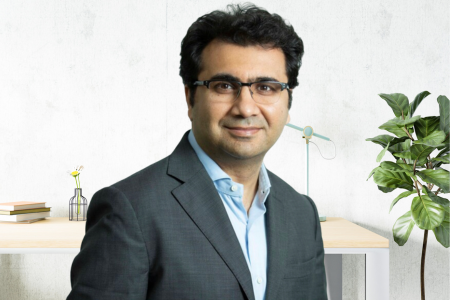




As India’s business aviation market expands and operators grapple with pilot availability, evolving regulations and the need for specialised training infrastructure, Nimrod Meuleman, CAE Vice President, Business Aviation & Helicopter Training (EMEAA), shares with Rakesh Gera insights into how CAE is supporting Indian and regional operators through its global simulator network, the implementation of Competency-Based Training and Assessment (CBTA), and the use of digital and immersive tools to shape the next generation of pilot training.
How does business aviation training differ from commercial airline training, specifically regarding regulatory compliance?
Broadly, there are two main segments: commercial airlines and business aviation.
On the commercial airline side, pilots typically undergo recurrent training twice a year, driven by regulatory requirements.
On the business aviation side, there are two categories in India. The first is operators holding a Non-Scheduled Operator’s Permit (NSOP), which allows them to run charter operations. NSOP pilots are required to complete two training events a year, very similar to airline pilots.
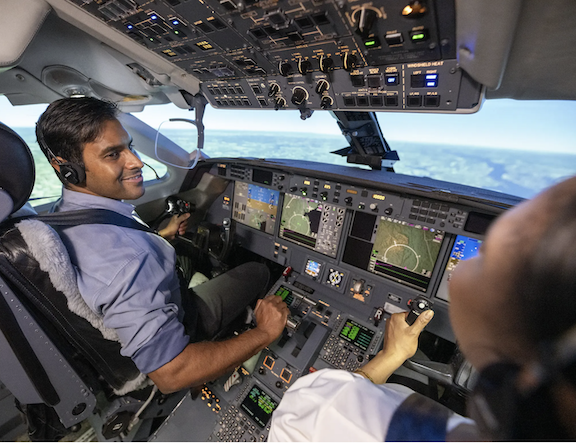
The second category is private operations. In that segment, pilots generally come once a year for recurrent training.
Under India’s Directorate General of Civil Aviation (DGCA) requirements, they complete their instrument rating (IR), licence renewal (LR) and pilot proficiency check (PPC).
When they do a type rating, they also complete all-weather operations training and Civil Aviation Requirement (CAR) 40 day and night checks.
So while the categories and flying patterns differ, the depth and rigour of training in business aviation are very similar to those applied to airlines.
With the majority of Indian operators classified as NSOP holders, how does their training infrastructure compare to that of commercial carriers?
Yes, a substantial portion of Indian business jet operations is under NSOPs, and those operators must comply fully with DGCA requirements.
In terms of the training footprint and ground school, the standards are comparable to those of airlines. The key difference is in how training is organised. Airlines typically conduct their own internal ground school and either own full-flight simulators or have long-term agreements with training providers.
Business aviation operators, by contrast, usually outsource both ground school and simulator training to specialist providers like us. Another factor is that there are no business jet simulator types available in India. As a result, most Indian business aviation pilots travel abroad for simulator training. Dubai has been an important hub. We have been training Indian business jet crews here since 2004 across a wide range of business aviation types, including Bombardier, Gulfstream, Dassault, and others.
If a particular aircraft type is not available in Dubai, we support Indian operators through CAE’s global network. For example, some Cessna Citation types and older Dassault Falcon models are trained in North America at facilities such as CAE Dallas and CAE Morristown (New Jersey). In Europe, our Burgess Hill centre in the UK provides training on types such as the Citation XLS and Learjet 45.
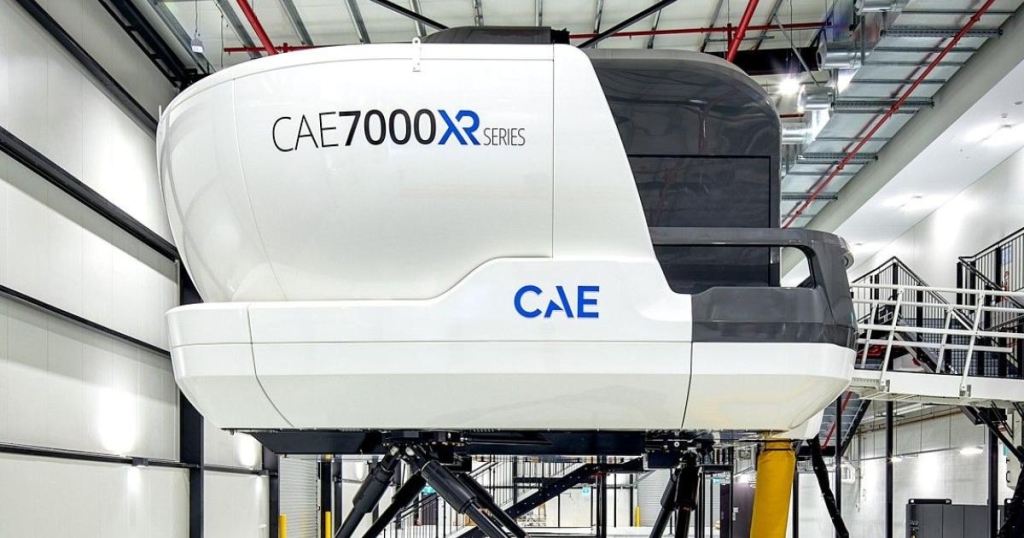
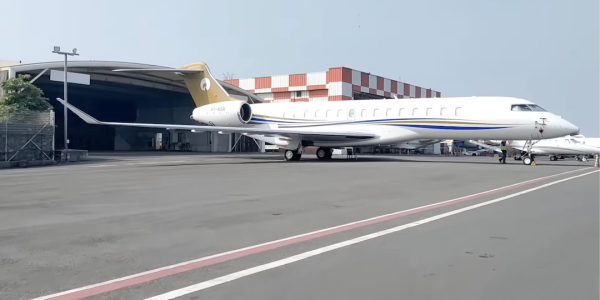
In Dubai itself, our focus is on large-cabin business jets, including the Bombardier Global 7500, the Global 5000 and 6000, the 5500 and 6500, and a range of Challenger and other Global models. We also train on the Gulfstream G650 and other large-cabin aircraft. Many Indian operators have also used our Dubai centre historically for types like the Hawker.
So the NSOP regulatory framework and the lack of local simulators mean that Dubai and the wider CAE network are central to meeting India’s business aviation training needs.
Given the diverse operational environments in business aviation, what specific competency gaps do you address that might differ from standard airline training?
Fundamentally, business aviation pilots are expected to meet the same minimum competency standards as airline pilots. Our role is to ensure they have the knowledge, skills and behaviours to operate safely and reliably for their operators.
Where business aviation is different is in the variety of destinations. Business jet operators in India, for example, often fly into a broader and more diverse set of airports than many domestic airline pilots do. Some of these are classified as “special airports” and come with specific training requirements.
We therefore provide special airport training for destinations such as Kathmandu, Queenstown (New Zealand), Sion, and Innsbruck (Europe), and London City (UK). These airports typically involve demanding terrain, approach paths or weather conditions. In most cases, that training cannot be conducted in India, so we replicate those environments and procedures in our simulators.
The goal is to ensure that business aviation crews are fully prepared, procedurally, technically and in terms of threat and error management, before operating into such airports.
How do you maintain standardised courseware across such a wide variety of aircraft models?
The advantage we have is that, for every aircraft type we launch, we build a complete training programme, courseware plus a full suite of scenarios and tools, and get it approved as an integrated package.
Our programmes are certified by authorities such as the US Federal Aviation Administration (FAA), the European Union Aviation Safety Agency (EASA), Transport Canada and several other national aviation authorities (NAAs).

When we train Indian pilots, we layer DGCA-specific requirements on top of those base approvals. DGCA often follows FAA or EASA standards, but there are always local nuances. We incorporate those into the training footprint. Over the years, we have built extensive experience with Indian regulatory requirements, so we understand what is needed for approvals and validations.
On the commercial side, CAE also operates a joint venture with InterGlobe in India, CSTPL, with training centres in Delhi and Noida, and a new facility in Mumbai. Those centres are dedicated to commercial aviation, but they underline how deeply embedded we already are in India’s training ecosystem.
Do those domestic facilities (CSTPL) also cater to business aviation training?
No. Those centres are focused on commercial aviation and are managed by our commercial division.
From a training philosophy perspective, however, there are many similarities between commercial and business aviation. One of the main challenges we see in India on both sides is pilot availability.
The industry has gone through periods where there were simply not enough pilots in the market.
While the situation has improved in some areas, demand remains strong, and it is particularly acute in business aviation.
High-net-worth individuals and corporates want the very top tier of pilots for their aircraft, which makes recruitment highly competitive.
On top of that, DGCA rules require pilots to observe a six-month notice period before moving from one operator to another. That applies to many business aviation pilots as well as airline pilots. It complicates workforce planning and makes it difficult for operators, especially on the business jet side, to respond quickly to growth or fleet changes.
You recently emphasised the standardisation of operating procedures. How has the implementation of Competency-Based Training and Assessment (CBTA) progressed?
We have introduced a new approach built around competency-based training and assessment (CBTA). This framework is increasingly becoming the global standard.
In the EASA environment, recurrent training is structured as a phased programme. We embed CBTA principles into that model, so specific competencies, both technical and non-technical, are rotated through the training footprint over a multi-year cycle.
The result is that recurrent training becomes dynamic rather than static. Each year, different elements and scenarios are introduced, reflecting fleet changes, operational experience and emerging risks. Some airlines in Europe and elsewhere have already adopted this approach, and ICAO is looking at how to extend the CBTA philosophy globally.
From our side, we took the decision to integrate CBTA elements into our business aviation recurrent training footprint from 1 January, so business aviation pilots now benefit from the same structured methodology.
How are you expanding your business aviation simulator network, particularly with the new Vienna centre, and what guides where you add capacity?
Vienna is our most recent business aviation training centre in Europe, and it represents a significant investment. We held the official opening in September.
When we design a centre, we must decide which full-flight simulators to install, how many bays to allocate and how to future-proof the facility as fleets evolve. Vienna has nine simulator bays, and we have already deployed several full-flight simulators there. We focus on types that reflect the current and expected fleet mix in the region.
Beyond Vienna, we are examining opportunities to expand capacity at existing centres. In Singapore, for instance, we have a Gulfstream G650 simulator serving the Asia-Pacific region. In Dubai, we are also looking at how best to increase capacity.
Ultimately, where we place simulators depends on where new aircraft are being delivered and based. Take the Bombardier Global 8000 as an example. We already have a broad network of Global 7500 simulators. By offering difference training (training highlighting the differences of the aircraft) or dedicated Global 8000 programmes, as we have done in Montreal, we can support operators as that fleet enters service.
We have also announced training for the Pilatus PC-24 in Vienna. Several PC-24s are already operating in India or are on order, and we already train that company’s pilots on other business jets, so adding the PC-24 is a natural extension.
How many full-flight simulators do you have in this region, and in Dubai specifically, which business aviation types do they cover?
If I look at our network in this region, we have 14 full-flight simulators in Dubai, 1 in Singapore, 5 in Vienna, and 14 in Burgess Hill, UK. Together, these centres provide a broad training network for operators in India, the Middle East, Europe and Asia-Pacific.
In Dubai specifically, on the business aviation side we host a wide portfolio across multiple original equipment manufacturers. We train on two Hawker variants and a full suite of Bombardier business jets, including the Challenger 604 and 605; the Global Express Classic; the Global 5000 and 6000; the newer Global 5000, 5500 and 6500 variants; and the Global 7500, which we will be using to train on the Global 8000 as well.
On the Gulfstream side we provide training for the G550 and G650.
For Dassault, we cover the Falcon 900, Falcon 2000EX EASy and Falcon 7X in Dubai, while Falcon 6X training is available in Burgess Hill.
Collectively, this means we cover almost all of the major business jet OEMs relevant to our customer base in this region.
Transitioning between aircraft types in business aviation is often more complex than in commercial aviation. How do you manage these transitions?
In business aviation, pilots generally need to complete a full initial type rating when they move to a new aircraft type, unless the regulator explicitly allows a differences course.
For example, if a pilot is already qualified on a Global Express or Global 5000, they may be able to transition to a Global 5500 or 6500 with a differences course, subject to the authority’s approval. But in many other cases, a full type rating is required.
If a pilot is flying the Global 7500 and wishes to move to a Gulfstream G650, that would involve a complete G650 type rating, which typically takes around one month of training.
Airbus has deliberately designed a high degree of commonality across its cockpits, which is why it can offer a cross-crew qualification (CCQ) course between models like the A320 and A350. In business aviation, cockpit designs and systems architectures vary more significantly between OEMs and models, so there is far less scope for abbreviated transition courses.
How do you support smaller operators or those who do not have the scale of a large NSOP holder?
We support operators of every size, from single-aircraft operators to large fleets, and we also work with individual pilots.
A good illustration is the self-sponsored pilot. In many hiring processes, operators indicate that they want candidates to arrive already type-rated on a particular aircraft. That leads some pilots to fund their own type rating to qualify for a specific role.

As long as a pilot holds the appropriate licence, typically an Airline Transport Pilot Licence (ATPL) or equivalent, we can deliver the required training, whether that is an initial type rating or recurrent training.
The Indian business aviation market is fragmented. There are very small operators and much larger ones, and we adapt our support accordingly. The common denominator is that we provide structured, regulator-approved training pathways regardless of fleet size.
How do you see demand for business aviation pilots and other aviation professionals evolving over the next 10 years?
Our latest study indicates that, over the next 10 years, the global aviation system will require around 1.5 million new aviation professionals. That figure covers the entire ecosystem: pilots, air traffic controllers, engineers, technicians, cabin crew and other aviation roles.
If you focus on Asia, including India, the numbers are still substantial. We expect demand for around 7,000 business aviation professionals, of which approximately 3,000 would be pilots and about 4,000 would be aircraft maintenance technicians – these professionals are not yet in the system today.
The challenge is that both airlines and business aviation operators draw from the same talent pool. That makes it difficult, particularly for business aviation, to secure and retain pilots with the desired experience and profile.

I spoke about this at a Corporate Jet Investor conference in Singapore.
One of the key themes was the need to develop the next generation of aviation professionals.
Many young people simply do not know the pathway to becoming a pilot or an aviation professional.
This is an area where the industry, including training organisations like CAE and operators themselves, needs to work together to build awareness and create sustainable training pipelines.
How are you incorporating new digital tools and technologies, including artificial intelligence, into your training offering?
We see digital tools and artificial intelligence (AI) as important enablers across several aspects of training.
One area is immersive training. We have started using devices such as the Apple Vision Pro to create immersive ground-school experiences. These tools allow trainees to interact with virtual cockpits and systems in an intuitive way. For a generation that is very comfortable with digital interfaces and gaming environments, this can be a powerful way to learn and retain complex technical information.
We are investing in this space and evaluating how immersive technologies can be integrated into standard training curricula, both for initial and recurrent training.
On the AI side, we are exploring how to enhance courseware and training content. AI can support faster updates to training material, more intelligent scenario design and better use of data from training sessions. There are several projects underway, and as they mature you will see more concrete applications becoming part of mainstream programmes over the next couple of years.
Given your long association with India, how do you see the evolution of its business aviation sector?
I have been closely involved with the Indian market since 2004, and over that period the business jet segment has grown significantly.
When I first started visiting India, there were only a small number of business jet operators. Today, there is a much broader base of high-net-worth individuals and companies using business aviation. Utilisation has grown, not only around peak periods such as elections, but also in day-to-day corporate travel.
The behaviour of owners and users has also evolved. Historically, many owners preferred to keep their aircraft strictly for personal, family or corporate use and would not make them available for charter. Today, more individuals are comfortable using charter without owning, and more owners are willing to place their aircraft on charter to improve utilisation and economics.

As a result, the market has expanded noticeably in recent years. The area that still needs to catch up is legislation and regulation. Business aviation is often still viewed primarily through a luxury lens, whereas its contribution to connectivity and economic activity is substantial. Aligning regulation more closely with the sector’s actual role in the economy is a recurring theme in my discussions with Indian operators and has been for the past two decades.
That said, the underlying trajectory of business aviation in India is clearly upward, and with the right regulatory support, the sector can play an even stronger role in supporting the country’s growth.