









India’s Pilot-Training Crunch: The Quiet Crisis Behind the Aviation Boom

- India issues around 1,600 CPLs a year, but training capacity is constrained by too few qualified instructors, uneven training quality, limited simulator availability, and weak integration between flying schools and airlines.
- Competency-based training within the 200-hour CPL structure and MPL-style simulator-led pathways are being discussed as ways to produce pilots better prepared for airline operations from the outset.
- The expansion of simulator infrastructure, the development of trained technicians to maintain them and the possibility of assembling or manufacturing training devices in India are identified as key elements in addressing the current constraints.

India is living through the most frenetic phase of aviation expansion in its modern history.
With mega fleet orders topping 1,100 aircraft across IndiGo, Air India and Akasa; a domestic market growing at double digits; and regional connectivity stabilising, the country is accelerating toward becoming the world’s third-largest aviation market far sooner than expected.
Yet beneath this headline boom lies a structural fault line — one that industry leaders warn could slow down India’s ascent unless addressed with urgency. That fault line is pilot training.
Airlines have long admitted quietly that pilot availability — not aircraft, infrastructure or airports — is the real friction point in India’s growth story. Today, the country issues around 1,600 Commercial Pilot Licences (CPLs) a year, with 1,622 issued in 2023 alone — the highest on record. Over the next decade, various industry estimates suggest that India will need well over 1,000–1,500 job-ready pilots every year, driven by fleet induction, retirements and high-utilisation cycles. The gap is widening in real time.

But the shortfall isn’t simply about quantity. It is multi-layered: too few instructors, uneven training quality, limited simulator availability, and a disconnect between flying schools and airlines.
What is emerging now is a decisive — and overdue — push to redesign India’s entire pilot training ecosystem.
And this push is coming simultaneously from regulators, airlines, flight schools and global training partners, rather than from any single player.
India’s training constraints start with a factor rarely discussed publicly: the shortage of qualified flight instructors. Flying academies can purchase aircraft and expand airfields, but they cannot operate without instructors who meet DGCA standards and can guide trainees efficiently.
For years, many Indian flight instructors have been pilots who did not secure airline jobs, rather than professionals who deliberately chose teaching as a career path — an arrangement that is increasingly seen as unsustainable for a system trying to scale.
As Y.N. (Bobby) Sharma, CEO of Chimes Aviation Academy, explains, India has expanded its training fleet significantly: “Three years back, there were a hundred-odd training aircraft. Today we’re at roughly 325 aircraft, with another 75 arriving soon. With each aircraft flying around 600 hours per year, the installed capacity is around 200,000 hours of training annually — and growing.”
But he cautions that capacity is not competence. “It’s not about just banging out the 200 hours required for a CPL. The real challenge is producing an airline-ready pilot. That is where competency-based training becomes vital.” Bobby points out that when India reduced the CPL requirement from 250 to 200 hours in the early 2000s, the internal sub-requirements — like 100 hours of Pilot-in-Command time — were not reduced proportionately. As a result, there is still a ‘buffer’ within those 200 hours that can be reallocated for deeper, competency-based training without increasing the overall cost to the cadet.

India’s flying schools and airlines are finally converging on the need for competency-based training (CBT) — focus on decision-making, situational awareness, resource management — not mere hour-building. That convergence is also reshaping how airlines view their role: from passive recipients of CPL holders to active co-owners of the training pipeline, involved in curriculum design, quality checks and instructor development.
This is also bringing the MPL (Multi-Crew Pilot Licence) program back into debate.
Khushbeg Jattana, GM India at Simaero, suggests that MPL-like models, which rely heavily on simulators and low-level training devices, offer real promise: “The MPL encourages the use of devices other than an aircraft — but also other than a full-flight simulator. There’s a huge range of training devices in between that India hasn’t leveraged yet. Policy must evolve to enable their use.”
Globally, MPL pathways — usually airline-sponsored — produce pilots who are trained from Day One for multi-crew airline operations, with far more simulator hours than traditional CPL cadets. India has been slow to adopt it, but industry leaders now believe it is time for a structured rethink. However, MPL’s success in India will depend as much on implementation as on regulation: thousands of additional simulator hours will need to be delivered by a limited pool of Synthetic Flight Instructors and Type-Rated pilots, and airlines will have to decide how many pilots they can afford to pull out of cockpits to teach.
Captain Ashim Mitra, SVP Flight Operations at IndiGo, is candid about India’s structural constraints: “With the 25 flight training organisations that are there approximately in India, we won’t meet future demand. Airlines need to get far more involved in training — syllabi, standards, apprenticeships, everything.”
IndiGo already employs 5,300 pilots, a number expected to double to 11,000 by 2030.
“For us, the question is — five years from now, what will be the cockpit experience level? We have to shape that today.” This marks a generational shift: airlines are accepting that they must co-own the training pipeline rather than passively hire CPL graduates.
Mitra recalls that when the Airbus A320 first entered service, regulators worldwide required first officers to have at least 500 hours on a conventional jet before moving into the right seat. “Today we sometimes think a short jet-orientation course and a few simulator sessions can replace that,” he warns. “The only realistic way to compensate for that lost experience is through a robust MPL framework, backed by strong airline involvement and regulatory oversight.”
For years, many Indian pilots have gone overseas for type ratings and recurrent checks, particularly to training centres in the Gulf, Southeast Asia and South Africa. While more simulators are coming into India, the absence of a large, stable pool of instructors and examiners means that many Indian pilots still find themselves training abroad or waiting for simulator slots.

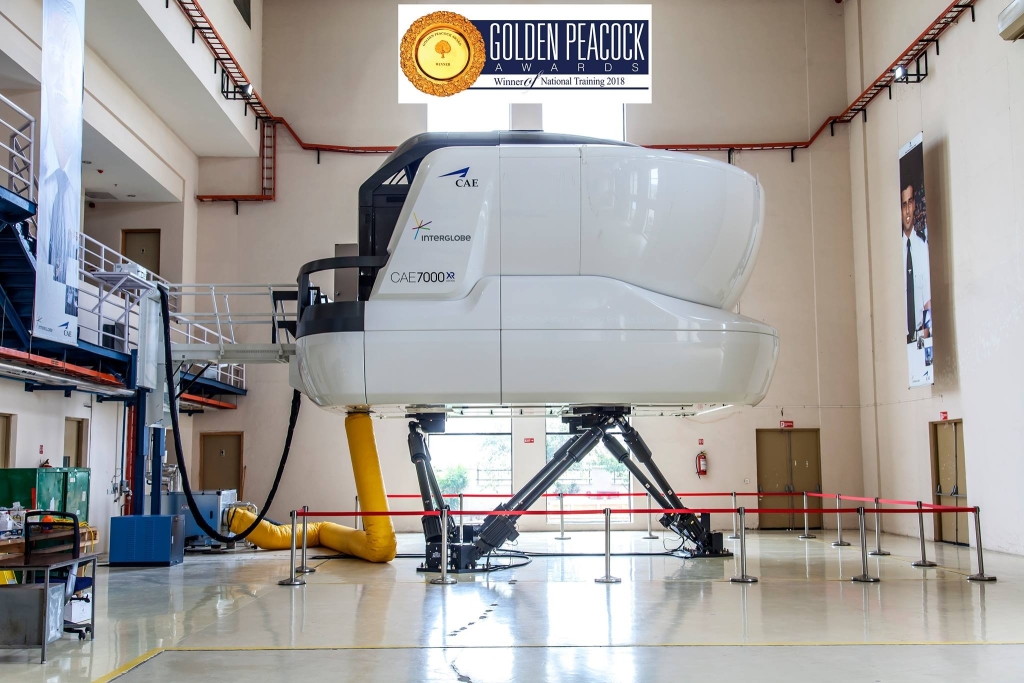
Capt. Christopher Ranganathan of CAE pointed out that, “Importing simulators is only part of the answer, maintaining them — keeping them updated — requires trained technicians.”
He also believes that India must move from being only an end-user of foreign-built simulators to at least assembling, if not fully manufacturing, devices in-country. “Five years ago, China didn’t have a single simulator manufacturer. Today it has four, competing globally on quality.”
This is where CAE, which operates the world’s largest civil aviation training network, plays a critical enabling role. CAE already runs training centres in India, supporting fleet expansions and enabling local type-rating capacity. But even CAE has warned that infrastructure without manpower won’t solve India’s bottleneck. Ranganathan underlines that placing a simulator and building a training centre is only the first step; keeping that device serviceable, updated and aligned with evolving regulations requires a pipeline of highly specialised technicians and engineers — an area where India is only just beginning to invest systematically.
India faces a temporal mismatch: fast fleet growth, slow training growth. To fix this, India must:
- Scale instructor training, with global partners
- Standardise flying training through CBT and airline-aligned curricula
- Adopt MPL-style pathways to reduce airframe dependency
- Expand simulator infrastructure, but also create sim-tech training programs
- Move toward local simulator manufacturing and assembly
- Deepen airline involvement in the entire training pipeline

Overlaying all of this is a demographic reality that industry insiders rarely state publicly: by 2030, a significant share of India’s pilots will have less than five years of experience in their current role, and by the mid-2030s, three-quarters of cockpit crew could be under the ten-year mark.
Compressing what used to be a decade-long progression to command into four or five years will only be safe if CBTA, MPL and high-fidelity synthetic training are fully embedded into the system.
India is not merely trying to produce more pilots. It is trying to build a globally competitive, technologically modern, self-reliant pilot-training ecosystem.
Regulators are already moving in that direction — tightening oversight of 28 FTOs, nine ATOs and dozens of simulators; digitising CBTA records so instructor sign-offs flow straight to licensing; and working with industry on a first MPL framework that could be notified within months. The onus now is on airlines, training organisations and manufacturers to move in lockstep.
The pieces are finally in motion. The question is whether they can move fast enough.
Also Read: India’s Aviation Sector: Navigating the Talent Shortfall in a Booming Market