














India’s SAF Bet: From Samosa Oil to Supply Chain Power — Can India Overtake Europe in the Race to Decarbonise Aviation?

- India is reframing aviation decarbonisation as an industrial and geopolitical strategy, not just a climate obligation — turning agricultural waste, used cooking oil, and municipal biomass into a new value chain that could rival Europe’s SAF leadership.
- Unlike the EU’s “mandate-first” approach that caused cost and feedstock pressures, India is sequencing the transition around feedstock aggregation and affordability, aiming to become a global SAF production hub with surplus capacity by 2040.
- If approved, linking CSR capital with refinery innovation and rural participation could help India build a supply chain–driven, subsidy-free model where farmers, corporates, and refineries jointly shape a new industrial base — positioning the country to export sustainable fuel rather than import fossil ATF.
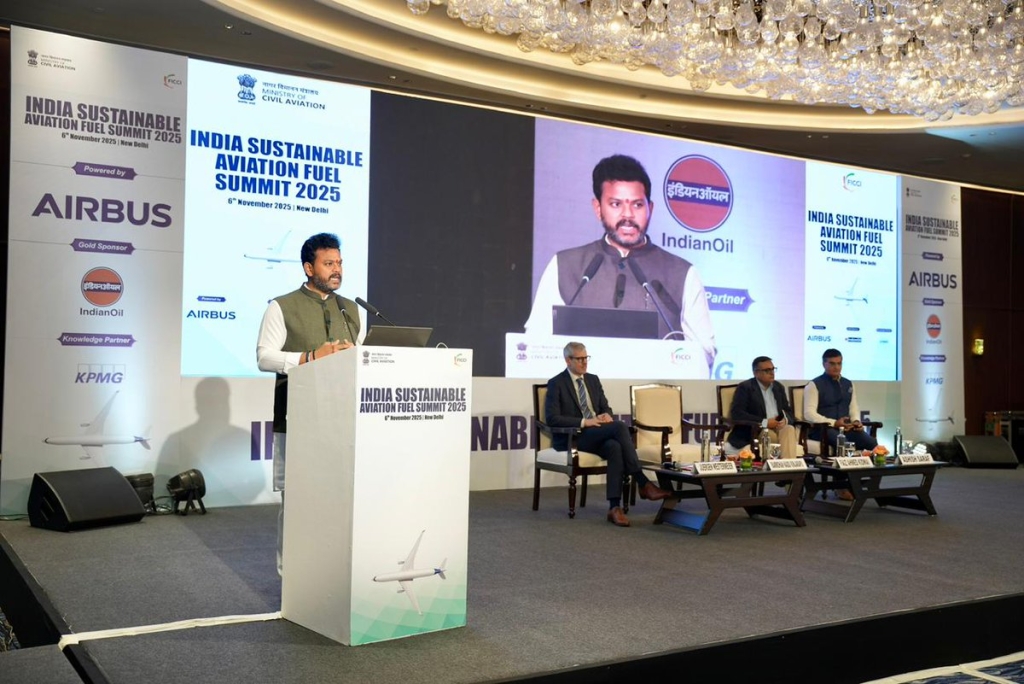
When Civil Aviation Minister K. Rammohan Naidu said that even leftover samosa oil could one day power a commercial jetliner, it wasn’t a casual remark at the ‘India Sustainable Aviation Fuel Summit’, organised by FICCI, jointly with the Ministry of Civil Aviation. It was a signal of ambition.
Because India is not entering the sustainable aviation fuel (SAF) transition as a reluctant follower. It is entering as an industrial strategy player — where climate decarbonisation, rural wealth, energy sovereignty, and global aviation supply chain politics converge.
Most geographies are still struggling to answer a narrow climate question: How do we comply with emissions targets? India is framing a different and much larger question: How do we convert aviation decarbonisation into a national strategic capability — and industrial export leverage?
India’s first-ever national SAF policy, expected any time now, may look cautious to climate activists: 1% blending by 2027, 2% by 2028, 5% by 2030. Europe, by comparison, has mandated 6% SAF by 2030 (likely rising further), and Japan and Singapore have already laid mandated glidepaths.
But India’s sequencing logic is different — and this is where India’s play diverges from the EU. Europe mandated first — and has since run into supply cost shocks, severe feedstock scarcity, refinery struggle to scale, and price volatility.
India is sequencing the opposite way: build feedstock aggregation first, cost curve second, mandate third. This is not climate incrementalism. It is cost realism.
India is designing SAF for affordability at scale, not boutique pilot programmes. At below 5% blending, SAF is a symbolic transition. Above 5%, it becomes a market structure. India is moving deliberately to the second category.
India’s SAF opportunity is not theoretical — it is feedstock backed: surplus agri residue (230+ million tonnes), total biomass (750 million tonnes), used cooking oil potential above three million tonnes, and municipal waste streams cities cannot even find enough industrial scale use for. This is where India stands apart globally.
Europe’s biggest SAF constraint is feedstock scarcity. The US has much stronger corporate offtake but is still reliant on subsidies and is politically cyclical. Brazil is strong in biomass, but its aviation scale is small relative to India’s future passenger + cargo growth.
India is the only major aviation geography which can realistically claim domestic surplus capability — potentially 8–10 million tonnes production annually by 2040, against an estimated 4.5 million tonnes domestic requirement.
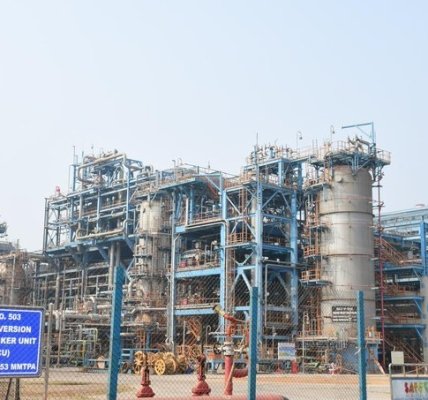
This is why Boeing-HPCL, Airbus-CSIR-GSV, and multiple refinery pivots are happening now. OEMs are signalling they don’t want India only as a testbed. They want India as a supply basin.
India imports huge amounts of fossil ATF — and that is a direct vulnerability to global pricing cycles. Ten per cent SAF blending alone could cut billions of dollars off import bills annually. SAF is now part of industrial de-risking, not only climate compliance.
SAF, therefore, is not tailpipe news — it is sovereign industrial policy. India is positioning climate action not as a penalty cost, but as a competitive industrial hedge. India is also rewriting the decarbonisation narrative architecture. Western climate narratives are centred around constraint — feedstock limits, rationing, and regulatory tightening.
India’s narrative is mobilisation. For the first time in aviation history, the farmer is a direct contributor into future global fuel value creation. Biomass, farm waste, crop residue, used cooking oils — these are not waste streams anymore — they are refinery-grade input assets.
This also opens one more non-linear innovation zone: India may become the world’s first nation where CSR funding becomes industrial co-financing for SAF uptake — if the Government greenlights FICCI’s proposal to classify voluntary SAF procurement under CSR.
If this is approved, India may actually solve the cost problem before the West — because corporate India (especially FMCG, IT, finance, and manufacturing) already has a CSR compliance pool searching for credible climate deployment verticals.
Make CSR = SAF capital — and you unlock a subsidy-free scaling mechanism. And what is important is that airlines need this — now. Indian carriers have more than 1,700 aircraft on order — the fastest fleet pipeline in the world after the US.
While hydrogen is not ready this decade, electric aviation is regional. New aircraft tech cannot decarbonise fast enough on its own. So, SAF is the only transition lever that actually works for the next 10–15 years — for the aircraft actually flying. Which is why lessors and ECAs are watching India closely — because if India becomes the first Asian SAF surplus geography, it can set price reference points for this region.
In an India vs the world scenario, India holds a competitive position. Take, feedstock and industrial capacity potential, for example.India could surpass the EU, UK, Japan, Singapore and even compete with the US/Brazil in the next decade.
As for policy mandate progression, India is slower than the EU/Japan in mandate speed — but smarter on industrial sequencing. India is trying to avoid paying the European penalty of mandating before cost rationalisation.

The world’s aviation sector needs 185 million tonnes of SAF by 2050. If India delivers surplus production by FY40, India will become one of the few nations capable of being a structural supplier into that market.
This is no longer a climate target story. This is a commodities and geopolitical advantage story.
What is important is that India’s SAF revolution will not be driven by lab white coats alone — but by refinery engineers, mandis, district aggregators, QSR kitchen networks, municipal operators and farmers.
The next time someone fries a samosa, that oil might not just be waste going down a drain. It could be the feedstock that powers the most important industrial repositioning of India since IT services — this time not digital — but green molecules, flying globally.
That is the deeper SAF story: India is not just decarbonising. India is trying to redefine where the world buys its clean aviation fuel from.
Also Read: India moves ahead toward Sustainable Aviation Fuel leadership even through global challenges