













- India’s drone sector is witnessing rapid innovation and expanding applications across defence, logistics, agriculture, and surveillance, as seen at Aero India 2025.
- With supportive government policies, growing startup participation, and international collaborations, the industry is poised to become a key pillar of India’s logistics and technology ecosystem.

Away from the roar of the engines of the F-35s, the Su-57s and the Tejas over Bengaluru skies, in the halls of Aero India 2025, drones took Centre-stage and, rightly so, as these unmanned aerial systems (UAS) are going to make their presence felt in the not-so-distant future, deployed for a variety of purposes – defence, health, agriculture, logistics, surveillance, entertainment etc. Drone technologies are fast developing and one got to witness that at Aero India, though large-scale deployment of drones has not happened, due to several factors, primarily to do with safety and security regulations.
Drones have been around for quite some time now, having moved from only defence usage to commercial applications in the last decade. The first-ever commercial drone delivery took place a little over a decade ago in China. Called ‘Fast Service’, drones were used to deliver medical goods to remote places. Amazon with its ‘Prime Air’ followed suit, delivering parcels weighing less than five pounds and within a 30-minute range. In 2017, UPS got permission from the Federal Aviation Administration to use drones to transport packages, but with a caveat that they should operate only during the daytime. During the pandemic, there was accelerated deployment of drones, yet it has not taken off as anticipated.
For instance, Dronamics, the world’s first cargo drone airline, announced that it would begin commercial operations in 2024, but has not been able to. Dronamics flagship drone – Black Swan – had its first flight at Balchik airport in Bulgaria in May 2023. Black Swan can carry 350 kg at a distance of up to 2,500 km up to 80per cent faster, 50 per cent cheaper and with up to 60 per cent lower emissions than alternative modes of transport, including air cargo. The industry is awaiting Dronamics to commence commercial operations soon even though the company has secured launch customers including Hellmann Worldwide Logistics (Germany), Hellenic Post (Greece), Emirates Post Group (UAE), Aramex (UAE), and Qatar Airways Cargo among others. Qatar Airways Cargo is the first airline to agree to offer cargo services from any of the droneports of Dronamics.
Safety and Security Concerns
With drones on the horizon, the logistics industry is gung-ho about it. At Aero India, there was palpable excitement among the drone exhibitors, the majority of them startups, who showcased drone technologies for various purposes – cargo, ISR (intelligence, surveillance and reconnaissance), humanitarian relief etc. The opportunities are aplenty and E-commerce and other logistics companies are awaiting their deployment having understood their usefulness – last mile delivery and short to medium-distance transportation; inventory management and order picking; and surveillance and inspection.
India’s most powerful cargo drone
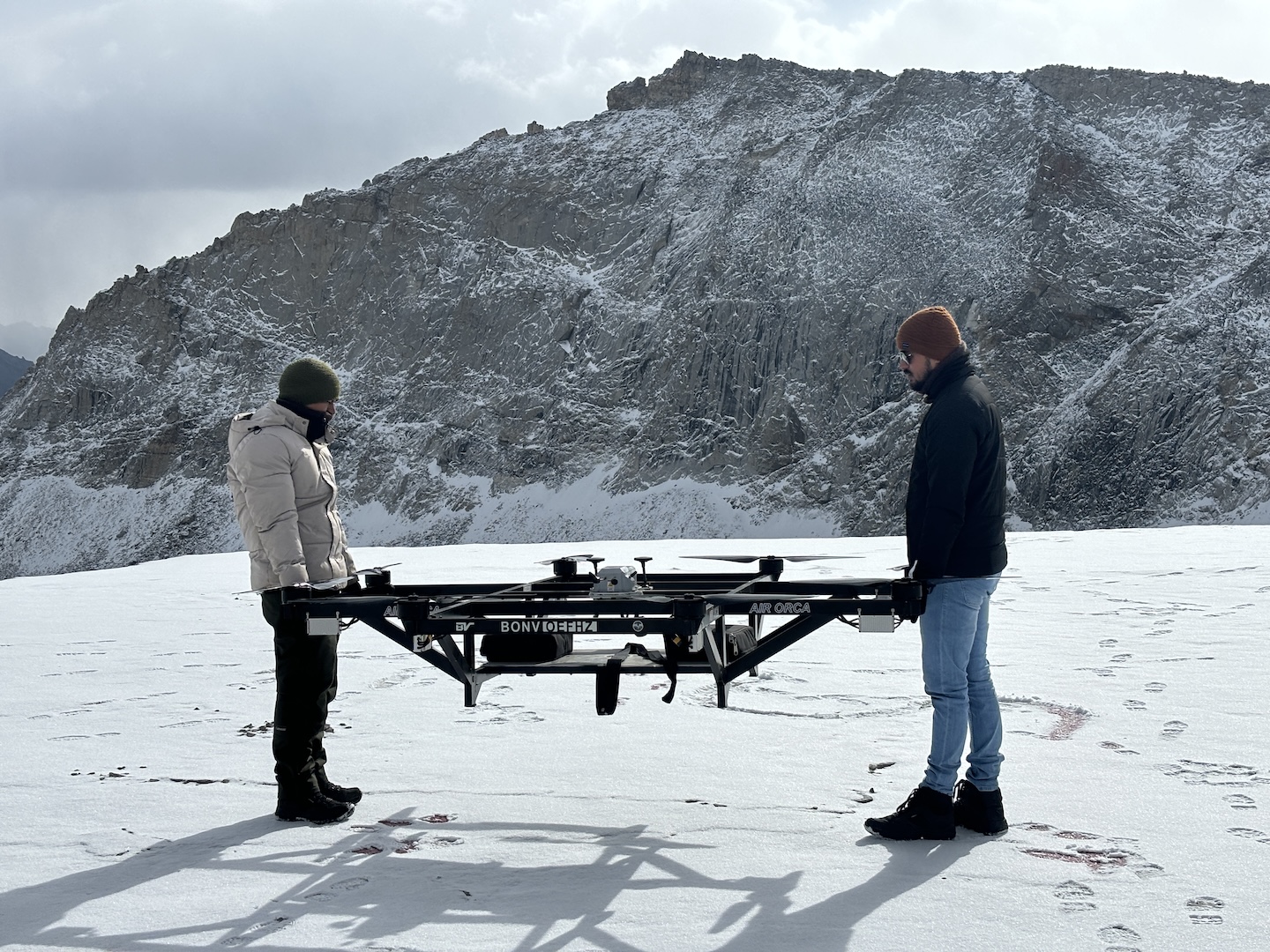
Garnering significant attention was Bengaluru-based drone manufacturer Scandron which introduced the CargoMax 20KHC, touted to be India’s most powerful cargo drone, having a payload capacity of 200kg (Black Swan has 350kg payload). The drone has been built to support the Indian armed forces, paramilitary units, and emergency response teams. The drone will be manufactured in Ladakh as the company wants to be closer to where it is going to be delivered. The CargoMax 20KHC has an operational range of 15km and an altitude ceiling of 6,000 metres above sea level and is designed to operate in demanding environments, including high-altitude regions, deserts, and naval zones.
Arjun Naik, the founder and CEO of Scandron said “The CargoMax 20KHC is designed to provide the Indian armed forces with a stable, reliable aerial logistics platform for last-mile deliveries. All our CargoMax drones have variants that enable them to offer superior logistics capability, whether it is for high-altitude operations, desert operations or naval operations The drone is fully autonomous, requiring no pilot intervention, and features a common command-and-control system with built-in redundancies for safety and reliability. It can execute pinpoint landings, including on moving naval platforms, making it suitable for maritime supply missions.” It is not just the armed forces the company is targeting but other industries too which have logistical challenges.
Drones with AI capabilities
Meanwhile, Garuda Aerospace, another startup, signed a Memorandum of Understanding (MoU) with Himachal Futuristic Communications Limited (HFCL) to drive innovation across critical sectors, including defence, agriculture, surveillance, industrial inspection, disaster response, and logistics. HFCL will focus on designing advanced payloads such as EO/IR sensors, LiDAR, and AI-driven communication systems, while Garuda Aerospace will integrate these technologies into its UAV platforms, ensuring seamless deployment for both commercial and defence applications.
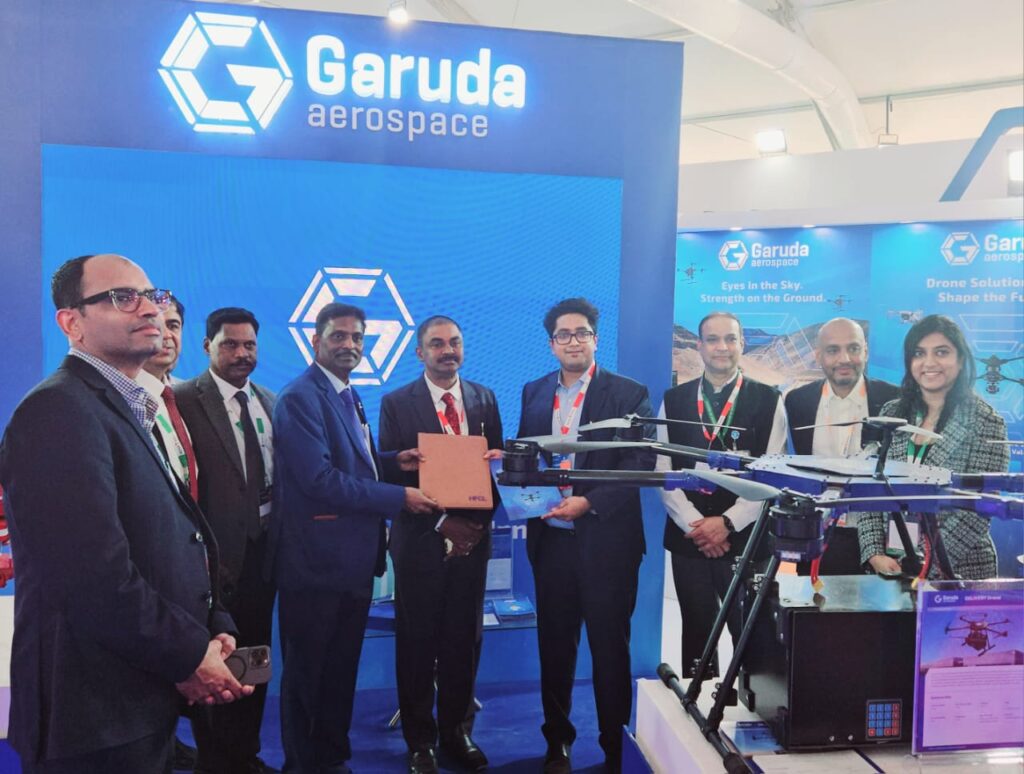
Under this MoU, drones will be equipped with AI capabilities to support various applications, including disaster management with thermal imaging drones for search, rescue, and damage assessment. Industrial inspections through high-resolution cameras and 5G-enabled drone networks for smart city surveillance will also be tapped. Additionally, AI-powered cargo drones will optimise logistics and urban mobility. Real-time monitoring and analytics for the Namo Drone Didi and Viksit Bharat initiatives will also support farmers. The partnership will further involve joint research in AI, machine learning, and sensor fusion technologies, driving the development of next-gen UAV systems with extended flight times, autonomy, and swarm capabilities.
Agnishwar Jayaprakash, Founder & CEO, of Garuda Aerospace, said “We are building a foundation for next-generation drones that will strengthen UAV technology. This collaboration gives Garuda a significant competitive advantage, enabling us to offer our customers the most advanced drone solutions available. The integration of high-performance payload technology for our drones will benefit various sectors, reducing our reliance on foreign suppliers and boosting our ‘Make in India’ initiative.”
Garuda Aerospace also has tied up with Tata Elxsi, a global leader in design and technology services to establish a dedicated UAV design, engineering, and certification centre to develop indigenous drone technologies specifically for Indian defence applications, along with agriculture, and smart cities, supporting the ‘Make in India’ initiative.
Xagrotor bags GBP 50 million UK contract
In a big breakthrough for Chennai-based Indian drone startup – Xagrotor Tek has bagged a contract from ACS Airobot, the United Kingdom’s drone solutions provider. The partnership formally signed at Aero India 2025 entails Xagrotor Tek to provide proven drone designs to ACS Airobot which will assemble, and rigorously test these drones to ensure they meet the stringent standards of the British Civil Aviation Authority (CAA).
Aravindh Prabhu, Director, Xagrotor Tek said the international roadmap has four stages starting with setting up production lines in the UK to scale up drone manufacturing; followed by product demonstrations and UK approvals for which it would be conducting extensive trials to secure regulatory clearance for industry-wide adoption. This would be followed by a rollout of UK-built drones across critical industries for real-world applications. In stage four it will be expanding into European markets, using the UK connect.
With a sales commitment of INR 500 crores (approximately GBP 50 million) over the next three years, this collaboration signals a major step towards strengthening the UK’s autonomous aerial systems industry by combining India’s cutting-edge drone technology with the UK’s high-quality manufacturing and regulatory expertise.
Another example is that of Droneco, the logistic arm of drone tech startup, TSAW Drones, which has delivered 43,256 packages as of 2025, having done nearly 294 flight hours, covering 25,045 km. Set up in November 2022, Droneco is currently running on three routes in two states, serving Kolkata and Nizamabad. The brand is witnessing high deliveries from the medical sector and with its aggressive outreach approach looking forward to adding e-commerce, q-commerce, agriculture, and defence deliveries. Droneco’s clients include Medvolant, TATA 1MG, GIMS, and Kanhaiya Life Care Medicine.
A lot is happening and Adani Defence & Aerospace is also in the thick of things. In association with the Defence Research Development Organisation (DRDO), it unveiled India’s vehicle-mounted counter-drone system. This state-of-the-art system marks a significant step in enhancing India’s defence preparedness against evolving aerial threats. The Vehicle-Mounted Counter-Drone System ensures long-range protection, agility, and precision, making it a formidable asset for modern defence forces.
Drone market to touch $1.43 billion by 2029
The Indian drone market is projected to grow from $654 million in 2024 to $1,437 million by 2029, at a CAGR of 17 per cent during this period. The drone volume in India is expected to rise from 10,803 units in 2024 to 61,393 units by 2029, reflecting the humongous growth potential. The government is encouraging startups and Micro, Small and Medium Enterprises (MSMEs) to invest in drone technology.
While that is happening, the government has been tweaking rules to simplify many restrictive rules introduced in 2018. As per the recent law, authorisation is only required when there is a departure from prescribed procedures. The documentation required to obtain a drone usage permit is simplified substantially. Fees to get a remote pilot license have also been reduced. “Digital Sky” has been developed as a user-friendly, single-window online system for all approvals and permissions.
The Drone Shakti Scheme is a flagship initiative by the Government of India designed to propel the growth of the drone industry and foster innovation among startups. It aligns with the government’s broader vision of a digital and self-reliant India (Aatmanirbhar Bharat). It aims to boost the adoption of drone technology across various industries, create employment opportunities, and make India a global leader in drone manufacturing and services.
India’s drone sector is at an inflexion point and is forecast to become a critical component of India’s logistics ecosystem in the near future, irrespective of what some political leaders have been dismissing India’s drone capabilities. It is hoped that the government and the industry join hands to resolve some niggly issues such as regulatory, human resources, infrastructure, network design, awareness, and pricing.