













- IndiGo reported a sharp quarterly loss of ₹2,582 crore for Q2 FY26, driven by forex losses and rising operational costs, despite a 9.3% revenue increase year-on-year.
- Foreign-exchange losses of ₹2,686 crore and higher maintenance, airport, and staff expenses pushed IndiGo’s cost per seat-kilometre up 10%, reflecting heavy margin pressure even as fuel costs declined.
- CEO Pieter Elbers highlighted seasonal weakness and macro challenges but pointed to stabilising demand, international expansion, and a modest underlying operational profit (₹104 crore ex-forex) as signs of resilience heading into the peak season.

InterGlobe Aviation Ltd, the parent company of IndiGo, one of the fastest growing low-cost carriers in the world, has reported a troubling reversal in fortunes for the seasonally weak quarter ended September 2025 (Q2 FY26). While InterGlobe’s revenue rose by 9.3 % year-on-year to ₹19,599 crore, total expenses surged 18.3 % to ₹22,081.2 crore, resulting in a net loss of ₹2,582 crore, nearly three times the loss from the same quarter a year ago.
IndiGo posted a top-line uptick driven by improved demand, with ticket revenue rising to about ₹15,967 crore (up 11.2 % YoY), and ancillary revenue increased 14 % to roughly ₹2,141 crore. The growth reflects healthy consumer interest, even as the broader aviation industry faces softness in domestic markets.

Impact of Forex
Despite revenue growth, IndiGo’s cost base expanded sharply, worsened by currency impact of about ₹2,686 crore, due to a weaker rupee and dollar-denominated input costs. Fuel costs fell (about 10 % to ₹5,962 crore), but this was more than offset by other operating costs (maintenance, airport charges, staff), which rose nearly 34 % to ₹16,119 crore.
As a result, cost per available seat-kilometre (CASK) rose 10 % to ₹5.16, and CASK excluding fuel spiked 25 % to ₹3.71, signalling significant margin pressure. The airline’s reported EBITDAR fell to ₹1,114 crore (vs ₹2,434 crore), while EBITDAR excluding forex rose to ₹3,800 crore (vs ₹2,667 crore), reflecting stronger core operations despite currency headwinds.

The airline highlighted that Q2 is typically the weakest quarter seasonally for Indian carriers.
But a combination of macro-headwinds, weak domestic demand and increasing international capacity added complexity. Moreover, IndiGo has been progressively shifting capacity towards international routes to optimise asset utilisation and support its long-haul ambitions.
Moreover, IndiGo has shifted capacity increasingly into its international business (now estimated at 20% of ASK vs 16% last year) to optimise asset usage, including for its long-haul ambitions.
Commenting on the results, CEO Pieter Elbers acknowledged the challenging quarter, stating, “Our optimised capacity deployment has enabled us to deliver a 10% growth in topline revenue and, excluding the impact of currency movement, an operational profit of 104 crore rupees as compared to an operational loss last year. As India’s aviation sector continues to grow and mature, we recognise the importance of structurally optimising capacity during seasonally weaker periods to sustain profitability. The quarter also had a very strong Operational Performance as IndiGo continues to lead the On Time Performance charts, Customer appreciation, and expansion of the network.
“The year began with significant external challenges across the industry, but we saw stabilisation in July and a strong recovery through August and September. Looking ahead, we have scaled up our operational plans for the second half to meet demand and continue driving growth. With that, we have nudged up our capacity guidance for the full financial year 2026 to early teens growth”
While the statement emphasises network growth and operational metrics, it also underscores the need to explicitly manage capacity and cost in weaker seasonal windows.
Although the headline loss is alarming, there are some positives, and they include a small profit from underlying operations (adjusted for forex) of ₹104 crore for the quarter, suggesting the business model remains viable if currency headwinds are removed. Demand remains resilient and the airline is expanding internationally, which may help enhance yields and margins in H2 FY26. It is hoped that the airline will manage capacity additions more prudently than in the hyper-growth years, indicating a shift to more balanced growth.
Nonetheless, the expanded cost base (especially maintenance, engine/aircraft groundings, staff) and volatile currency remain substantial risks. The margin squeeze in this quarter may also raise concerns around competitive pricing dynamics as capacity growth picks up.
The results highlight that while growth remains, cost and currency risks are very real and can rapidly erode profitability. The quarter underlines how airlines remain vulnerable not just to demand swings but also structural cost pressures and macro-factors such as currency and fuel.
Hopes on the upcoming peak travel season
As IndiGo heads into the peak travel season and builds on its long-haul network, the key watch-points will be whether it can contain unit costs (CASK ex-fuel & ex-forex) and protect margins in a higher-capacity environment; How currency movements evolve, especially as dollar-denominated aircraft leases, maintenance and engine parts remain large cost drivers. Also to be seen is whether its international foray and network diversity pay off in improved yields and load factors beyond the domestic market.

IndiGo’s Q2 FY26 results remind that even as Indian aviation continues to expand, the business remains acutely exposed to cost, currency and seasonal risks. The loss is a stark warning, but the underlying demand, expansion strategy and operational resilience suggest potential for recovery in the quarters ahead.
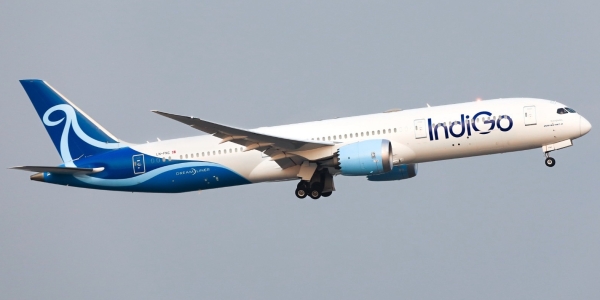
IndiGo has a fleet of 417 aircraft, providing scheduled services to 94 domestic and 41 international destinations as of 30th September 2025.
Also Read: IndiGo Q1 profit drops 20% as airspace closures and weaker yields impact performance