





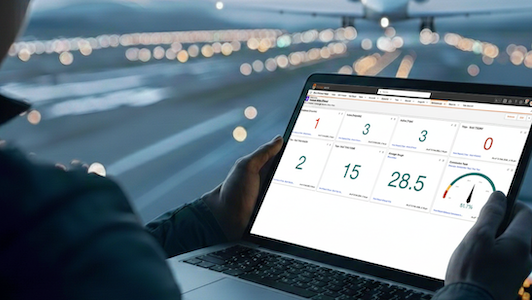








- Predictive maintenance is a clear digital priority for MROs.
- This transformative approach enhances efficiency, reduces costs, and minimises downtime, addressing evolving challenges in fleet management
The aircraft Maintenance, Repair And Overhaul (MRO) industry is moving towards the greater use of Artificial Intelligence (AI) based predictive maintenance to increase efficiencies. Airlines invest extensive resources in aircraft MRO, which is key to keeping their fleets safely in the air. However, older MRO methods and practises feature paper heavy processes, which track the various routine checks that have been performed at predetermined intervals. Historically, it has been difficult to analyse the data in a timely fashion to undertake the maintenance, repair or replacement of parts before their performance starts to suffer or they break down. The industry also continues to face evolving challenges related to supply chain complexity, talent shortages, and rising competitive pressures. Airbus has estimated that the market for aircraft aftermarket services will reach US$290 billion globally in 2043, up from US$150 billion in 2024. It also estimates that operational inefficiencies would cost the airline industry an estimated US$70 billion in 2030, but digital services could address up to one-third of that figure.
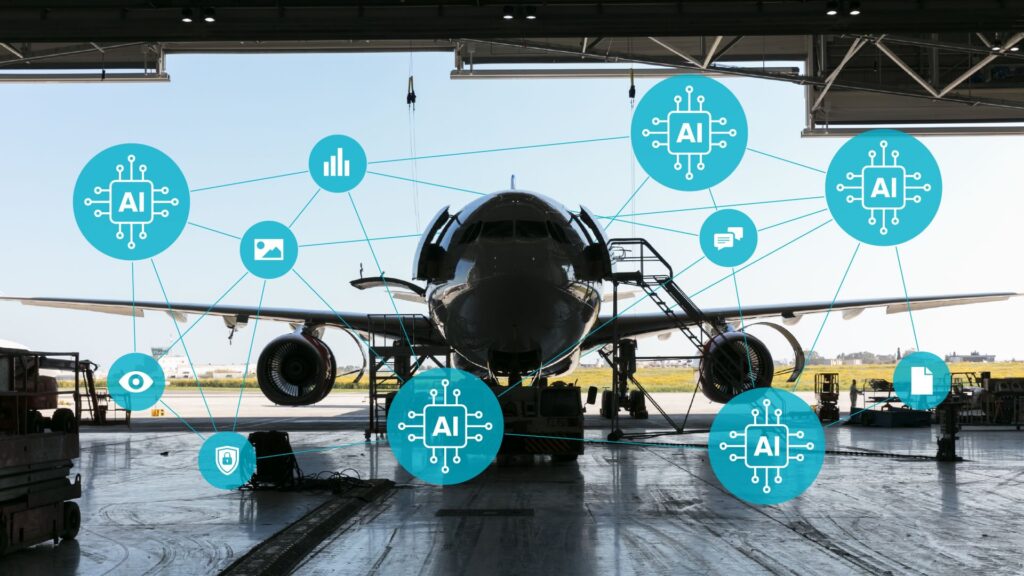
However, modern commercial aircraft gather vast amounts of data from their sensors and computers, which, coupled with the server capacities, transmission speeds and self-learning algorithms already available today, make it possible to automatically aggregate and analyse huge quantities of data. A typical A320, for example, has over 180 monitored airframe and systems items, including complex systems such as those related to hydro-mechanical, electrical and fuel system parts. As an example, one year of 787 sensor measurements from one airplane results in 1TB of data.
The use of ‘Big Data’ solutions for maintenance services has resulted in the rapid growth of predictive maintenance in MRO, which is being accelerated further by the incorporation of AI. This has already resulted in a reduction in aircraft fleet operation and MRO costs, as well as reducing the associated unscheduled downtime for aircraft. Predictive maintenance has been consistently cited as a digital priority in the MRO industry and is where advanced digital solutions are being deployed. Its use increases schedule reliability by determining the best time to replace and repair components, hence maximising useful service life and minimising disruption. This affords tremendous cost savings to airline operators, as a mid-air turnback can result in additional costs to the tune of approximately US$85,000 dollars.
Change Makers
A July 2024 survey released by McKinsey & Company, titled ‘Aircraft MRO 2.0: The digital revolution’ suggested that AI-powered advances could reshape aircraft MRO, but companies will need to embrace digital disruption. Highlighting the increase in costs related to fleet maintenance, the McKinsey survey stated that in the United States, for instance, airlines have endured a 15 per cent increase in maintenance costs over the past five years. Survey respondents identified their organisations’ top digital priorities over the next three to five years, with 56 per cent of them naming predictive maintenance, which can identify non-routine maintenance issues in advance—as one of their key priorities. “Given that up to 60 per cent of technicians’ time can be spent on unplanned work (often on problems that are only discovered in the course of remedying other problems), it makes sense that MRO respondents would be eager to take advantage of digital’s ability to flag potential maintenance issues before they arise,” the McKinsey report stated.
However, the report also cited that data limitations and resistance to change were among the major barriers that had to be overcome. “More than 80 per cent of respondents consider data limitations to be the most significant barrier to digital adoption at their organisations.” This is largely due to the MRO industry’s reliance on physical recordkeeping, which, to be fair to them, is also required by the regulators. However, this often ends up in fragmented data collection that is difficult to transfer into digital databases. Machine learning solutions—which can generate insights from unstructured, partial source data—could eliminate many of these quality issues. Organisational resistance to change and the lack of internal digital talent were both cited by more than 70 per cent of respondents as additional barriers to the successful deployment and scaling of digital capabilities.
The report highlights, however, that respondents whose organisations had embraced digital said that the advantages are clear across the value chain. “Fifty per cent of these respondents say they’ve experienced revenue uplifts of more than 5 per cent and a more than 10 per cent improvement in engineering productivity. More than 25 per cent of respondents indicate that they have realised a 10 to 20 per cent reduction (or more) in maintenance spending as a result of digital efforts.”
However, releasing the full value of modern digital solutions could require MROs to inject new talent into the organisation, invest in new capabilities, and embrace a new way of working.

MRO and AI
In December 2024, Lufthansa Technik announced that it would collaborate with Microsoft to drive forward the use of AI, that will optimise entire maintenance processes and significantly improve efficiency. The collaboration with Microsoft is part of “Digitise the Core”, a comprehensive initiative by Lufthansa Technik to drive forward the digitisation of the company’s core operational processes. “We are excited about our collaboration with Microsoft,” said Dr. William Willms, Chief Financial Officer of Lufthansa Technik and responsible for the IT department of the company. “This partnership will allow us to harness the power of AI to solve highly complex challenges, improve our operations, and deliver exceptional value to our customers.” The initiative includes over 50 context-sensitive AI use cases based on Microsoft Azure AI Services and the Microsoft Azure cloud. Florian Deter, Managing Director at Microsoft Germany, said, “AI is the pivotal technology of our time. It not only enables incredible breakthroughs that could hardly have been imagined before. In its development, security and data protection have the highest priority for us and for Lufthansa Technik.” Lufthansa Technik aims to distil knowledge from vast amounts of data, including unstructured data such as work instructions, by utilising Large Language Models (LLM) provided via Azure AI Services and a memory-enabled cognitive architecture. The optimisation of layover planning will be one of the most impactful use cases, with the promise of reducing the ground time by five to ten per cent, resulting in significant cost savings.
GE Aerospace announced in November 2024 that it is collaborating with Microsoft and Accenture to develop generative AI-powered solutions for the aviation industry. It unveiled its first solution, which would allow airlines and lessors to access aircraft maintenance records in a few minutes. A global lessor that manages aircraft and engine assets of all ages, Carlyle Aviation Partners was announced by GE Aerospace as being the first company to test the solution in a private preview. “We are thrilled about the direction in which AI integration with asset records is heading. This has the potential to open so many opportunities to actively manage our fleet, giving us instant access to data and information that would normally take hours, days, or even weeks to find. We’re very excited to partner with GE Aerospace, Microsoft, and Accenture on building the future of AI in aviation,” said Donal Mc Gowan, senior vice president, Technical Management, Carlyle Aviation Partners.
The compliance documentation status of aircraft fleets has traditionally been a time-intensive and manual process, with workers spending days, and even weeks, combing through multiple physical documents and data sets. Andrew Coleman, general manager, GE Aerospace Software as a Service (SaaS) Group, said, “With the entire aviation industry working to meet the increased ramp in air travel, GE Aerospace is turning to technologies like generative AI to help our customers revolutionise how they track and monitor their assets. Asset tracking is just one area within aerospace that can be transformed using generative AI. This technology is bringing a whole new era of productivity and efficiencies that can also revolutionise the manufacturing process and makes it such an exciting time to be in the industry.”
GE Aerospace’s new asset insights solution provides status information on their aircraft at any point in time, to maintenance and repair workers. Customers will now have better information about leasing details and gaps in critical documents, and, for lessors specifically, it will help quickly determine the technical status of their leased aircraft to help protect asset value and proactively identify contractual compliance concerns. “Smart digital transformation is a critical success factor for aerospace companies, and it’s vital that investments into new, advanced technologies are made in a smart way, too. This solution is a tangible way to show impressive benefits within a short timeframe, and it’s also something that can be scaled quickly as needed,” said Joyce Kline, managing director, Accenture. With GE Aerospace’s generative AI-powered solutions, generative AI is now being used to help airlines and lessors increase scale and efficiency across their maintenance and repair operations, allowing customers to unlock critical asset information in minutes.
OEMs Join In
The Boeing Flight Data Analytics – Insight Accelerator (IA) advanced analytics solution is an OEM offering that delivers effective predictive maintenance through the identification of patterns of premature component failure. All Nippon Airways (ANA) emerged as the launch customer for Insight Accelerator in September 2022. “There are many products on the market for flight data analytics, but Insight Accelerator is the most effective tool for our aircraft operation,” said Manabu Tono, All Nippon Airways manager of Planning & Administration, Engineering. “It’s very innovative and meets our primary goal of leveraging features in-flight data that indicate a system failure before it happens.” The new cloud-based digital solution employs AI to improve operational efficiency by allowing operators to pre-emptively undertake maintenance and avoid the high impact of unscheduled replacements. Boeing estimates these capabilities can reduce unnecessary inspections by up to 85% when an Insight Accelerator recommendation is implemented. It also shortens the time for predictive maintenance analysis from months to days.
As part of the Boeing Flight Data Analytics integrated suite of solutions, IA’s state-of-the-art built-in Augmented Analytics provides a guided path for users to easily and quickly integrate and analyse maintenance and recorded QAR/CPL flight data using tens of thousands of flights for more accurate prognostics – all without the need for specialised data science or programming skills. The implementation of an automated tool eliminates manual and time consuming management of complex data. “IA’s built-in artificial intelligence, guided exploration and powerful visualisations allow airlines to investigate flight and maintenance data, identify trends and discover insights – all without specialised coding or programming skills,” said Duane Wehking, vice president of Digital Aviation Solutions at Boeing Global Services. Boeing’s Insight Accelerator is part of the company’s Flight Data Analytics suite, which includes advanced analytics solutions developed by aviation experts around a common flight data processing core.
It was in 2019 that Airbus and Delta Air Lines announced the formation of a digital alliance to develop new predictive maintenance and health-monitoring solutions for airline customers worldwide. In July 2021, the aviation Digital Alliance, expanded to include GE Digital. GE’s entrance into the alliance resulted its extensive aerospace systems engineering expertise and best-in-class predictive analytics being connected to Airbus’ proven Skywise digital solutions suite and Delta’s operational and maintenance excellence and related predictive models. The most recent entrant into the Digital Alliance for Aviation is Liebherr, extending the range of components the Alliance is able to monitor to operationally troublesome areas such as air conditioning, pneumatic, flight control and landing gear systems. Airbus has announced that the Alliance intends to extend predictive maintenance to the A220 and A350 in 2025, with the same product value delivered today on the A320 and A330. From 2026, the offer will extend to non-Airbus aircraft.
The Alliance is the only one of its kind in the industry and its platform is powered by Airbus Skywise, to which some 11,600 aircraft were connected in late 2024.As per Airbus, its digital models and predictive maintenance algorithms can identify part or system failures before they ground an aircraft. A switch to predictive maintenance for airlines customers could result in US$4 billion worth of annual maintenance savings by 2043.
Predictive maintenance will result in faster and smoother repair operations, along with the digitisation of the paper trails they create, allowing data to be organised and structured at scale. Offered to customers as Skywise Fleet Performance+ (SFP+), the predictive monitoring platform is already in use, with an estimated 40 customers operating around 1,500 aircraft between them. The UK airline easyJet has estimated that the annual fuel saving directly linked to SFP+ on its A320 Family fleet is 8.1 tonnes per aircraft. “Utilising the data and insights from SFP+, easyJet was able to anticipate several system failures, which led to proactive action by our maintenance teams avoiding unscheduled failures,” says Swaran Sidhu, Head of Fleet Technical Management at the airline. Using SFP+ easyJet was able to avoid 79 flight cancellations in the month of July and August 2024, respectively; delays and cancellations incur significant indirect costs on airlines when their aircraft are grounded, compounding the price of parts and maintenance, not to mention the loss of customer satisfaction.