















Quiet Powerhouses: Inside Liebherr-Aerospace’s Expanding Role in Modern Aircraft Systems

- Liebherr-Aerospace showcases its core systems portfolio at NBAA-BACE 2025, highlighting landing gear, air management, and electric actuation technologies.
- The company’s integrated engineering supports major programmes from Embraer and Dassault to Airbus, reinforcing its status as a tier-one supplier.
- Liebherr’s focus on electrification and lifecycle support reflects the aviation industry’s shift toward smarter, more sustainable aircraft systems.
In every aircraft, the visible airframe tells only half the story. Beneath the surface lies an ecosystem of systems that breathe, balance, and move the aircraft—and it is here that Liebherr-Aerospace has built a reputation that quietly rivals the world’s best.
Headquartered in Toulouse, with engineering roots tracing back to Germany’s Liebherr Group, the company today stands among the most comprehensive tier-one system suppliers in aviation. Its portfolio extends across environmental control and thermal management, landing gear and actuation systems, and onboard electronics, supporting both civil and defence programmes.
What distinguishes Liebherr’s contribution is not size but depth: the ability to design entire systems, from mechanical structure to electronic control, built for endurance over decades of flight cycles.
Landing Gear: Balancing Strength and Precision
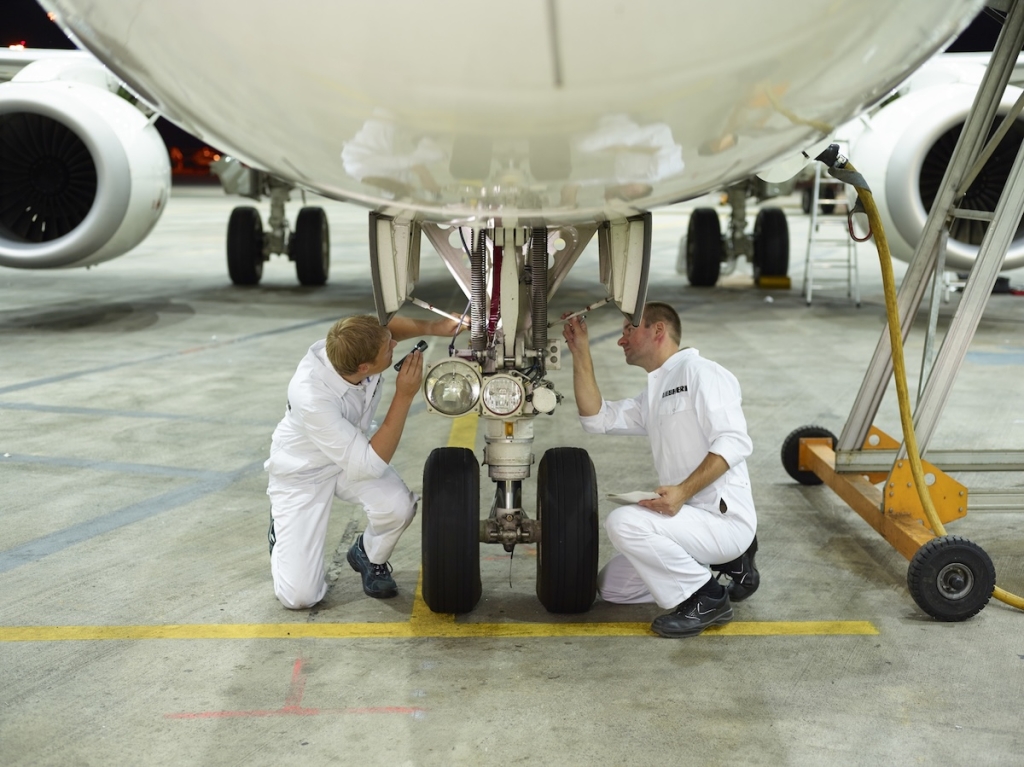
Few aerospace components combine so many disciplines—hydraulics, materials, sensors, and software—as a landing gear system. Liebherr’s approach integrates all of them, delivering complete assemblies from the main structure to the control interface in the cockpit.
The company’s landing gear is built to endure thousands of high-load cycles while maintaining millimetric precision during deployment and retraction. Its design philosophy emphasises maintainability and cross-platform reuse, allowing operators to streamline servicing and reduce downtime.
The nose landing gear of Embraer’s Legacy 650, for instance, showcases Liebherr’s design efficiency—a compact hydraulic system with integrated steering and extension actuators optimised for business jet weight categories. Liebherr also contributes landing-gear assemblies and subsystems to commercial programmes such as the Airbus A350 and A220, reflecting its versatility across aircraft classes.
Recent Liebherr gear and actuation designs incorporate sensing and health-monitoring features aimed at earlier fault detection and reduced unscheduled maintenance. The result is not simply a stronger gear but one that is engineered for reliability throughout its service life.
Air Management: The Science of Comfort and Control
Cabin environment systems are among the most invisible, yet most consequential, parts of an aircraft. Liebherr’s air management technology governs temperature, pressure, humidity, and airflow—essential not only to comfort but also to avionics stability and fuel efficiency.
The company provides fully integrated air management systems that merge air conditioning, pressurisation, bleed-air control, and anti-ice management into cohesive modules. These systems are engineered for minimal energy loss, drawing on the company’s thermal-management research originally developed for commercial aviation.
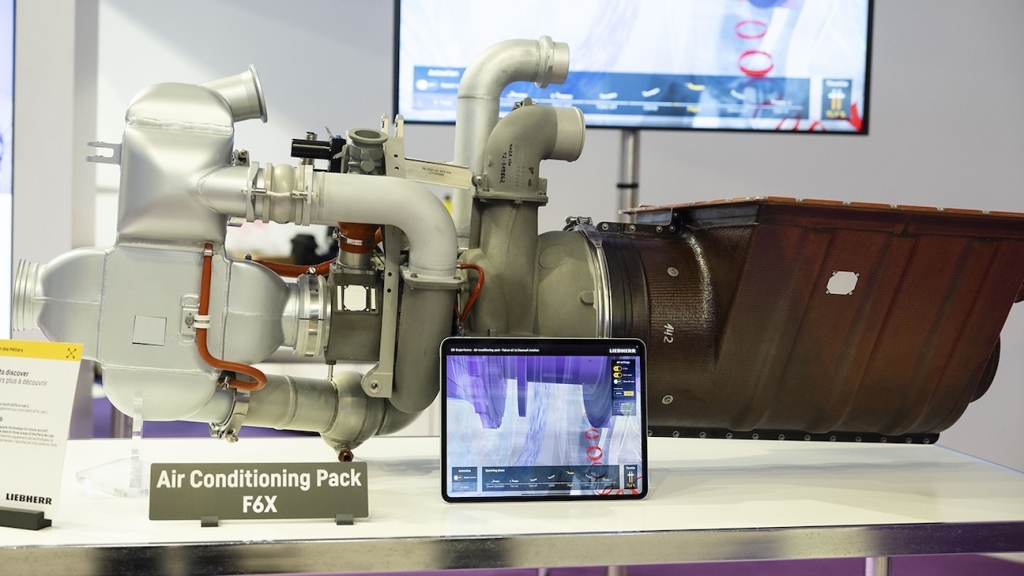
One of the latest demonstrations of this expertise is found on the Dassault Falcon 6X, whose environmental control system is entirely supplied by Liebherr. Designed for long-range, high-altitude cruise, the unit maintains consistent pressure and temperature throughout extended operations, ensuring both passenger comfort and equipment reliability.
Across civil fleets, Liebherr’s air systems are in service on multiple Airbus platforms, including the A320neo, A220, and A350, establishing the company as a key player in cabin air and thermal efficiency. Its control logic now informs newer systems designed for hybrid and all-electric aircraft, where efficient thermal regulation will be essential.
Leader in the development of electromechanical actuators
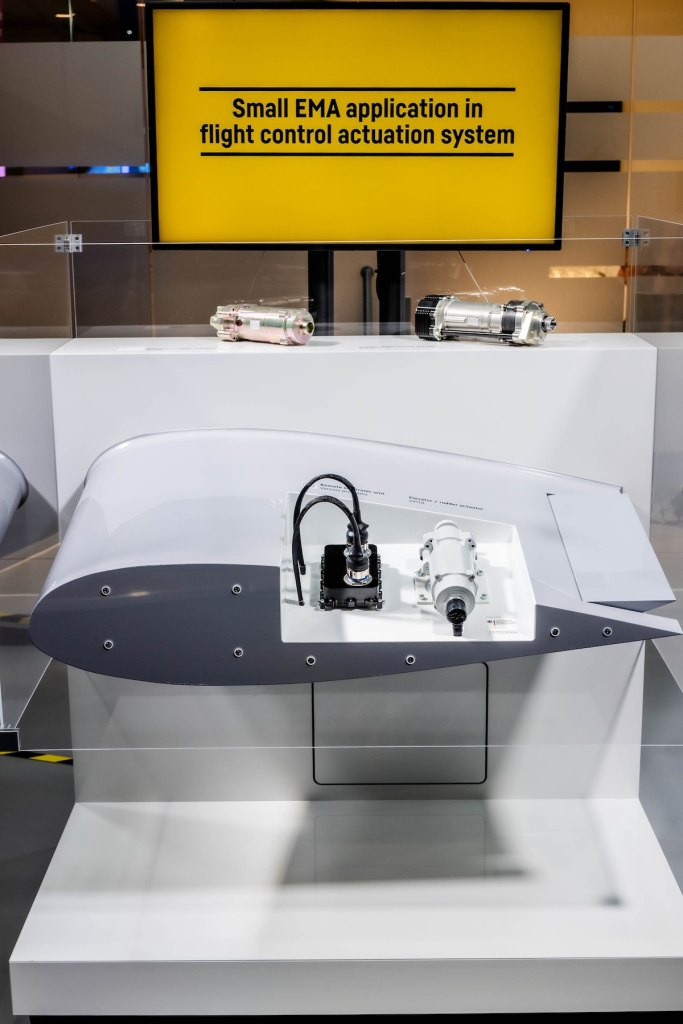
As aerospace engineering advances toward electrification, actuation systems have become a decisive frontier.
Liebherr has long produced hydraulic and electro-hydraulic actuators, but its current focus on electromechanical actuation (EMA) marks a step change in design philosophy.
The company’s EMA family concept, introduced in 2025, brings scalable actuator technology suited for business jets, helicopters, and emerging Advanced Air Mobility (AAM) vehicles.
By converting electrical energy directly into linear or rotary motion, these actuators remove the need for centralised hydraulics—reducing weight, maintenance complexity, and environmental impact.
Liebherr describes its EMA line as compact, power-dense and digitally controlled, building on experience from long-running commercial programmes. In practical terms, this means a lighter aircraft with fewer moving parts, greater reliability, and lower lifecycle cost—all critical to the “more-electric” architectures shaping future OEM roadmaps.
Aftermarket and Lifecycle Support
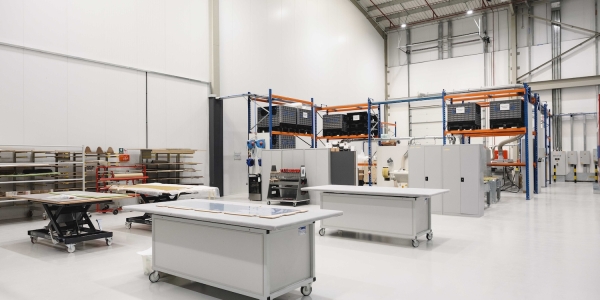
Beyond production, Liebherr sustains its equipment through a network of dedicated service facilities. Centres in Saline (Michigan) and Laval (Canada) handle repair, testing, and component pooling, while European bases in Toulouse and Hamburg manage global logistics.
These hubs reflect the company’s commitment to long-term support, not only for major airframers but also for operators seeking predictive maintenance and system optimisation. The aftermarket division also feeds engineering data back into product development, shortening the loop between field performance and design refinement—a crucial advantage in fleet operations where reliability and turnaround time are key metrics.
Outlook: System Integration as Competitive Edge
Liebherr’s trajectory mirrors the aerospace industry’s most significant transformation: the convergence of mechanical engineering with digital control and electrical efficiency. Its product lines—from landing gear and air systems to actuators and thermal management—are not isolated technologies but interconnected enablers of a broader shift toward intelligent, sustainable flight systems.
In an era where manufacturers and operators seek partners that can deliver both performance and predictability, Liebherr’s system-level integration model stands out. The company’s strength lies in designing the hidden architecture that keeps aircraft stable, comfortable, and efficient—the kind of quiet innovation that defines the evolution of flight itself.
As the company showcases these solutions at NBAA-BACE 2025 in Las Vegas, its message extends beyond exhibition. It is about continuity—the transition from hydraulic to electric, from mechanical durability to digital predictability—and about how a systems specialist continues to shape the next chapter of aerospace evolution.
Also Read: Advancing Air Mobility: Overcoming Challenges, Seizing Opportunities