






- Lufthansa has survived a hundred years by repeatedly reshaping itself — from national carrier to alliance-led network utility — using hubs, fleets and partnerships to absorb every major shock the industry has faced.
- India has long been integral to Lufthansa’s network, supplying resilient passenger demand and high-value cargo that strengthened its hubs — especially during moments when local Indian long-haul capacity fell short.
- Lufthansa’s centenary illustrates a lesson many airlines still struggle with: durability comes from alliances, cargo depth, fleet discipline and efficiency — not growth alone.

Lufthansa’s 100th anniversary in 2026 is more than a milestone. It is a capsule of a century in which aviation learned to defy distance, politics, economics and now carbon. The airline likes to describe itself as a global citizen powered by digital elegance, yet the real narrative reaches far beyond glossy boardrooms and commemorative liveries.
Lufthansa’s past is a record of repeated resurrection — an organisation that answered every crisis with a technological leap, every market shift with a strategic alliance, and every modern doubt with the language of efficiency and sustainability.

The tale opens on January 6, 1926, when, through the merger of Junkers Luftverkehr and Deutscher Aero Lloyd, Deutsche Luft Hansa Aktiengesellschaft was founded in Berlin.
The new company launched its first scheduled services in April the same year, carrying mail, businessmen, journalists and curious travellers across a Europe still recovering from one war and unknowingly walking toward another.
Those early flights stitched together German cities with a punctuality that soon became a cultural habit — timetables treated as promises rather than aspirations.
During the inter-war years, the original Deutsche Luft Hansa acted as Germany’s national airline and a symbol of industrial modernity. It helped establish radio navigation, maintenance routines and airport processes that would later shape European aviation. But the Second World War pulled many institutions into uncomfortable service, and the airline was no exception. Its association with the Nazi government’s war machine is today acknowledged as part of the full historical ledger — a reminder that airlines, like nations, sometimes fly routes they do not choose.

Photo: X/@clark_aviation

Photo: Lufthansa
After 1945, the company was dissolved. The Lufthansa familiar to the modern world was legally established in 1953 as Aktiengesellschaft für Luftverkehrsbedarf, with operations resuming in April 1955. This “second Lufthansa” was essentially a new beginning, born into a divided and rebuilding Germany. What it inherited was not assets, but memory: the discipline of engineering, the pride of service and the burden of history. From that fragile runway, the airline began to grow again.
Not many global companies survive a hundred years without changing themselves; Lufthansa has changed almost continuously. Post-war leaders rebuilt trust in the 1950s and 60s, expanded to the Americas, and prepared for the jet age that would soon make Europe feel smaller than a single map. Management teams learned to treat disruption as permanent weather — strikes, oil shocks, reunification, the rise of Gulf competitors and the pandemic years all demanding new mathematics.


A defining reinvention arrived in 1997 when Lufthansa became a founding member of Star Alliance, the world’s first airline alliance. The idea was radical then: connectivity created through cooperation rather than conquest. Frankfurt and Munich turned into organising hubs for dozens of partner airlines, allowing Lufthansa passengers to reach cities the German flag never flew to directly. Alliances converted the carrier from a national champion into a network utility.

Lately, executive teams have focused on digital transformation and operational efficiency. Ventures such as the Lufthansa Innovation Hub have generated new platforms, APIs, and AI-driven travel services intended to keep pace with a generation that buys tickets on phones and judges airlines by algorithms.
Corporate strategy also evolved through acquisitions and equity investments — most visibly the 2025 purchase of a 41 per cent stake in Italy’s ITA Airways, with options to increase that holding. The move tightened Lufthansa’s European spine and brought more airlines under a unified alliance philosophy.
If leadership provided direction, the fleet provided muscle. Lufthansa’s aircraft history resembles a moving museum: from the Ju 52 propeller workhorse to Constellations, early Boeings and the majestic 747s that redefined scale. Each generation carried a piece of the airline’s personality.
The Boeing 747, inducted in 1970, delivered Lufthansa its second great transformation. Widebody capacity allowed the airline to think in hundreds rather than dozens of seats, lowering per-seat costs and enabling high-volume cargo under passenger floors.
Later decades brought Airbus widebodies, and today the flagships are the Airbus A350 and Boeing 787 Dreamliner families — aircraft that burn around a quarter to a third less fuel than the types they replace, emit up to 30 per cent less CO₂, and stretch range to the length of continents.

By 2024, Lufthansa Group operated more than 700 aircraft and had over 230 Next Gen jets on order, including roughly 100 long-haul machines scheduled for delivery through 2030. Fleet renewal became a prerequisite for competitiveness, customer attraction and sustainability rather than a cosmetic exercise. Hangar One at Frankfurt — where the centennial celebrations gather around restored old-timers — therefore functions as a visual metaphor: witnesses of aluminium standing beside composites of tomorrow.
For India, Lufthansa is remembered not from posters but from departure gates and cargo floors. The relationship began in September 1963 , when services to Delhi were launched via several intermediate points using Boeing 720 equipment. In the decades that followed, Lufthansa steadily expanded to Mumbai, Bengaluru, Chennai, Hyderabad and other cities, treating Frankfurt and Munich as organising hearts for Indian traffic.

Photo: Dirk Grothe/planespotters.net
The 1970s Jumbo-era transformed the India-Europe corridor. Universities in Delhi organised group travel for students; Mumbai agents created early tour packages; families discovered that Europe could be reached without courage. The aircraft cemented hub dependence — Lufthansa preferring to fill deep German metros rather than scatter across Europe, an approach that protected yields whenever India’s own international fleets were thin or inconsistent.
That cushion was tested after the collapse of Jet Airways in April 2019. Jet had provided substantial belly capacity on India–Europe routes; its disappearance pushed thousands of passengers toward Lufthansa Group carriers. The German airline responded by adding frequencies from Delhi and Mumbai while alliance partners redistributed travellers beyond Germany.
For Indian policy makers, the episode carried a blunt lesson: foreign networks provide shields whenever local champions fail, exposing vulnerabilities in owning long-haul capacity.

Photo: Air Cargo Week/ Lufthansa Cargo
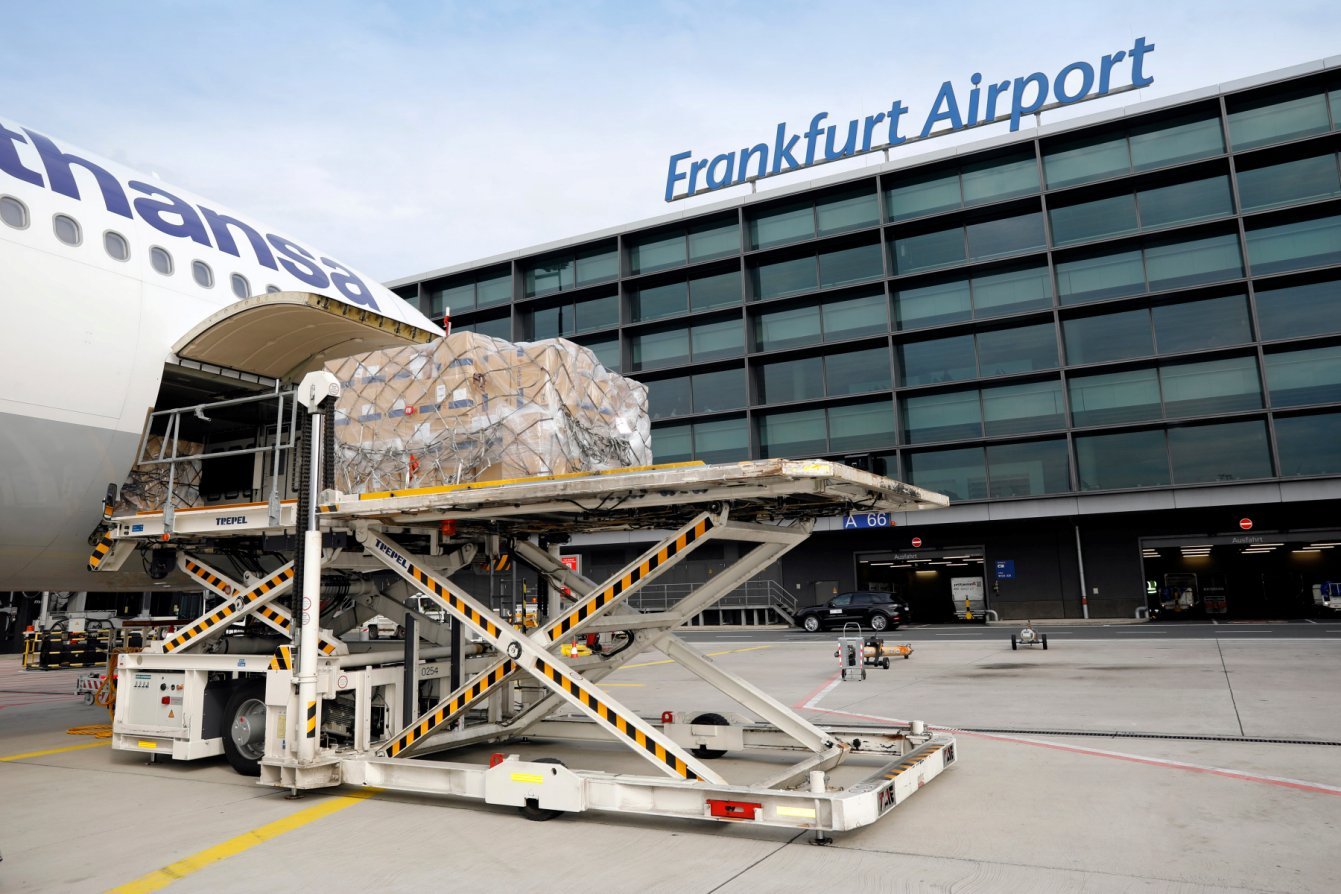
Lufthansa’s influence in India has been particularly evident in cargo operations. Pharma exporters adopted Lufthansa-mandated data loggers to keep vaccines within range; Mumbai and Delhi forwarders learned to time trucks to the minute for German cut-offs. The “Frankfurt cut-off culture” shaped service ethos long before e-commerce gave Indian airports their present frenzy.
The carrier also maintained a notable presence through Hinduja Cargo Services, a joint venture that operated freighters from the 1990s until the partnership wound down as demand shifted toward direct services from European hubs. Even without that venture, Lufthansa Cargo continued to treat Mumbai, Delhi and Bengaluru as strategic nodes for pharmaceuticals, electronics and automotive spares, pushing local handlers toward European-style precision.

By 2026, Lufthansa and partner airlines operate close to one hundred weekly flights between Germany and India, providing tens of thousands of seats each week.
India has become both a travel source and a business corridor for pharmaceuticals, technology and engineering executives. Growth in the premium segment — particularly from Bengaluru’s tech community and Hyderabad’s life-sciences cluster — is now funding competitive economy pricing on the route.
The airline, therefore, views India not as an exotic spoke but as part of its daily arithmetic of intercontinental aviation.
Where Lufthansa once rerouted geopolitics, it now struggles to reroute emissions. The group publicly commits to halving net emissions by 2030, scaling Sustainable Aviation Fuel (SAF) usage and replacing older aircraft with A350/787 types. BASF-backed AeroSHARK film is cutting drag by about one per cent on every flight — a marginal gain that becomes substantial across a tightly packed global schedule.
SAF, first trialled by Lufthansa in 2011, typically yields around 80 per cent lower lifecycle carbon emissions compared with conventional jet fuel, thanks to renewable feedstocks such as used cooking oil and other biogenic residues.
The airline contracts SAF volumes and blends them with traditional kerosene under EU quotas requiring minimum percentages. Lufthansa Cargo has added fuel-efficient Boeing 777 and 747-8 freighters and deployed smarter fuel-planning programs that cut thousands of tonnes of CO₂ annually. Technology, sustainability and efficiency have begun to share the same sentence.

AI and automation are reshaping internal processes as well. In 2025, Lufthansa announced initiatives to reduce administrative roles through AI and streamlined workflows — not as a retreat from flying operations but as a pivot toward operational excellence. Digital brains are meant to support greener wings.
Together with subsidiaries Lufthansa Airlines, Austrian, Swiss, Brussels Airlines, Discover, Eurowings, and the newly integrated ITA, the group transports more than 150 million passengers annually, employs over 100,000 people across 160 nations, and continues to scout for new footprints, such as a potential acquisition of TAP Portugal. Scale remains impressive; the mood remains cautious.
Lufthansa’s century contrasts sharply with India’s pattern, where celebrated brands often collapsed within two decades. The German group protected itself by converting hubs into global utilities and by treating cargo and premium cabins as core engines rather than side shows. Indian carriers, tied overwhelmingly to passenger cycles and high domestic taxation on ATF, rarely built that cushion.

Therefore this anniversary invites scrutiny — in Frankfurt, Munich and equally in Mumbai, Delhi, Bengaluru, Hyderabad and Chennai — because Lufthansa learned to treat trust as daily labour. Its history is not only about aircraft and apps, but about standards that travelled quietly across oceans and shaped markets like India long before India recognised the power of air cargo as a strategic pillar.
As global economies grow more interconnected and sustainability expectations harden into market-access rules, Lufthansa’s lessons of continuity, innovation and strategic foresight will continue to resonate far beyond Germany’s runways — and deep inside India’s own aviation future, which is still learning to build airlines that can live several lives.
Also Read: Air India’s Quiet Revolution: From Rebuild to Global Flag Carrier