











Re-engineering the Edge: How Infrastructure Is Redefining Safety at Mangaluru Airport

- The overhaul at Mangaluru reflects a broader shift toward strengthening safety margins at tabletop airports through infrastructure upgrades rather than relying only on post-incident oversight.
- Upgrades include full runway recarpeting to improve wet-surface braking and broader infrastructure enhancements, including a Category-1 precision approach lighting system to enhance visual guidance during final approach.
- Land acquisition to complete the full runway safety area remains pending, limiting the airport’s ability to achieve the recommended safety buffer.

India’s memory of tabletop runway disasters is long and sobering. In 2020, an Air India Express Boeing 737 overshot Kozhikode’s rain-soaked runway and plunged into a gorge, killing 21 people. A decade earlier, another Air India Express aircraft overshot at Mangaluru and fell into a ravine, claiming 158 lives. Investigations into both pointed primarily to operational factors—unstable approaches, delayed touchdown—yet they also underscored a harsher truth: when terrain is unforgiving, the margin for recovery disappears quickly.
The Kozhikode crash triggered rare judicial scrutiny. India’s Supreme Court sought explanations from aviation authorities on why enhanced stopping systems such as engineered arrestor beds had not been installed at vulnerable airports despite prior recommendations. The moment marked a shift in public discourse—from questioning whether tabletop airports are inherently unsafe to asking whether India’s aviation oversight tends to accelerate only after tragedy.
Criticism of the Directorate General of Civil Aviation (DGCA) has often followed that pattern: post-incident audits, urgent directives, and stricter surveillance. The regulator has ordered “360-degree” safety inspections after incidents, flagged lapses ranging from faded runway markings to unserviceable equipment, and imposed penalties when compliance fell short. Such responses show regulatory muscle, but experts argue they also highlight timing gaps.

Aviation safety specialist Mohan Ranganathan, for instance, had warned as early as 2011 that wet-runway landings with tailwinds at Kozhikode could be hazardous.
After the crash, he remarked that many inspections remain largely procedural until an accident forces deeper scrutiny.
Former DGCA chief Bharat Bhushan has similarly stressed that infrastructure constraints—especially runway length and safety buffers—can compound operational challenges. A runway that is adequate in dry weather, he notes, may prove marginal during heavy rain because stopping distance increases dramatically. Attempts to lengthen such runways often stall over land acquisition, showing how local politics can shape aviation safety as much as engineering.
Those lessons form the backdrop to what is unfolding at Mangaluru International Airport today.
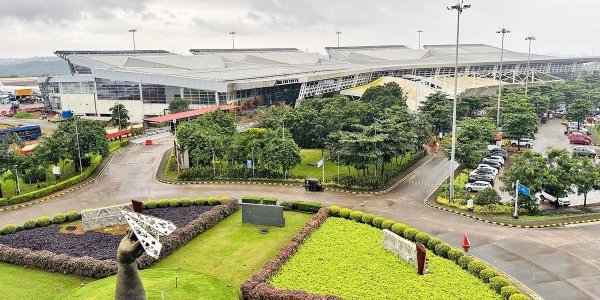
Since taking over operations in October 2020 under a 50-year PPP concession, Adani Airport Holdings Ltd has committed more than ₹800 crore to a safety-centric modernisation programme at Mangaluru—one of India’s most geographically demanding airports. The 2,450-metre runway sits atop a hill flanked by deep valleys, meaning any overshoot can escalate rapidly. Here, infrastructure is not just about growth; it is about survival margins.

Photo: Adani Airports
The most visible upgrades focus on runway performance and approach guidance.
The surface has been fully recarpeted using a flexible asphalt overlay atop rigid pavement—a rare engineering solution designed to improve braking friction during monsoon rain. Centreline lighting has been installed to sharpen pilot alignment cues in poor visibility.
A Category-1 Precision Approach Lighting system is now rising from the valley below Runway 24, mounted on lattice towers nearly 70 metres high. According to Amber Dubey, CEO (Aero) at Adani Airports and former Joint Secretary in the civil aviation ministry, the system will provide pilots with clearer visual references during final approach and, once operational, will make India only the second Asian country, after China, to deploy such lighting at a hilltop airport. Similar enhancements are planned for the reciprocal runway direction.

Safety buffers are expanding alongside these navigation aids. Runway End Safety Areas measuring 240 m × 90 m have been completed on one side and are progressing on the other, while reinforced retaining walls are stabilising slopes to prevent erosion beneath runway edges—engineering that is largely invisible to passengers but critical to structural resilience.
A ₹98-crore parallel taxiway will double aircraft movement capacity from eight to sixteen per hour. Though framed as an efficiency upgrade, it is equally a safety measure: reducing runway occupancy time lowers congestion, pilot workload, and the risk of runway incursions.
Physical improvements go hand-in-hand with tech monitoring. Grouped under Adani’s “Airport in a Box,” systems use sensors, IoT tracking, and real-time data review to watch equipment condition, plane turnaround times, and any strange operations. A 5G network allows fast data transfer, as AI passenger systems ease movement through the terminal, helping keep airside operations on schedule.


Emergency readiness is another priority. Intrusion systems, quick-response tools, and yearly emergency exercises (instead of every other year) assess coordination among rescue teams, air traffic control, and medical staff. Locally, these drills, called “Mangalam,” introduce unexpected issues to simulate real crises and reduce response times.
However, Mangaluru’s key safety improvement is still not done: getting land for a complete runway safety area. Following the 2010 accident, investigators suggested a 140-meter space on each side of the runway’s centre. Right now, only one side meets this requirement. Finishing the other side needs 32.97 acres, still in talks. Without it, the safety range during a runway incident isn’t as wide as it should be.
Other issues exist. Plans to lengthen the runway beyond 10,000 feet were reduced due to land and cost constraints. City growth near flight paths needs strict height restrictions to prevent problems. These limits point to an important fact about tabletop airports: improvements can lower risk, but location sets the limit. The Baramati accident showed again something that aviation experts often say: safety builds up. Facility, rules, training, and control must come together for protection. At tabletop airports, each of these should be strong because the terrain is unforgiving.


If remaining land and regulatory hurdles are resolved, the airport could emerge as a national benchmark for modernising difficult airfields. For travellers descending toward that narrow hilltop runway above the Arabian Sea, the significance is straightforward: aviation safety is no longer defined only by where an airport stands, but by how intelligently it is strengthened.
Also Read: How the Airports Authority of India is Expanding Aviation Infrastructure