














- The global market for regional jets is expanding, driven by rising air travel demand, with India poised for growth despite cost challenges.
- Airlines and manufacturers like Embraer, Airbus, and COMAC are expanding their regional aircraft offerings to enhance connectivity and efficiency.

The market for regional jets is growing globally due to the increased demand for air travel. The growth of regional air travel in India has been slower to take-off due to the high cost environment for commercial aviation which prevails in the country. However, it is quite certain that as the civil aviation market in India continues to grow, there could emerge a sizeable opportunity for sales of regional jets. Regional jets not only offer more efficient connectivity to passengers but also delivers a sizeable competitive economic advantage as compared to using larger single-aisle jetliners such as the Airbus A320neo and Boeing 737 MAX aircraft.
According to a market report released in July 2023 by Allied Market Research, the global regional jet market which was valued at US$5.7 billion in 2022, is projected to reach US$10.6 billion by 2032, growing at a compounded annual growth rate (CAGR) of 6.4 percent from 2023 to 2032. As per the report, the, 80-125 seat regional jet segment is projected to manifest the highest CAGR of 8.3 percent from 2023 to 2032. The 80-125 seat regional jet segment is likely to grow in India as well, in the coming years.
Regional Carrier Expands
One of the most successful Indian regional carriers, Star Air announced an ambitious expansion plan in early November. Capt. Simran S Tiwana, CEO of Star Air, spoke about the airline’s long-term growth strategy, stating, “The addition of these new Embraer E175 aircraft marks a pivotal step in our journey. As we expand our fleet to 25 aircraft, we reaffirm our commitment to reaching more underserved markets and setting new standards in air travel. Each milestone in this expansion brings us closer to connecting more of Real India, offering fast, efficient, and high-quality flying experiences for our passengers.”
Star Air, which presently operates an all-Embraer regional jet fleet, has stated that it will grow its fleet to 25 aircraft in the next 36 months (by 2026). Speaking to CH, a Star Air spokesperson said that as part of this plan, “Star Air will induct two new Embraer E175 aircraft in the current fiscal year (FY25), with an additional four scheduled for FY26.” The airline currently operates a fleet of nine aircraft – four Embraer E175s and five Embraer E145s.
“This fleet expansion reflects Star Air’s commitment to “Connecting Real India” by enhancing access to quality air travel for underserved regions and reinforcing the Government of India’s UDAN (Ude Desh ka Aam Naagrik) initiative, the spokesperson added. The new E175s will allow a regional airline like Star Air to seamlessly increase its deployed capacity and operate more efficiently on existing and upcoming routes. This will strengthen the airline’s ability to offer enhanced connectivity across Tier 2 and Tier 3 cities in India. Star Air began operations in 2019 and has successfully carried over 1.3 million passengers across 22 destinations across states, including Karnataka, Andhra Pradesh, Gujarat, Madhya Pradesh, Rajasthan, Uttar Pradesh, and Maharashtra.
Embraer Eyeing Regional Jet Growth
With Star Air now having been operational for more than five years, Embraer has gained a much needed foothold into India’s growing commercial aviation market. In addition to Star Air, Embraer has close to 20 operators in the Asia Pacific region who are collectively operating approximately 200 E-Jets. According to Embraer, the post-pandemic landscape for commercial airlines is different with demand and booking patterns being different and the business/leisure customer mix also being different. According to the Brazilian airframer, the increase in the average aircraft size flown in key world regions is a reflection of the strong order backlog for new large narrowbodies. But larger aircraft are not always economically or operationally optimal for medium and lower-density markets, particularly when multiple daily frequencies are essential for those cities to stay well-connected.

As per Embraer’s Market Outlook 2024, which was released in July this year at the Farnborough Air Show, Arjan Meijer President & CEO Embraer Commercial Aviation, said, “Some airlines are pursuing a strategy to up-gauge aircraft. Yet we see risks associated with that approach, especially when social changes are driving a shift to regionalization. That, in turn, creates a need for better airline network connectivity as we live, work, and trade in more decentralized communities. It’s a shift that impacts both passenger and cargo aircraft capacity.” He added that, “We believe an optimal mix of sub-150-seat jets and larger narrowbodies is more conducive to the new environment. The market sizes and demand patterns are simply too varied to support a fleet strategy focused solely on larger aircraft. Mixed fleets address that diversity.”
As per Embraer’s 2024 Market Outlook, it foresees world demand for 10,500 new up-to-150-seat aircraft over the next 20 years with a market value of USD 640 billion. Replacement of ageing aircraft will account for 54% of all new deliveries, while 46% will be used to grow markets. World RPKs will reach 17.8 trillion by 2043. Asia Pacific will be the largest market by then, with 38% of global traffic. Combined, Europe and North America will generate the same 38% of total air transport demand.
Embraer is counting on growing the market share of its popular E-Jets family of regional transport aircraft, which have been steadily growing their orderbook. The E190-E2 is part of Embraer’s latest E-Jets E2 family of commercial jets and entered service in 2018. Singapore Airlines, the low-cost subsidiary, Scoot is now operating a fleet of four E190-E2s. The airline commenced operations with the type in May, this year. The E190-E2 is currently the industry’s quietest and most fuel-efficient single-aisle aircraft. Scoot’s E190-E2’s are configured with 112 seats in a 2-2 single class configuration. All aircraft on order are slated for delivery by end-2025. These aircraft will support Scoot’s network growth strategy by serving thinner routes to non-metro destinations out of Singapore. The Brazilian airframer has also been succesful in gaining a new customer in Malaysia, when in May 2023, Malaysia’s SKS Airways closed an agreement to add ten E195-E2 jets to its fleet.
This July, Embraer revealed upgrades to its E195-E2, E190-E2, and E175 aircraft, including fuel burn and range improvements, avionics and cabin upgrades, which were announced at the Farnborough Air Show. In addition to improving the operational effectiveness of the jetliners, these measures would also deliver a net present value of US$ 6 million per aircraft over 15 years in cost reduction and additional revenue. Indian regional carriers are sure to have appreciated the improvements to the E175, which receives E2 features such as
larger overhead bins and mood lighting, Multi-band satellite connectivity, Recaro Seats and Next generation weather and data avionics. The E175 had last been updated in 2016 when Embraer improved fuel burn by 6.4%. The latest improvements available to customers upon request, focus on the cabin and passenger experience, as well as updated avionics that are more in line with the E2 family. The E175’s overhead luggage bin capacity will double in size to be similar to those on the E2, now fitting one bag ‘wheels first’ per customer as in the E2. Mood cabin lighting, as seen on the E2, will also become available, as will new Recaro seats. Satellite connectivity will soon be available for the first time on the E175, a major boost for business travellers and those who want to stay connected in the sky. Both Ku and Ka band satellite connectivity will be available for retrofit by 2026. The data transfer solutions and the weather radar will be upgraded to match the capabilities of the E2. This will enable digital transformation and wireless retrieval of flight data and will be available by Q4/2024The next generation weather radar provides turbulence detection and alert, predictive windshear detection, and 3-D volumetric scanning and will be available by Q2/2026.

Airbus A220 Ready for Regional Operators
Airbus’ marketing muscle and global presence has ensured that orders for the A220 have grown ever since the European airframer took over the programme. Airbus has positioned the A220 as the perfect platform for an airline’s domestic network that includes everything from short hops to flights of five hours and beyond. While no Indian carrier has currently placed orders for the A220, it could simply be a matter of time before an order for this modern and fuel-efficient jetliner is obtained. The A220 is promoted as the most modern airliner in its size category. Specifically designed for the 100 – 160 seat segment, it can fly up to 6,700 kilometres and offers the largest cabin, seats and windows in its class, for superior passenger comfort. The A220 is available to airlines in two versions, the -100 variant, seating between 100 – 130 passengers and the larger -300 variant, seating between 130 – 160 in typical layouts. The A220 is powered by Pratt & Whitney’s PW1500G geared turbofan engines.
Airbus had actively promoted the A220 for the Southeast Asian market during a regional tour with the aircraft in May 2023. The aircraft was displayed at the LIMA International airshow in Malaysia, with Airbus citing the aircraft’s capabilities, stating that the aircraft would enable carriers to offer direct non-stop services between any two points in Malaysia and regional services to destinations afield such as Darwin and Perth in Australia, the Middle East, Tokyo and Seoul. The aircraft on display at LIMA 2023 was leased by Airbus from airBaltic and featured a 148 seat single-class layout. Following the stop in Langkawi, the aircraft continued on its tour to visit Kuala Lumpur, Jakarta, Bangkok and Koh Samui.
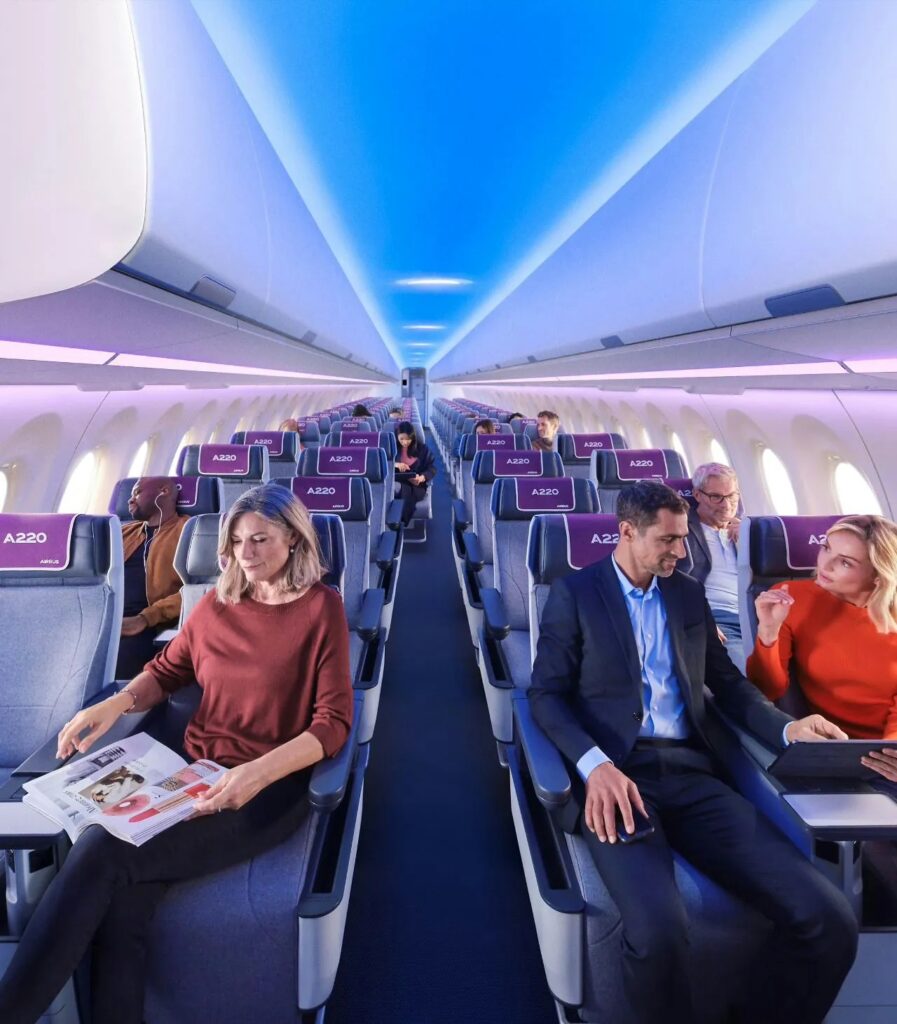
Airbus, which has reported its consolidated financial results for the nine months ending 30 September 2024, stated that the A220 programme will continue towards a monthly production rate of 14 aircraft in 2026, with a focus on financial performance. Airbus had received more than 900 orders from around 30 customers for the A220, (as of 30 July, 2024). Over 350 aircraft have now been delivered by Airbus, and the A220 is in service with more than 20 operators worldwide on 1,400+ routes. Over 100 million passengers have flown on the A220. The A220 Family is produced under the management of the Airbus Canada Limited Partnership, in which 75% is held by Airbus and 25% by the Government of Québec. The programme is based in Mirabel, Quebec, where operations include programme management, engineering, customer support and services. Mirabel is home to the main A220 final assembly line, and a second assembly line has been established in Mobile, Alabama, to serve the U.S. market.
China Growing Regional Jet Aspirations
China is a new entrant into the world of commercial aviation with the Commercial Aircraft Corporation of China’s (COMAC) C919 and ARJ21 (Advanced Regional Jet for the 21st Century) commercial jetliners. COMAC has stated that it plans to attain a production capacity of 150 C919s annually by the end of the decade and it presently has a production capacity for 50 ARJ21s annually. COMAC has delivered 11 C919s till date with the aircraft having been operated on nine routes in seven cities, carrying over 700,000 passengers. COMAC has produced over 150 ARJ21s till date and the aircraft has been operated on more than 600 routes in more than 150 cities, and carried more than 17,000,000 passengers. COMAC is also developing the CR929 long-range widebody dual-aisle jetliners jointly in partnership with Russia. The baseline CR929-600, will have a range of 12,000 km and seat 280 passengers. COMAC will also develop the smaller CR929-500 and the larger CR929-700.
While the C919 is technically in the class of the Airbus A320 and Boeing B737 MAX, it will more likely compete in the market for regional jets in export markets outside of China. The C919 can seat between 158 to 192 passengers and will have a range of 4,075 to 5,555 kilometres. Its cockpit is equipped with a new generation of integrated side stick controls and five 15.4-inch HD displays. The C919’s cabin has an aisle height of 2.25 m, and its middle seats are slightly wider than the seats on both sides.
China Southern and Air China took delivery of their first C919 aircraft in August this year. The first C919 aircraft of Air China is an Extended Range version of aircraft in two-class layout with 158 seats, including eight Business Class seats and 150 Economy Class seats. The first C919 aircraft of China Southern is a standard range version of aircraft in three-class layout with 164 seats, including eight Business Class seats, 18 Premium Economy class seats and 138 Economy class seats. China Eastern Airlines (CEA) was the launch operator of the C919, and had taken delivery of its first brand-new aircraft in December, 2022. The registration number of CEA’s first aircraft, B-919A, corresponds to “B”, which represents the Chinese nationality of the aircraft, “919” for the aircraft type, and “A” for the first aircraft. B-919A completed its first commercial flight from Shanghai to Beijing in May, marking a major milestone in Chinese civil aviation history. The CEA flight, took off as MU9191 from Shanghai Hongqiao International Airport with 128 passengers on board and touched down at Beijing Capital International Airport.
CEA took delivery of its second C919 in July. CEA is one of the three largest state-owned airlines in China and the seventh largest airline in the world. It has a route network covering 1,062 destinations in 170 countries. CEA placed orders for five C919 aircraft with COMAC in March 2021. As per the Chinese airframer, the C919 currently has orders for 815 aircraft from 28 customers. COMAC launched the C919 project in 2007 and the aircraft made its maiden flight in 2017. The first C919 aircraft rolled off the COMAC production line in Shanghai in November 2015.
The ARJ21 aircraft is short-medium range regional jet, which can seat 78 to 97 passengers, with a range of 2,225 to 3,700 kilometers. The aircraft has five seats in each row. The ARJ21-700 is the basic aircraft of ARJ21 family, and its passenger basic layout has three types: mixed class with 78 seats, full economy class with 90 seats and premium economy class with 68 seats. The twin CF34-10A turbofan powered ARJ21, has a high horizontal tail and tricycle retractable landing gear. Its cockpit is designed for a two-member crew. To meet the requirements of different regions and different route structures for regional aircraft, the basic ARJ21 has a Standard Range Version (STD) and an Extended Range Version (ER).
The ARJ21-700 aircraft obtained the Type Certificate from Civil Aviation Administration of China (CAAC) in December 2014 and the Production Certificate (PC) from CAAC in July 2017. Indonesian carrier TransNusa, was the first overseas customer for the ARJ21, taking delivery of its first aircraft in December 2022. TransNusa’s ARJ21 is configured in an all economy-class cabin layout with 95 seats. Since its entry into service, the ARJ21 aircraft has been delivered to Chinese carrier’s such as Chengdu Airlines, Jiangxi Airlines and Air China.