















- “Pilot mental health” is a symptom, not the problem — driven by extremely long duty hours, minimum rest, and restrictive employment conditions, says Captain Shakti Lumba.
- Despite updated FDTL norms aimed at reducing fatigue, implementation challenges and exemptions mean many pilots still face roster pressure and unreported exhaustion.
- With no transparent data, limited pilot freedom to switch jobs, and no structured return-to-fly pathway, experts warn India must reform fatigue policies and acknowledge systemic causes before safety is compromised.

Aviation was a profession defined by discipline, stability, and rigid systems designed to minimise human error. Yet today, India’s aviation sector finds itself confronting a situation that has been building silently, but steadily, pilot fatigue and the mental-health problems that follow. Therefore, it becomes critical to analyse pilot fatigue and the mental-health problems that follow.
Veteran aviator Captain Shakti Lumba, who flew from 1969 to 2010, puts it clearly: “At that time, we had not even heard of pilot mental health, and it was not an issue. Pilot mental health became an issue with the expansion of IndiGo and the takeover of Air India by the Tatas.” The shift, he argues, coincided not with changes in pilots themselves, but with profound restructuring in how Indian airlines scheduled, managed, and controlled their cockpit workforce.
In Lumba’s view, the term “pilot mental health” misleads more than it clarifies. What manifests as anxiety, burnout or depression, he argues, is the outcome, not the root cause. “When you look at pilot mental health, don’t look at mental health alone as it is a symptom, but look at what are the causes, which are extremely long duty hours, minimum rest and no time for family. These are the main reasons. You cannot address pilot mental health unless you address these issues.”
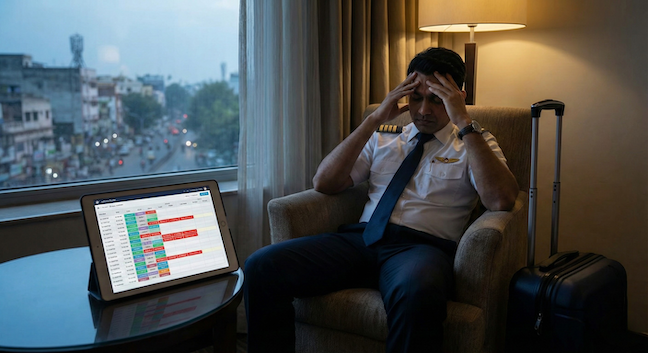
India’s aviation boom has led to tightly stretched rosters designed for relentless efficiency.
Pilots often describe schedules that push them to the very edges of legal limits, limits that many experts argue are outdated and not based on modern fatigue science.
Lumba is scathing: “The main cause of pilot mental health issues is airlines and the way they schedule pilots, which is to the legal maximum limits and legal minimum rest.”
In other countries, a fatigued or dissatisfied pilot might switch employers or move to a carrier with better schedules. In India, this option is severely restricted. “Most pilots are bonded with their airline for five years,” Lumba explains. On the other hand, he has a DGCA notice period. There is not even the option to leave his job.”
This lack of mobility has deepened what many pilots experience as entrapment. Lumba goes further: “There is an understanding between Air India and IndiGo that they will not take each other’s pilots. All this adds up to pilot mental health.”
Foreign airlines, often cited as an escape route, are rarely a realistic option. “Very few go to foreign airlines because they have responsibilities here. Foreign airlines are not hiring that much. They’re only hiring co-pilots and not hiring captains.” Even the conversation around foreign hiring, he argues, has been manipulated. “Foreign airlines are a non-issue. It is the issue created to close pilot options. Created by the Federation of Indian Airlines, FIA, with MoCA, to give the Indian pilot no option but to only stay in the airline he is bonded to.”
The result is a workforce that often feels cornered. Experts are clear that performance degrades significantly beyond 10 hours of duty, especially during circadian lows and consecutive night operations. NASA studies recommend 10 hours for short-haul as a baseline, extendable only to 12 under tightly controlled conditions. India’s historical regulations? 13 hours, extendable to 16.
Lumba argues that the regulator’s rules have been shaped more by airline pressure than safety science. “The DGCA’s FDTL has been made in coordination with the airlines, and it’s been amended from time to time on airline requirements. So DGCA is not interested in fatigue management or anything. They’re interested in keeping the airlines flying.”
Regulators face a delicate balancing act of protecting the flying public while removing disincentives for pilots to seek care. In recent years, the US Federal Aviation Administration has taken steps to expand special-issuance pathways for certain antidepressants, increase mental-health training for aeromedical examiners, and convene rule-making panels. These are aimed at lowering barriers without compromising safety.
The FAA’s Mental Health ARC and guidance packages reflect a shift toward treatment-friendly policies and faster, more transparent return-to-fly processes. Yet critics warn that disclosure rules and cumbersome certification procedures still deter many from coming forward.
India’s rapid growth and chronic pilot shortages mean that rosters are often built to the maximum permissible duty rather than what is scientifically advisable. Pilots routinely report fatigue but fear being labelled uncooperative or unfit.
This produces a silent epidemic, which is unreported exhaustion.
Perhaps the most striking illustration of the systemic pressures comes from the way leave is treated. Lumba highlights a little-known operational reality: “The mandatory off-time regulations are counted even when a pilot takes a casual leave. So there is no real downtime.”
This effectively cancels out the rest designed for fatigue recovery.
He reiterates the absurdity: “The mandatory off-time for pilots is often counted even when someone takes a casual leave. So, in effect, they’re cornered from all sides — by the airline, by the DGCA, and by the system itself. This constant pressure and lack of genuine rest are at the root of the growing mental health crisis among pilots.”
With rest eroded, rosters stretched, mobility restricted, and fatigue unacknowledged, pilots find themselves with few avenues for relief.
One of the most significant obstacles to reform is a lack of transparent data. As Lumba notes, “There is no appropriate data available on what percentage of aviation professionals tend to experience prolonged psychological effects. Both airlines and pilots suppress it. What is required is data from the DGCA about how many pilots are temporarily medically unfit.”
Without data, there is no trigger for policy change. No number to quantify the scope of the crisis. No yardstick for progress. Unlike other high-risk professions, aviation in India lacks a structured, graduated return-to-duty system. Lumba highlights this flaw: “There is no system of gradually introducing into flight duties. The pilot has to report sick and take treatment. He has to report fit, and he starts flying.”
Such binary rules discourage pilots from reporting problems early, when intervention could prevent deterioration.
Asked what mindset shifts or strategies help pilots regain confidence, Lumba places the responsibility squarely on operators: “The airlines themselves must address the issue and rectify themselves. Ultimately, pilot mental health affects the airline. So, each airline should have a programme to address the causes of pilot mental health and they have to be truthful about it.”
Airlines cannot create safe spaces for reporting or treatment, he argues, until they acknowledge their role: “They have to first look at it sympathetically themselves. They have to first own up to the fact that they are the cause of pilot mental health. Only then can they proceed forward. If they don’t think they’re the cause of it… then there’s no solution. It’s an industry problem.”
The stakes, ultimately, are too high for complacency. For India, one of the fastest-growing aviation markets in the world, this is an inflexion point. The industry can either modernise its fatigue management systems and align with global best practices, or continue walking a risky tightrope where safety depends not on systems but on individual resilience.
Also Read: Pilot Mental Health Is Aviation’s Next Safety Frontier