












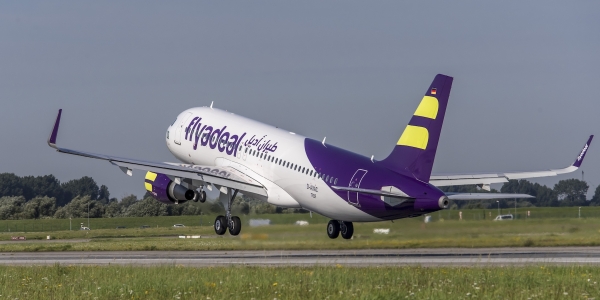


- India’s commercial MRO sector could attain its hidden potential with a critical mass of a large domestic aircraft fleet and a more supportive regulatory framework.
By all accounts, India should have a thriving domestic Maintenance, Repair and Overhaul (MRO) industry with a commercial aviation sector that is booming as never before. In 2023, scheduled airline operators had inducted 112 aircraft in their fleet, and the total number of aircraft in commercial service in India now is over 800 aircraft. Indian domestic airlines have over 1,100 aircraft on order, and the demand to maintain these aircraft is expected to double the size of India’s MRO industry from Rs 16,500 crore currently to Rs 33,000 crore over the next seven years.
India’s geographical location should also be advantageous in allowing domestic MRO players to offer their services to numerous international airlines, making them competitive global players in the MRO industry. The actual picture, however, is not as rosy with a large quantum of MRO work today, especially those related to engines still being performed outside India. Speaking to Cruising Heights, Pulak Sen, Founder Secretary General of the MRO Association of India, said, “We welcome the reductions in GST for the MRO industry; however, to get the entire benefit of these incentives, the volumes in India’s MRO industry need to grow, especially for the private sector players.” As of March 2017, there were 110 approved MRO firms in India, of which only seven were capable of carrying out aircraft overhauls. This number has not grown significantly. The Indian MRO market, which was worth approximately Rs 12,750 crore in 2021, has grown to Rs 17,000 crore today.
Policy Reforms to Drive Growth
As compared to years past, the Ministry of Civil Aviation (MoCA) appears to be seized of these challenges; Union Minister for Civil Aviation, Rammohan Naidu, in August emphasised the government’s commitment to creating a robust environment for both domestic and international airlines to access world-class MRO facilities in India. “We are not only focusing on the needs of Indian airlines but also aiming to attract international carriers to use our MRO services, including in strategic locations like Thiruvananthapuram,” he said while speaking in the Lok Sabha. He added that the Government was open to extending a Production Linked Incentive (PLI) scheme to the MRO industry to further accelerate its development, should the industry demand it.
Several reforms have been introduced in the regulatory framework to help make the Indian MRO industry more competitive. Perhaps the most significant of these is the landmark decision notified this July, whereby a uniform IGST of five per cent shall be applicable for all parts of aircraft/ aircraft engines and Auxiliary Power Units (APU). Previously, the varying GST rates of 5 per cent, 12 per cent, 18 per cent, and 28 per cent on aircraft components had created challenges, including an inverted duty structure and GST accumulation in MRO accounts. The uniform rate of five per cent IGST will apply to imports of parts components, testing equipment, tools and toolkits of aircraft, irrespective of their HSN classification subject to specified conditions.
As part of the announcements made in the Union Budget 2024-25, the Government of India has extended the period for exporting goods imported for repairs from 6 months to 1 year. Also, the time limit for re-importing goods for repairs under warranty has been extended from three to five years. Transactions subcontracted by foreign original equipment manufacturers (OEMs)/MRO to domestic MRO are now treated as ‘Exports’ with zero-rated GST from 1 April 2020. The customs duty on tools and toolkits had already been exempted earlier.
Additionally, the government has allowed 100 per cent Foreign Direct Investment (FDI) via the Automatic Route for MROs, aimed at achieving the best possible Turn Around Time (TAT).
Unmatched Potential
The MRO industry world over thrives on cost-efficiency for which large volumes over an extended period of time are required. The large aircraft fleets with Indian carriers, especially those related to the Airbus A320 and Boeing 737 families and their high frequency of operations, will generate significant MRO demand. This means that the much-needed economies of scale will now add to the traditional strengths of the Indian MRO industry, which are related to a predominantly young, English-speaking workforce and low labour costs. The reduction of GST for MROs in India to five per cent will now allow MRO firms within the country to be competitive with MRO providers in Singapore and Malaysia, where they pay a seven per cent tax rate.
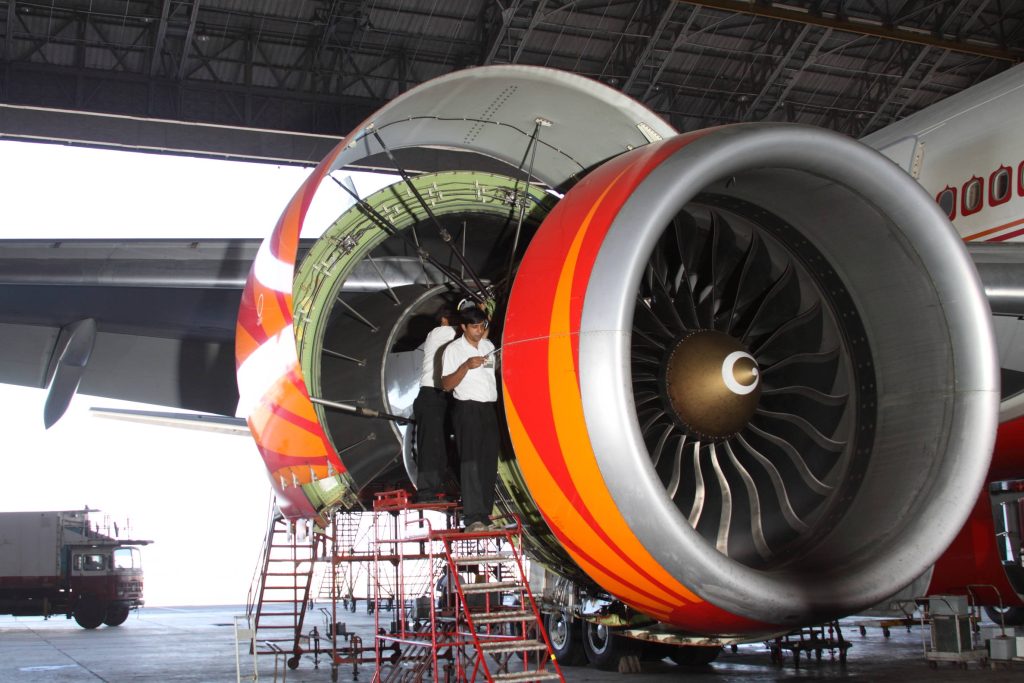
Aircraft MRO can be categorized into four major segments: Line Maintenance, Component Maintenance, Engine Maintenance and Airframe Maintenance. Engine and APU maintenance constitute approximately 60 per cent of the costs of the four categories described, and this is the area where Indian MRO is the weakest. Sen says that strong efforts need to be made to bring engine MRO to India as it is extremely capital-intensive, with nearly 80 per cent of its costs being related to the cost of spares. He cautions that unless India develops a credible engine MRO capability, the overall MRO industry may not grow as quickly as anticipated.
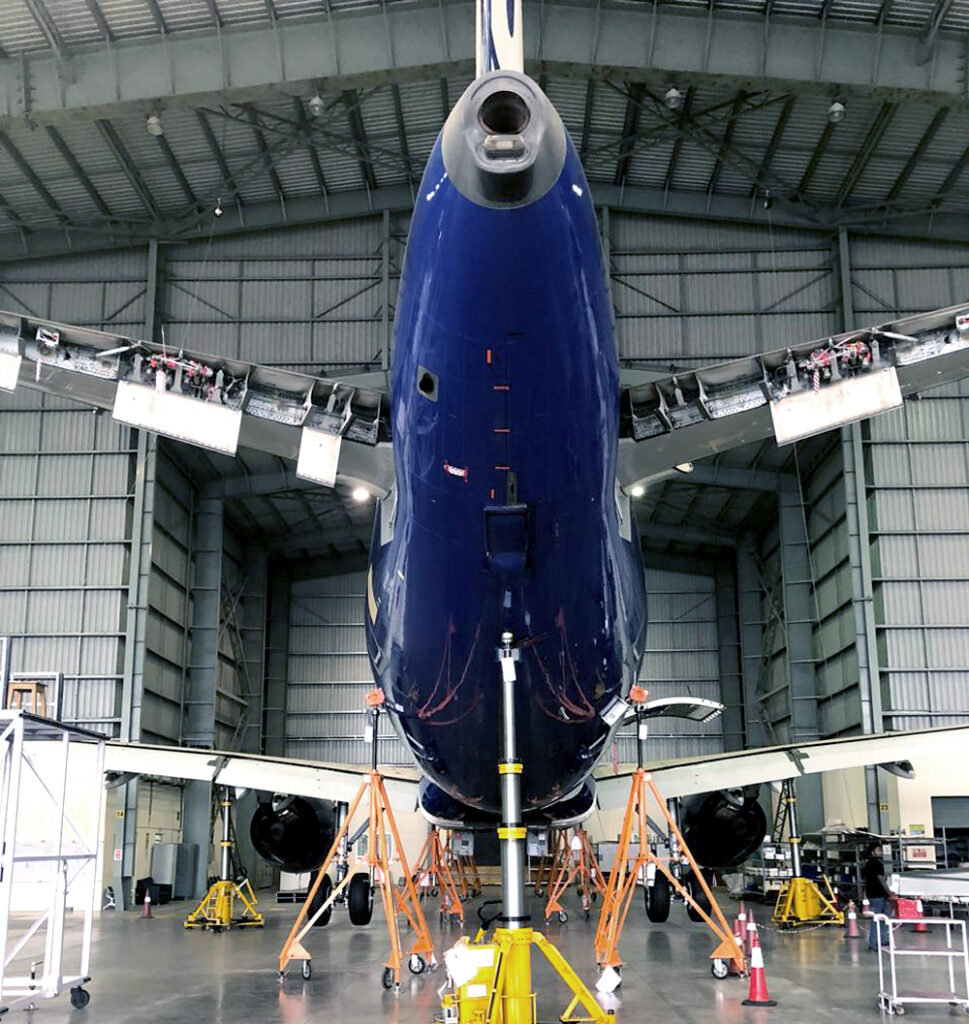
It is estimated that airlines spend, on average, anywhere between 12-15 per cent of their annual revenues on aircraft maintenance, their second most expensive cost after Aviation Turbine Fuel (ATF) expenses. While most airlines typically undertake A and B checks on their own, the more time-consuming and expensive C and D heavy maintenance checks are often undertaken by 3rd party MRO firms. At present, Indian MRO firms have developed deep capability in airframe MRO, but the costly and complex engine MRO work is undertaken abroad. Indian MRO firms are also well experienced with aircraft modifications and cabin upgrades as well. There is, however, no major helicopter MRO facility in India except for Pawan Hans and Hindustan Aeronautics Limited (HAL).
Indigenous MRO Firms Key to Growth
AIESL began operations in February 2013 and remains under Government control as part of AI Assets Holding Ltd. following the sale of Air India to Tata Group in 2022. It remains the biggest player in Indian MRO in terms of revenue, infrastructure and professional manpower. In FY 2022-23, AIESL’s total revenue increased to Rs 2029.86 crores, and the company handled around 450 aircraft.
AIESL reported a revenue of Rs 127 crore for 2016-17. AIESL provided Line Maintenance Services to Air India’s long-haul fleet along with various international operators such as Jazeera Airways, Oman Airways, Malaysian Airlines, Kuwait Airways, Tiger Scoot, China Airlines, MA Indo Airlines, Egypt Air, etc. and Indian operators including Air Asia India, Go Air, SpiceJet, Fly Big, and TATA Vistara.
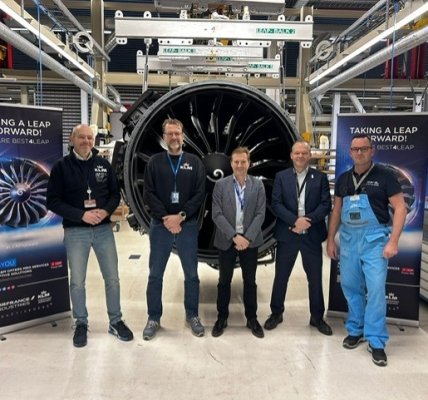
AIESL has undertaken capability enhancement for CFM LEAP1A aircraft checks and is also undertaking Phase 1 checks of Pratt & Whitney PW1100G-JM engines. At its Nagpur MRO, its Engine Test Cell has acquired approvals from EASA & FAA for testing of GEnx & GE90 engines. GEnx engines Quick Turn (QT) maintenance checks are undertaken at Nagpur.
In March this year, Boeing entered into an agreement with AIESL to work together to enhance aircraft maintenance training in India. “The tie-up with Boeing on maintenance training in the fastest growing aviation market will go a long way in supporting industry requirements. AIESL would be able to support training requirements for at least 100 engineers each year going forward,” said Sharad Agarwal, CEO of AIESL.
Air Works Group, established in 1951, is India’s largest, privately owned, integrated provider of aviation services to scheduled airlines, organizations and individuals owning/operating aircraft, as well as the nation’s defence services and leading institutions. Today, Air Works is India’s largest provider of International Line Maintenance services to global airlines and the most diversified MRO in the country with a pan-India presence in 27 locations with close to 1,500 employees and is certified to maintain more than 50 aircraft types. It undertakes base maintenance for ATR 42/72, A320 and B737 family of aircraft as well as medium and large business jets at its EASA and DGCA-certified facilities, including Mumbai, Delhi, Hosur and Kochi, supported by duly certified, in-house shops.
GMR Aero Technic (GAT), the MRO division of GMR Air Cargo and Aerospace Engineering Ltd. (GACAEL), is another of India’s leading MRO firms based at Rajiv Gandhi International Airport, Hyderabad. It has completed over 600 major checks to date, and its clientele includes all domestic airlines and 19 International airlines. It also provides line maintenance services at 13 airports to 20+ International customers.
In January this year, GAT announced partnerships with Lufthansa Technik AG (LHT) and Spirit Aero System at the Wings India 2024 airshow in Hyderabad. GAT and LHT have mutually agreed to bring Cyclean, an efficient and eco-friendly engine cleaning system, to Indian airports. Cyclean saves water and fuel and cuts down on emissions by washing aircraft engines. GAT also entered into a strategic partnership with Spirit Aero Systems to establish a cutting-edge Aircraft Nacelle component repair service at the GMR Aero Technic Base Maintenance Facility in Hyderabad. In March 2023, GAT was awarded a contract by Boeing to convert 737-800 passenger aircraft into a 737-800BCF configuration, becoming the first Boeing Converted Freighter (BCF) partner located in India. India is the 4th location after China, the UK and Costa Rica, where freighter conversion work will be performed for the B737 BCF programme.
Upward Trajectory
It has taken a long time, but in the years to come, India’s MRO industry will finally be able to compete with more established competition in Singapore, Malaysia, Thailand, and Indonesia. A capable homegrown MRO industry is vital for the growth of aviation in any country, and it would be fair to say that there is now the critical mass of a large aircraft fleet, sufficient numbers of qualified maintenance personnel, a friendlier regulatory environment and global support for the rise of Indian aviation in general and the MRO industry in particular.