










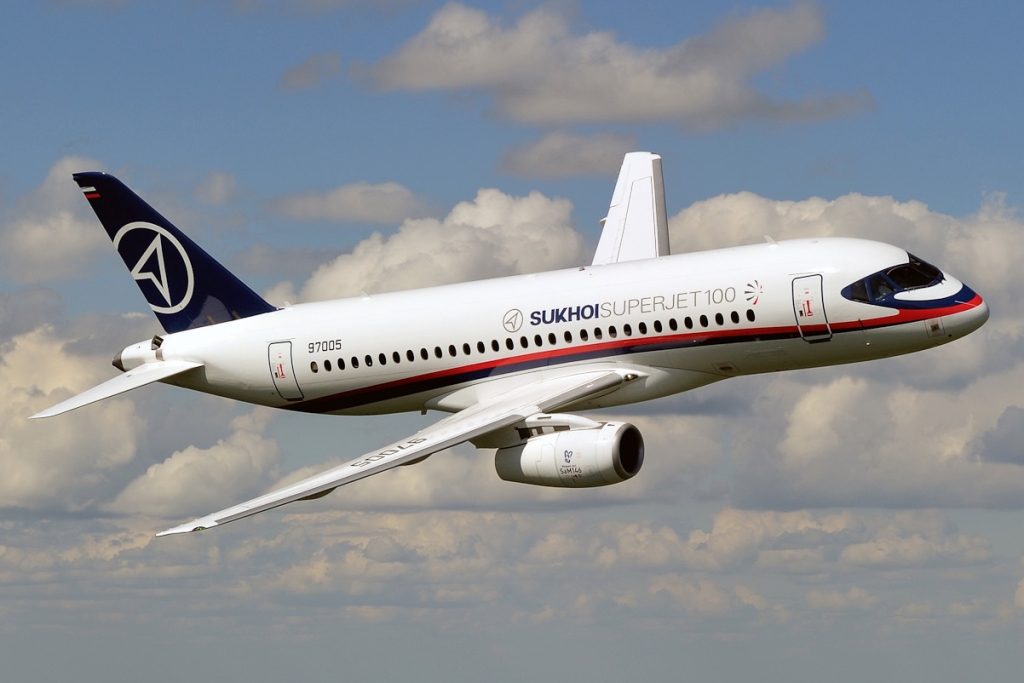
- On September 5, 2025, the Russian SJ-100 Superjet completed its maiden one-hour test flight, reaching 500 km/h.
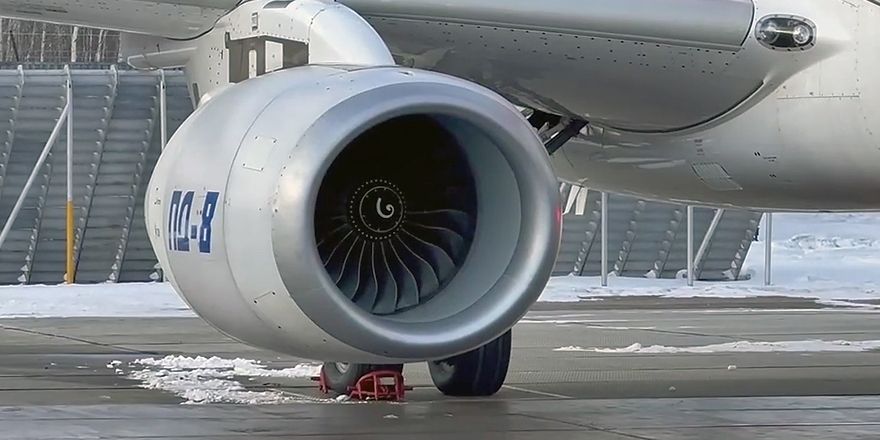
- Heralded as the centerpiece of Russia’s import-substitution drive amid Western sanctions, indigenous PD-8 engines and systems power the SJ-100 regional jet.
- The SJ-100 faces certification challenges in addition to sanctions and will take years, if at all, to gain international recognition, unlike China’s COMAC C909, which just launched international operations.
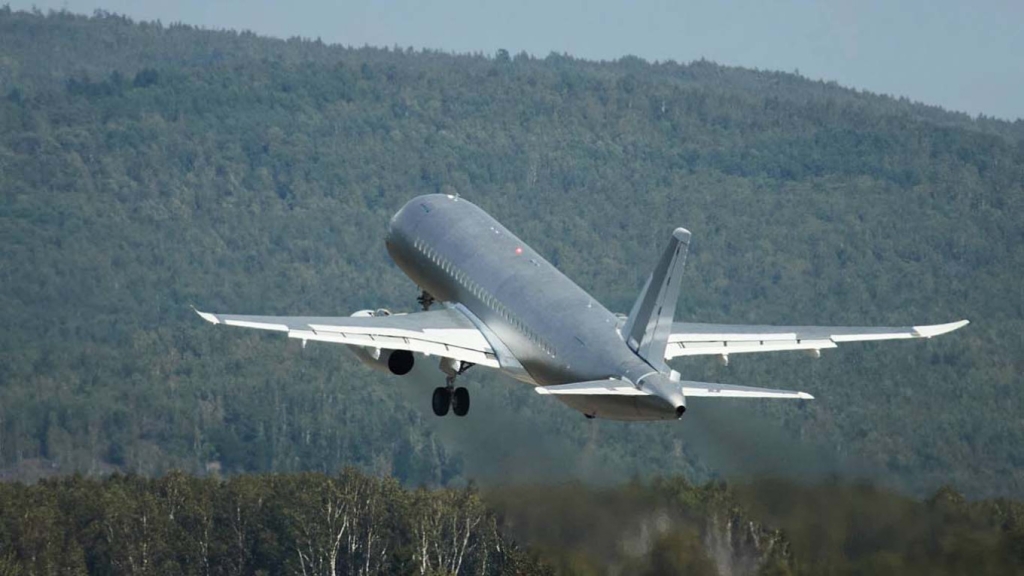
When Russia’s new SJ-100 Superjet lifted off for its first test flight on September 5, 2025, it was more than just another maiden sortie for an aircraft. For Moscow, the one-hour flight at 500 km/h and 3,000 meters represented both defiance and necessity: a bid to build a self-sufficient aviation industry cut off from Western technology.
The SJ-100 is the latest product from the Sukhoi Superjet family—but with a difference: it has nothing from the West in terms of avionics, engines, and components. All its components, from the fuselage to the flight controls and the new PD-8 engines, have been manufactured in Russian factories.
Incidentally, the PD-8 engine, described by Rostec chief Sergey Chemezov (Rostec is the state-owned conglomerate overseeing the project) as the “heart of the aircraft,” is scheduled to receive type certification by fall 2025. Achieving certification is a crucial step before progress can be made toward validating the fully import-substituted version of the SJ-100.
Overall, approximately 40 foreign-made systems and components—including avionics, landing gear, auxiliary power units, integrated control systems, power supplies, air conditioning, and fire protection systems—must be replaced.
However, Rostec has not yet clarified which replacements have been completed, which are still under development, or provided a timeline for the project’s full completion. Rostec has 24 aircraft in production at its Yakovlev facility in Komsomolsk-on-Amur.
Hype apart, a question that is doing the rounds is: Can this 100+ seater aircraft compete with Boeing, Airbus, or even China’s surging COMAC?
The SJ-100’s September test was not the first time it was in the air. Earlier prototypes had flown across Russia in April and June, including a 6,000-kilometre hop from Komsomolsk-on-Amur to Zhukovsky near Moscow. This time, however, the symbolism was heavier.
Since the invasion of Ukraine in 2022, sanctions have cut off Russia’s access to the global aerospace supply chain. Western parts, from avionics to landing gear, are off-limits. Russia’s once-promising Superjet program—originally developed with foreign partners like France’s Safran—faced brakes midway.
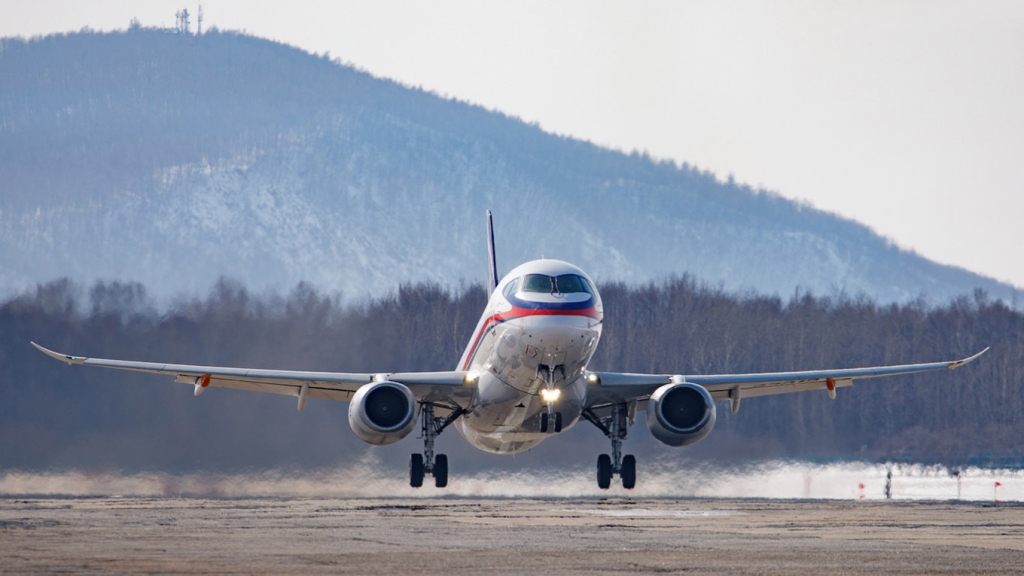
Well-known as the “Superjet New”, the SJ-100 is Russia’s answer to Airbus and Boeing, among others. On paper, the SJ-100 is in the same league as Embraer’s E-Jets or the COMAC C909 (formerly the ARJ21): a regional jet carrying 80–100 passengers on short-haul routes.
Official reports point out that it has replaced “dozens” of foreign-made components. Yet, there are no signs of certification: more than 200 test flights are needed before Russia’s civil aviation authority will approve the type for mass production. Deliveries are unlikely before 2026.
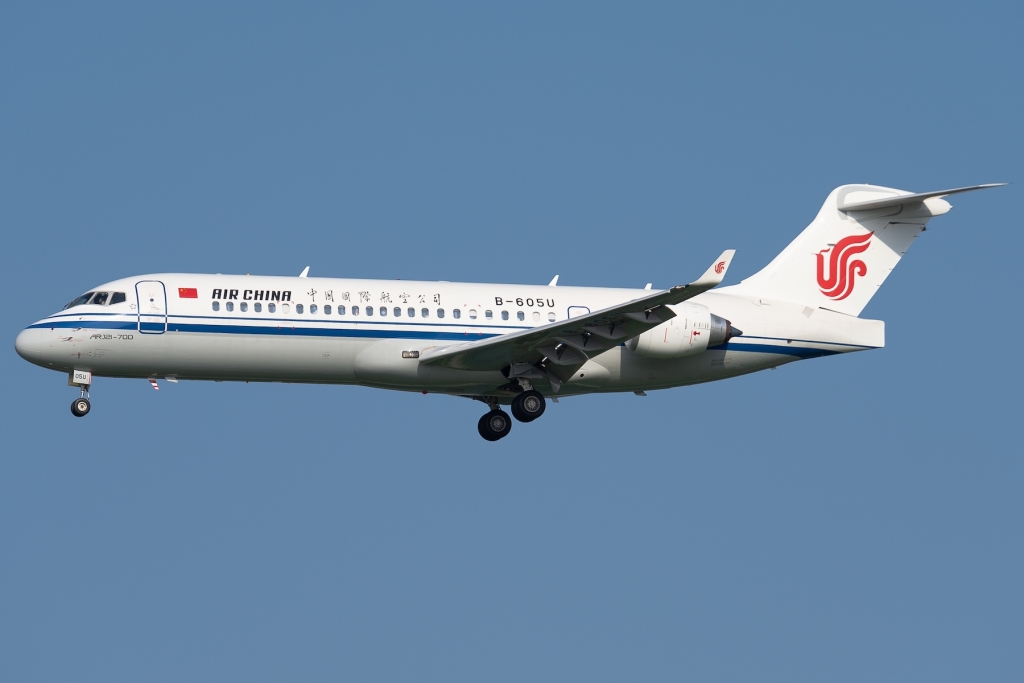
Brazil’s Embraer has made a name for itself globally, while China’s C909 has just completed its first international commercial flight to Mongolia, even as the SJ-100 is boxed in by geopolitics.
It cannot be certified by EASA or the FAA as long as sanctions persist, which means no access to lucrative international markets.
That makes the SJ-100 less of a commercial aircraft and more of a strategic project—one designed to ensure Russian airlines have replacements for ageing Boeing and Airbus planes that can no longer be maintained with Western parts.
It may be pointed out that its rival, China’s C909, a 78–90 seat regional jet, has already carried over 24 million passengers since entering service in 2016 as the ARJ21. In July 2025, it flew its first international route—from Hohhot in China to Ulaanbaatar, Mongolia. The C909’s maker, COMAC, is boosting its reputation by moving slowly into regional international markets. With 166 aircraft delivered, strong political backing, and growing export interest in Asia, the C909 is steadily gaining traction.
Russia’s SJ-100, meanwhile, is still struggling to clear its own test schedule. Aviation analysts note that while COMAC still depends on imported GE engines and faces certification barriers in Europe and the U.S., its head start and scale put it miles ahead of Russia’s effort.
Also, can the SJ-100 be a future challenger to Boeing’s 737 or Airbus’s A320. In fact, there is no comparison. The 737 and A320 families carry 150–200 passengers and dominate the global narrow-body market, while the SJ-100 is a 103-seat regional jet, closer to Embraer’s E2 family or COMAC’s C909. More importantly, its operational reliability is still questioned. The older Superjet 100s were notorious for spare parts shortages and high downtime, factors that crippled their appeal even in friendly markets.
Rather than threatening Boeing or Airbus, the SJ-100 is more about replacing Western aircraft inside Russia. Its role is inward-looking, not globally competitive.
There is no question that Russia’s engineers have pulled off an achievement under extraordinary constraints. Developing a domestic jet engine like the PD-8 and integrating it into an airframe is no small feat.
Aviation analysts point out that the success of an airplane does not depend on one-off flights but on sustained reliability, certification, and support networks. Russia is way behind on these factors. While COMAC plans to triple deliveries by 2030 and gradually move away from the Airbus-Boeing duopoly, Russia is still trying to get a single aircraft certified at home.
The maiden flight of Russia’s SJ-100 can be termed a milestone—but only for Russia. It showcases resilience in the face of sanctions and keeps alive Moscow’s ambition of aviation independence.
Side-by-Side Comparison
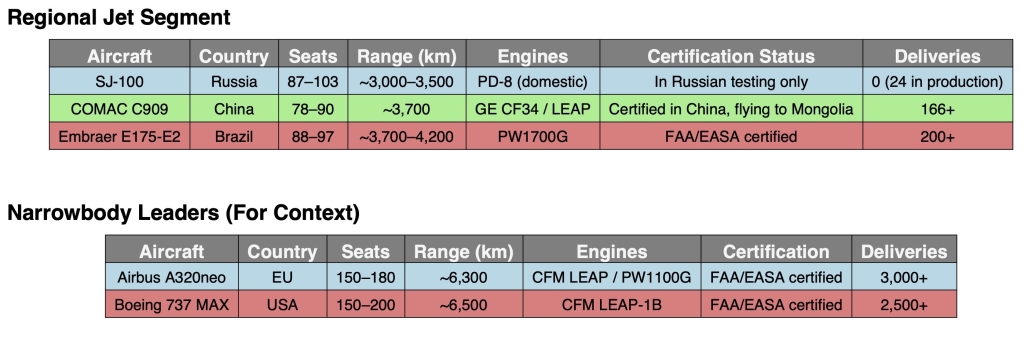
Despite the symbolism, the aircraft is unlikely to trouble Boeing, Airbus, or even COMAC. Without international certification, a global support ecosystem, or a proven record of operational reliability, the SJ-100’s market will remain confined to Russian carriers and perhaps a handful of politically aligned allies.
If COMAC’s C909 is writing the early chapters of China’s aviation rise, Russia’s SJ-100 is still trying to prove that its story has a future at all.
Also Read: Embraer Hits Record $29.7 Billion Backlog in Q2 2025 …..