














The Protection of Interests in Aircraft Objects Act to Save Indian Airlines $500 Million Annually

- The Act streamlines repossession timelines and protects international interests, improving India’s leasing environment.
- It positions GIFT City as a credible leasing hub and attracts aerospace manufacturing and MRO investments.
- Airlines, lessors, and passengers benefit from reduced costs, expanded infrastructure, and a more competitive market.
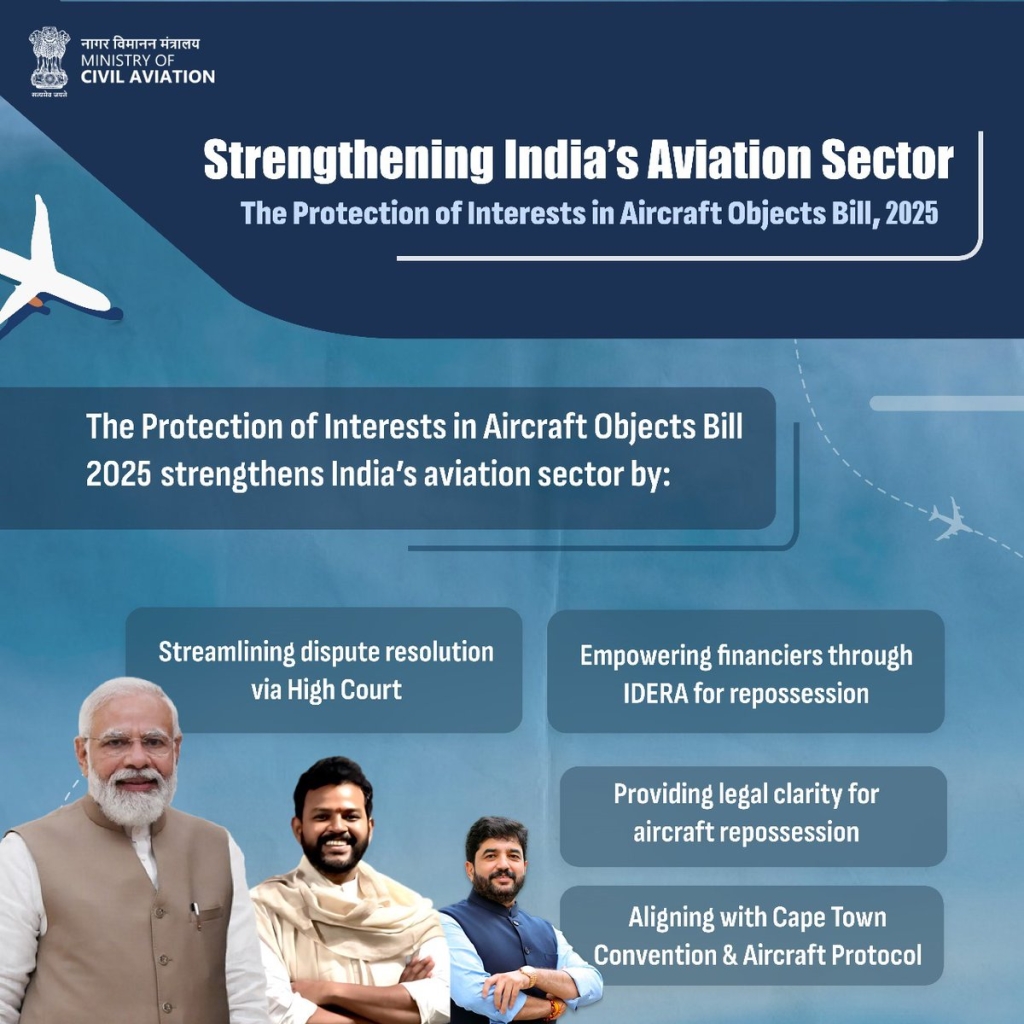
In the boardrooms of Dublin and Singapore, which are the nerve centres of global aircraft leasing, an Indian legislative file drew attention for fifteen long years. Now, as India enforced the Protection of Interests in Aircraft Objects Act, commencing May 1, the legislation transposes the Cape Town Convention (CTC) of 2001 and its Aircraft Equipment Protocol into domestic law, providing robust legal backing to international interests in aircraft assets.
The CTC, signed with fanfare in 2008 but left dormant, was bleeding the industry an estimated $400-500 million annually in punitive lease premiums.
The catastrophic 2019 collapse of Jet Airways laid bare the price of India’s delay. As lessors scrambled to repossess 120 aircraft from the bankrupt carrier, they crashed into India’s antiquated insolvency framework. The Insolvency and Bankruptcy Code (IBC), designed for factories and shops, triggered an automatic moratorium freezing assets, including leased planes. Dublin-based SMBC Aviation Capital, Avolon, and others found their $4 billion assets stranded in legal purgatory. Repossession took over 500 days in some cases, far exceeding the CTC’s envisioned 60-day window.
This debacle crystallised global lessor fears that India was a ‘high-risk’ jurisdiction. Consequently, lease rates for Indian carriers soared 10-15 per cent above those of their counterparts in CTC-compliant nations like Ireland or Singapore. For IndiGo and Air India, leasing 80 per cent of their fleets (versus a global average of 53 per cent), this premium became an unsustainable surcharge passed onto passengers.
Then happened the Go First case in 2023. Amidst the airline’s bankruptcy proceedings, global lessors such as SMBC Aviation were denied the ability to repossess over 50 leased Airbus aircraft. The delay caused by India’s insolvency moratorium under the IBC further ignited alarm across the aircraft leasing community and triggered India’s downgrade in the Aviation Working Group’s Cape Town compliance score.
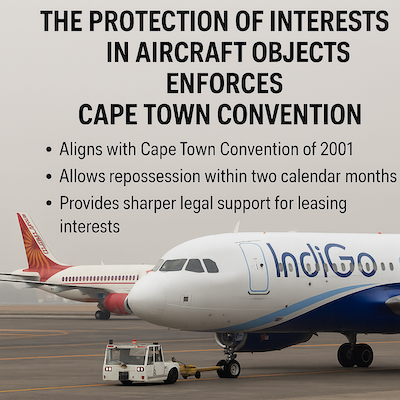
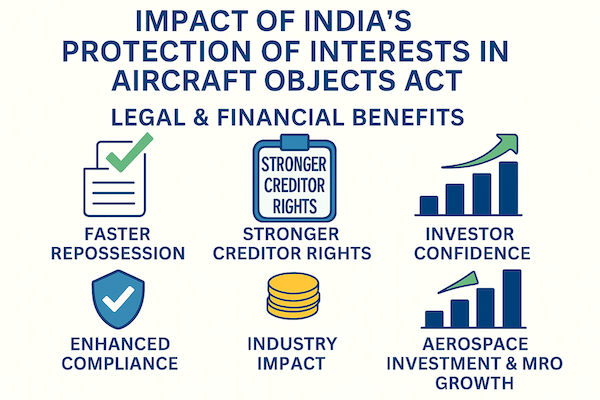
The new Act addresses this challenge head-on. Central to its provisions is the acknowledgement that creditors, lessors, and financiers can reclaim aircraft or engines within two calendar months of default, provided this interest is registered with the Directorate General of Civil Aviation (DGCA). This provision aligns with the Cape Town Protocol’s “Alternative A” under Article XI and directly counters the indefinite delays that could otherwise arise under domestic insolvency law. By embedding this timeline in statute, the Act mitigates a key barrier to trust and investment in India’s aviation sector.
Nitin Sarin, Managing Partner at Sarin & Co., explained, “The immediate impact has been significantly positive. Although India acceded to the Convention in 2008, its implementation remained theoretical until recent conflicts between domestic law and international norms highlighted the urgent need for specific legislation. Airlines like Kingfisher and GoFirst, along with several bankruptcies, exposed weaknesses in the legal framework. In GoFirst’s case, aircraft lessors were unable to repossess assets for over a year—a situation that undermined confidence in Indian aviation finance. This legislation addresses those loopholes and restores faith among international lessors. Streamlining deregistration and export procedures will help lower financing costs, benefitting large carriers like IndiGo and Air India, while providing new entrants and smaller airlines with access to more affordable leasing options.”
The Act’s Radical Mechanics
The legislation incorporates CTC principles into Indian law, placing a strong emphasis on creditor rights with exceptional clarity.
- The 5-Day Rule: The DGCA must deregister an aircraft within five working days of a valid court or authority order, a significant reduction from the current average of over 60 days. Physical repossession protocols override local police or tax authority interference.
- IDERA Supremacy: An Irrevocable De-Registration and Export Request Authorisation (IDERA), filed with DGCA, becomes a lessor’s “master key.” Once activated, it bypasses airline consent—critical during insolvency when management often vanishes.
- The 60-Day Cure Cliff: Airlines or insolvency administrators get just 60 days from repossession notice to cure defaults. After this, lessor rights trump all but narrow exceptions (like crew safety).
- International Registry Primacy: Ownership interests recorded on the global CTC electronic registry (based in Ireland) gain automatic legal recognition in Indian courts, ending disputes over competing claims.
According to Ankita Kumar, Partner, Shardul Amarchand Mangaldas & Co., “The Act introduces a standardised legal framework for the creation, registration, and enforcement of international interests in aircraft assets, aligning with best practices adopted by leading aviation jurisdictions worldwide. In global aviation financing and leasing, transactions are typically structured as asset-backed deals, meaning the aircraft itself serves as the primary security for the financing. This structure minimises reliance on the lessee’s or operator’s other assets or balance sheet. As a result, it becomes critically important to ensure the enforceability of security interests, particularly in cases of payment default. Swift and unencumbered repossession and export of aircraft are essential to safeguarding creditors’ interests. The Cape Town Convention and its Aircraft Protocol support this objective by offering creditors and lessors clear, enforceable remedies in instances of debtor default or insolvency. These include streamlined procedures for repossession, deregistration, and cross-border export of aircraft, thus reducing legal uncertainty and enhancing investor confidence in aviation transactions.”
The Act’s adoption has raised India’s standing from a score of ~50 to over 60 in the Aviation Working Group index, improving its reputation among global leasing firms and enhancing access to competitive debt and equity sources.
At the forefront is the ‘Cape Town Discount,’ a financial advantage confirmed by IATA, where airlines in compliant jurisdictions secure capital at three to five per cent lower interest rates. For India’s rapidly expanding aviation sector, projected to double its fleet to over 1,500 jets by 2030, the math is straightforward: annual savings of approximately $500 million. These savings could either fuel aggressive fleet expansion or be passed on to consumers through more competitive airfares, democratising air travel further.
Beyond financing, the ratification acts as a catalyst for India’s Maintenance, Repair, and Overhaul (MRO) and aerospace manufacturing ambitions. With predictable asset recovery mechanisms now in place, lessors are far more willing to station high-value engines and airframes in India, mitigating the risks that previously deterred such investments. This shift has already caught the attention of global aerospace giants, with Airbus and Boeing’s suppliers actively exploring India as a strategic MRO hub. The assurance that leased assets can be swiftly repossessed in case of default removes a critical barrier, positioning India to compete with established hubs like Singapore and Dubai.
Most importantly, the CTC acts as an insolvency shield, preventing future collapses like Jet Airways from paralysing entire fleets. Airline insolvency experts also cite the 2017 collapse of the UK’s Monarch Airlines, which resulted in airports absorbing significant losses. Finding a mechanism, such as escrow accounts or mandatory dues insurance, remains critical to avoid post-passage litigation.
It is also essential to examine the global precedents, and Ethiopia’s 2021 CTC ratification provides a blueprint. Following implementation, Ethiopian Airlines secured leases at rates comparable to those of European carriers. Closer home, China’s strict adherence cemented its position as the world’s second-largest aviation market. India’s judicial temperament remains largely untested. Will courts honour the 60-day cure window? Can the DGCA’s under-resourced registry manage 5-day turnarounds? The Ministry of Civil Aviation’s commitment in 2023 to enhance the DGCA’s digital infrastructure is a positive indicator.
Despite its promise, the Act’s efficacy depends on several critical factors. First is the complex tax and SPV structure surrounding foreign leasing, which could dilute the financial benefit from lower leasing rates. Second is the operational readiness of the DGCA. Unless the authority is fully equipped with trained personnel and digital infrastructure, the promised efficiencies may not be realised. Additionally, the implementation of the Act’s judicial framework will depend on the High Courts’ interpretations, which may vary regionally and impact enforcement consistency.
Another area to watch is the interface with insolvency laws. While the Act provides an override over IBC provisions, its successful application during airline defaults depends on harmonious interaction among DGCA actions, court directions, and insolvency proceedings.
Additionally, the Act reinforces Gujarat International Finance Tec-City (GIFT City) as a prospective aviation leasing hub, attracting foreign lessors who benefit from the clarity and protections provided, thereby supporting India’s goal of building a domestic aircraft financing ecosystem.
With the Insolvency and Bankruptcy Code (Amendment) Act, 2025, passed by the Lok Sabha and Rajya Sabha on April 16, 2025, and implemented on May 1, India’s aviation finance framework has been transformed. For global lessors controlling 50 per cent of the world’s fleet, it ends India’s reputation as a “repossession black hole.” For airlines, it means cheaper access to the 1,200+ aircraft on order from Airbus and Boeing. And for passengers? It’s the unseen tailwind that could make Indian skies more affordable and connected. After circling for 15 years, India’s aviation finance revolution is eventually on final approach.
Read More: Lower Leasing Costs, Greater Investor Trust…