












- Qantas’s Project Sunrise aims to launch nonstop ultra-long-haul flights between Australia and major global cities like London and New York using specially configured Airbus A350-1000 aircraft starting in 2026.
- With a focus on passenger well-being, sustainability, and cutting-edge design, these flights are set to redefine long-haul travel while challenging the dominance of traditional hub-based airlines.
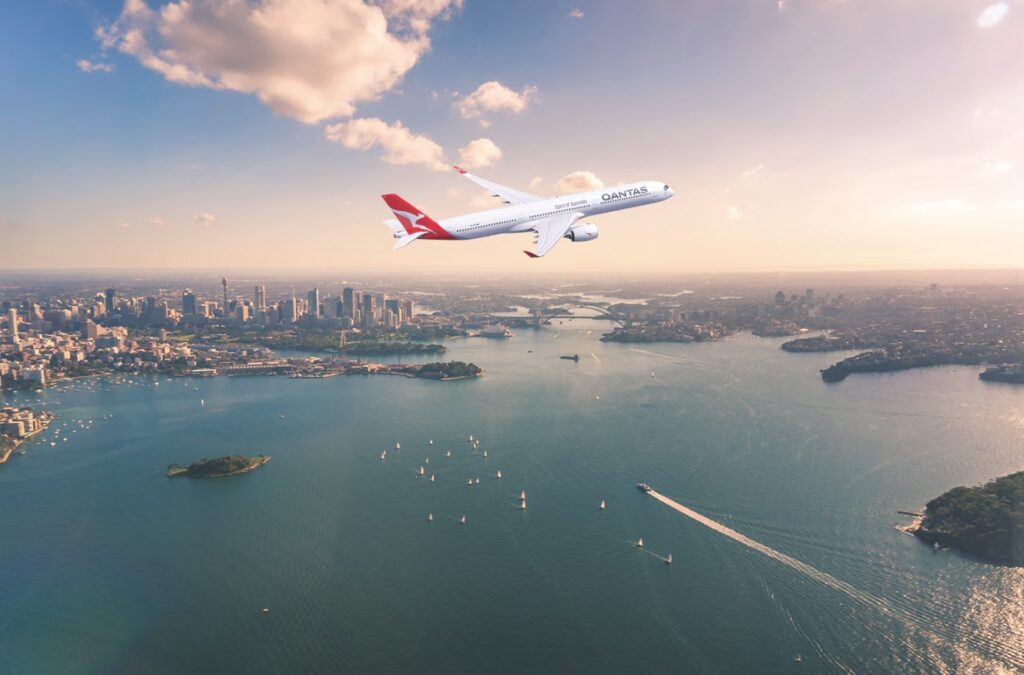
Few aviation projects have generated as much excitement and intrigue as Qantas’s Project Sunrise. Inspired by the airline’s historic ‘Double Sunrise’ flights of World War II, this bold initiative aims to revolutionise long-haul travel by connecting some of the world’s most distant cities with non-stop flights. It was in 2017 that Qantas announced that it is pushing the boundaries of modern aviation, challenging industry norms, and redefining what’s possible in air travel. At the heart of Project Sunrise is a daring yet simple goal: to operate non-stop commercial flights between Australia’s east coast—specifically Sydney and Melbourne—and major global cities such as New York and London.
With this ambitious endeavour, the linchpin of Project Sunrise is the Airbus A350-1000, a cutting-edge aircraft, engineered to conquer the immense distances these ultra-long-haul journeys demand. The airline recently unveiled the new upper-class cabins it will offer. Qantas has meticulously designed the A350-1000 cabins to prioritise well-being. A deliberate choice to limit passenger capacity to just 238, significantly fewer than typical configurations, ensures ample space for all. Forty per cent of the available seating will be allocated to premium cabins.
“Welcome to Australia in the sky.” That’s the tagline of a Qantas commercial created by filmmaker Baz Luhrmann (Elvis, The Great Gatsby, Moulin Rouge) to kick off the airline’s new brand campaign. And with the airline’s Project Sunrise ultra-long-range flights scheduled for 2026, flyers will be spending up to 20 hours in the sky.
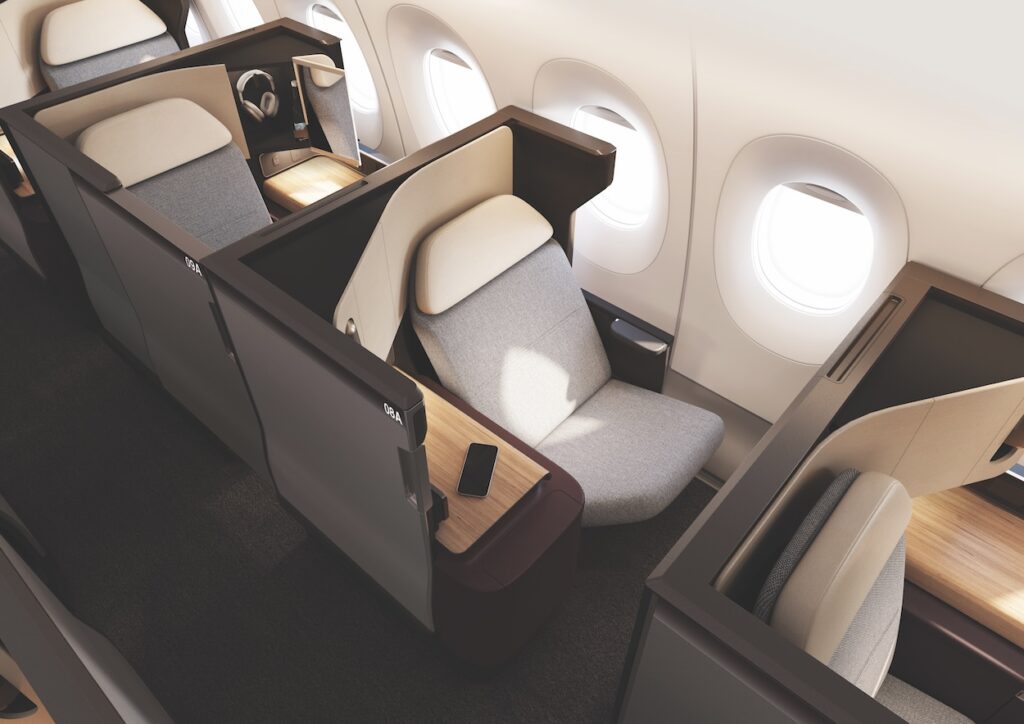
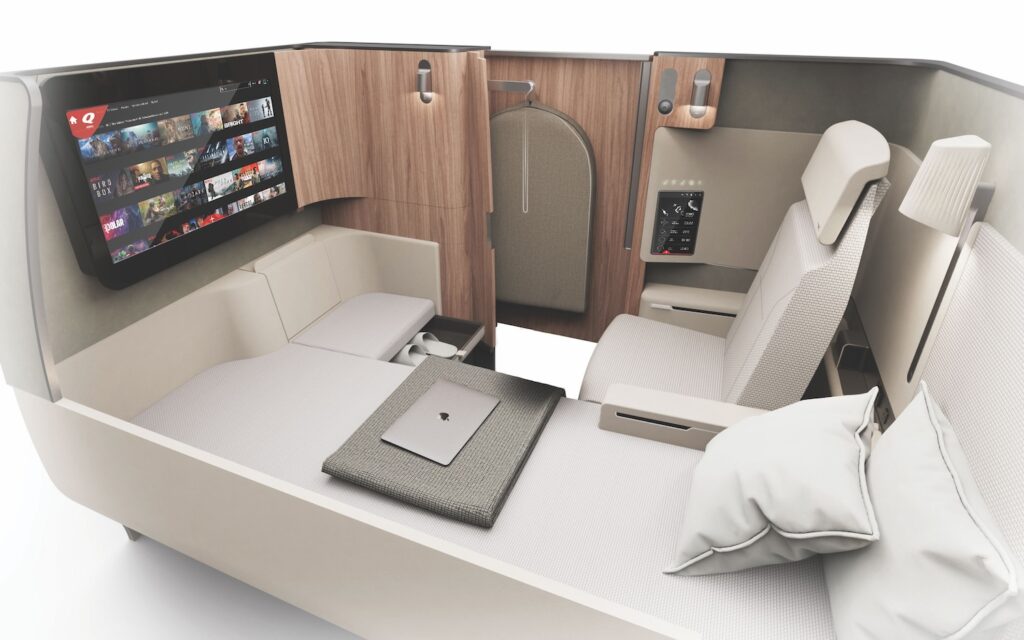
Passengers in First and Business Class will enjoy luxurious suites with fully reclining seats. Premium Economy and Economy cabins are equally thoughtfully designed, boasting generous seat pitch, ergonomic designs, and ample personal storage. The design and development of the new First and Business Class cabins were spearheaded by the renowned industrial design firm Caon Design.
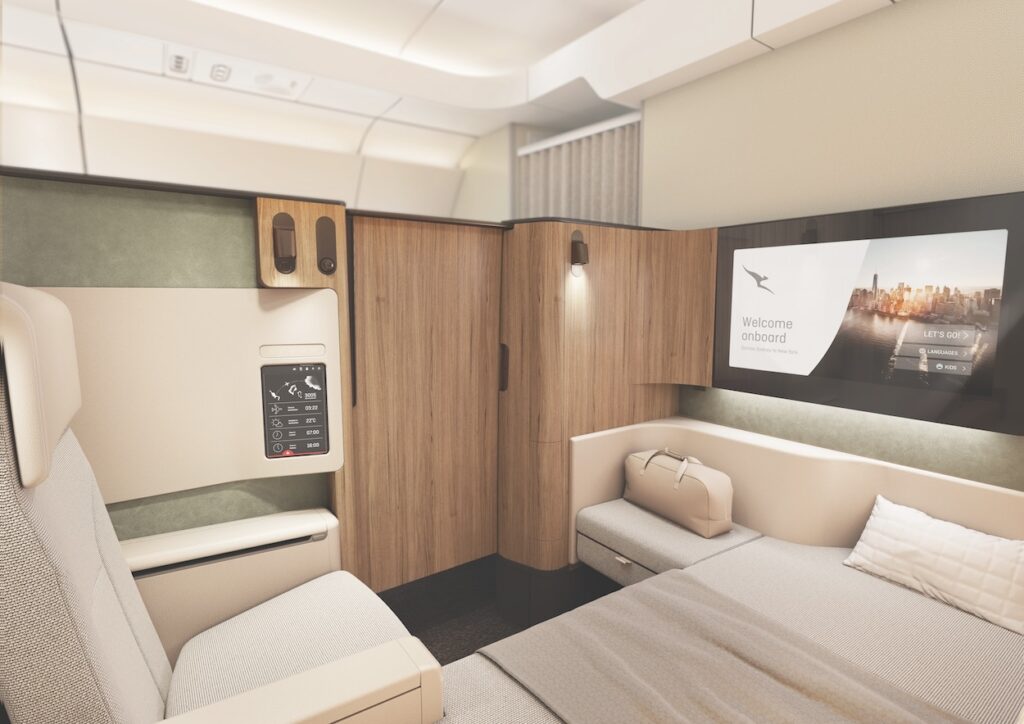
Qantas’ new first-class experience is designed to offer the luxury and privacy of a small hotel room in the sky. Passengers will enjoy a dedicated fixed bed, a separate reclining lounge chair, a personal wardrobe, a dining table for two, and a 32-inch ultra-high-definition entertainment screen. The airline’s A350-1000 fleet will feature six of these first-class suites, arranged in a spacious 1-1-1 configuration to maximise comfort and privacy on ultra-long-haul flights.
Every Business Class seat will feature direct aisle access, ensuring seamless movement throughout the cabin. To enhance privacy, Qantas will integrate sliding doors into each suite, offering passengers a more secluded and personalised space for their journey.
As a Qantas website put it, “Our fleet of specially designed Airbus A350s [will]overcome the tyranny of distance, with the ability to travel between Australia and almost any city in the world.” Qantas is assuring potential flyers that research and design will make the flights comfortable and safe.
Perhaps the most groundbreaking feature is the introduction of a dedicated ‘Wellbeing Zone,’ a world-first onboard space designed to combat the effects of jet lag. This innovative area will provide passengers with stretching areas, guided exercise programmes, and hydration stations, allowing them to actively manage their well-being throughout the ultra-long flight.
Qantas’s selection was far from a simple matter of range; it was a strategic decision driven by a holistic assessment of the aircraft’s capabilities, encompassing not only its impressive reach but also its exceptional fuel efficiency and, crucially, its passenger-centric design. However, the latest setback had come from Airbus manufacturing delays. The primary issue lies with the redesign of the centre fuel tank, which needed regulatory approval before being integrated into the aircraft. It was in June 2024 that Qantas and Airbus overcame the regulatory hurdle for Project Sunrise, which had delayed the first A350-1000 ULR deliveries until mid-2026.
Qantas has long been a pioneer in ultra-long-haul routes, dating back to the 1940s when its Catalina flying boats operated the gruelling ‘Double Sunrise’ flights—non-stop journeys between Perth and Sri Lanka (then Ceylon) that could last over 30 hours. This means that these routes were so long that passengers saw two sunrises in one journey. These wartime flights laid the foundation for Qantas’s reputation as a leader in endurance aviation.
Operating flights of this duration requires meticulous planning. Crew schedules, fuel management, and contingency plans for emergencies are all critical components of Project Sunrise. Despite its promise, Project Sunrise has faced significant hurdles. Extensive research has been conducted by Qantas to gather data on how these factors play out in real-world conditions.
It may be mentioned that the original launch was scheduled for 2022, but due to pandemic-related delays and financial setbacks, Qantas had to push back its plans. The airline eventually placed a firm order for 12 Airbus A350-1000 ULR jets in 2022, specially modified with extended-range fuel tanks, signalling a shift towards a more modern and efficient aircraft portfolio, gradually replacing the ageing Airbus A380s. At that time, the expectation was of service starting in 2025.
Covering more than 17,000 kilometres, if successful, the project will eliminate the need for layovers, offering travellers an unprecedented level of convenience while also posing new challenges in terms of aircraft capability, fuel efficiency, and passenger experience. According to Qantas CEO Vanessa Hudson, the project speaks to ‘Australians hunger to fly point to point.’ The upcoming long flights, she said, “are a great way for Australians to break out and see the world on the A350.”
Experts and industry watchers claim that this achievement could cement Airbus’s position as the leader in ultra-long-haul travel, making it the go-to choice for airlines looking to operate similar nonstop routes. Further, as Airbus strengthens its foothold in this high-stakes market, Boeing may find itself under mounting pressure to keep pace, facing an uphill battle against its European competitor’s technological advancements and growing dominance in the long-haul sector. Should everything proceed as planned and the A350-1000 successfully operate on these record-breaking long-haul routes, Airbus will establish a significant presence in a specialised market that prioritises extended range, fuel efficiency, and superior passenger comfort for ultra-long-distance travel.
Further, Qantas’ modernisation also includes the integration of Boeing 787-9 and 787-10 models. However, there are many who are likely to be less than pleased with Qantas’s Project Sunrise and these are airlines that rely on connecting passengers through major Middle Eastern and Asian hubs.
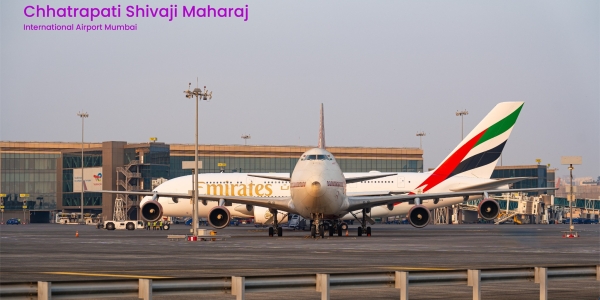
Carriers such as Emirates, which has developed Dubai International Airport (DXB) into a global transit hub, could face stiff competition as Qantas offers nonstop alternatives between Sydney and Europe. The success of these ultra-long-haul flights could significantly impact the volume of transfer traffic flowing through key airports in the region, challenging the dominance of hub-based carriers.
For years, Middle Eastern airlines have thrived by offering one-stop connections between Australia and Europe, providing travellers with extensive route options and competitive pricing. Dubai, Doha, and Abu Dhabi have served as crucial layover points, allowing passengers to seamlessly reach European destinations. Qantas itself has historically relied on partnerships with these carriers, such as its codeshare agreement with Emirates, to extend its reach beyond the few destinations it serves directly.
Moreover, at this time, other airlines, including Singapore Airlines (which operates the world’s current longest flight from Singapore to New York) and Emirates, are closely watching. Industry observers claim that with the introduction of Project Sunrise, Middle Eastern airlines may be forced to rethink their strategies. Direct flights between Sydney and cities such as London and Paris eliminate the need for layovers, appealing to passengers who prioritise time savings and convenience over stopovers. This shift could lead to a decline in demand for one-stop itineraries, compelling hub-based airlines to enhance their value proposition.
Many Experts have observed that if Middle Eastern carriers have to remain competitive, they will need to adapt by offering lower fares, enhancing in-flight services, or introducing innovative amenities to differentiate their one-stop journeys from Qantas’s direct routes. Additionally, these airlines might explore new partnerships or invest in ultra-long-haul aircraft of their own to counter Qantas’s bold move. As nonstop flights become more common, the traditional hub-and-spoke model of international travel could face a significant transformation, reshaping the way passengers fly between Australia and Europe in the years to come.
For Qantas, these flights will not only strengthen Australia’s position as a global aviation hub but also reshape passenger expectations. Further, recognising the growing imperative for sustainable aviation, Qantas is weaving environmental consciousness into the very fabric of Project Sunrise. The airline’s commitment extends beyond passenger comfort, encompassing a proactive approach to minimising its carbon footprint.
A cornerstone of this strategy is the integration of Sustainable Aviation Fuel (SAF). Qantas has secured agreements to procure up to 500 million litres of SAF annually, commencing in 2028. This significant commitment has the potential to fulfil 90 per cent of the airline’s SAF targets by 2030, marking a substantial step towards greener operations. The selection of the Airbus A350-1000s and Boeing 787s was a deliberate choice driven by their exceptional fuel efficiency and lower emissions. These aircraft are designed to minimise fuel consumption, contributing to a more sustainable and environmentally responsible aviation industry.
Qantas’s ambitious Project Sunrise isn’t merely about bridging geographical distances; it’s a carefully orchestrated fusion of advanced aircraft technology and a deep dive into the science of human comfort. It is being claimed that the project’s true groundbreaking nature lies in its unwavering commitment to passenger well-being.
The airline is betting big on demand for direct, nonstop travel, believing that travellers—especially business and premium-class passengers—will pay a premium for convenience and time savings. For now, all eyes are on Qantas and Airbus, as the aviation industry eagerly awaits the dawn of a new travel era.