














Transforming Air Traffic Management with Remote Towers and SWIM

- Remote-control towers and SWIM technology offer cost-effective solutions for managing small airports.
- They enhance data sharing, efficiency, and scalability while aligning with global aviation standards.
The remote-control tower concept emerged in 2001 to manage operations at far-flung remote airports where permanently deploying manpower is not viable. In December 2019, Sweden inaugurated a new airport without a traditional ATC tower, making it the first airport to rely solely on a virtual tower. This system was developed by SAAB. The integrated system operated from a central airport, where all flight-related data is accessible to control operations at remote airports. Meanwhile, discussions began about operationalising remote airports with limited flights. Developing conventional ATC towers and providing ATS services may not be cost-effective, as revenue generation from RNFC, landing, and parking charges is expected to be very low.
In 2008, Boeing introduced the concept of System Wide Area Management (SWIM) to the Ajay Prasad Committee as a new approach for the remote operation of airports. Leveraging state-of-the-art technology and high-speed data networks, SWIM provides a single access point for near real-time, relevant, and reliable aeronautical, flight, weather, and surveillance information. It delivers the infrastructure, standards, and services necessary to optimise the secure exchange of critical data across designated airspace and the aviation community.
As high-speed digital data-sharing underpins NextGen, SWIM enhances both operational efficiency and innovation. This concept is particularly scalable, as it reduces costs and minimises the need for trained manpower. The development of SWIM infrastructure and services should align with a globally accepted operational concept that defines the anticipated benefits, enablers, features, and principles for its development and transition.
The implementation of virtual or remote ATC tower operations can leverage SWIM, which complements human-to-human communication with machine-to-machine interactions. This approach improves data distribution, accessibility, and the quality of exchanged data. SWIM encompasses standards, infrastructure, and governance to facilitate the management of Air Navigation Services (ANS)-related information and its exchange among qualified entities via interoperable services.
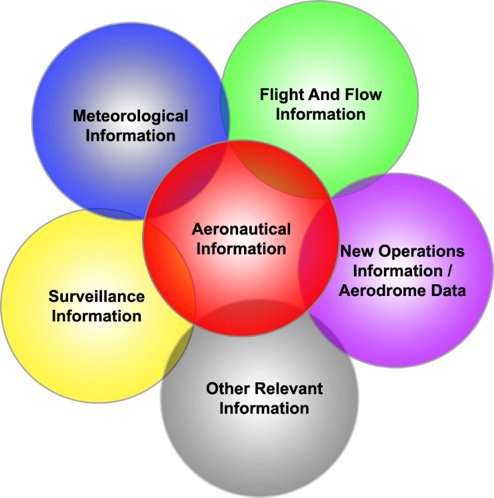
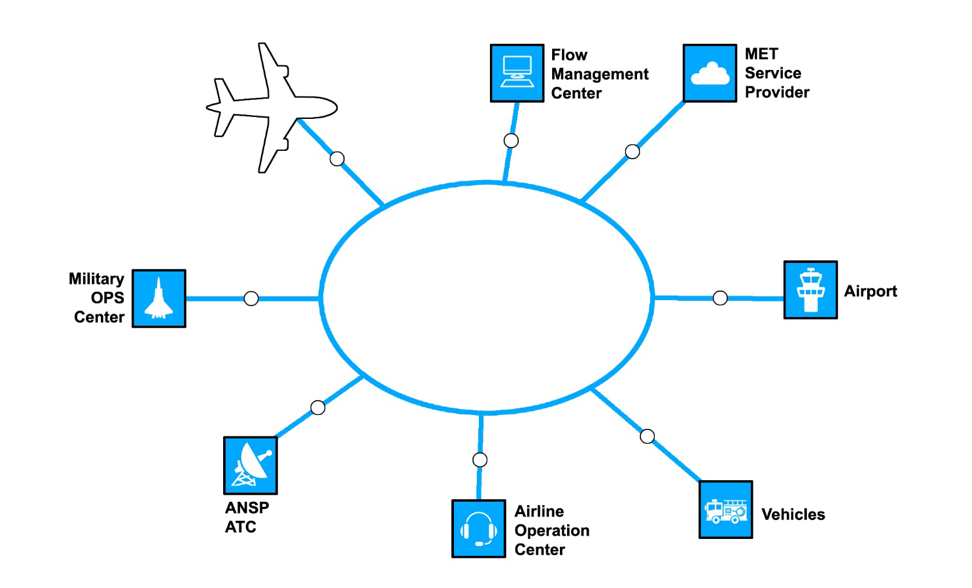
Aeronautical Information consists of surveillance data, meteorological information, flight data, air traffic flow management data, new operational information, and PANS-OPS charts of airports, as illustrated in Figure-1. The SWIM concept represents a transformative approach to managing information across the entire life cycle of an ATM process. Its implementation aims to deliver quality information to the right stakeholders, systems, and processes at the right time.
SWIM introduces a shift from traditional point-to-point data exchanges to a system-wide interoperability model within the ATM information architecture, enhancing the efficiency and accessibility of critical information to meet modern aviation demands.
In ongoing discussions, it has been emphasised that serving a large number of small airports through technology requires a robust and reliable system capable of providing accurate data to operators and vice versa. The implementation of SWIM should incorporate best practices from various ANS service providers within the aviation industry to align with the objectives of Global Air Traffic Management (GATM).
The primary aim of this concept is to ensure that users have access to relevant, interoperable, and mutually understood information, facilitating seamless communication and operational excellence.
Interoperability refers to the ability of diverse systems, often from different organisations, to exchange, interpret, and utilise information in a meaningful manner. It involves not only the communication and exchange of data but also ensuring that the information shared is usable, delivered in the correct format, with the right quality, at the right time, and to the right location. This capability is essential for enabling net-centric ATM operations, a key future requirement for air traffic services.
Seamless information exchange between space and ground systems is facilitated by SWIM-enabled applications, information services, ATM Information Reference Models, exchange models, and registries. According to ICAO Doc 9854, the key stakeholders include the aerodrome community, airspace providers, airspace users, ATM service providers, the ATM support industry, ICAO, country regulatory authorities, and the States. These entities collaborate to ensure effective and interoperable global air traffic management.
Some stakeholders, such as ICAO, States, and regulatory authorities, will primarily oversee the governance of SWIM. A significant change brought by SWIM is that these members can act as both information providers and users. While Airport Service Providers (ASPs) remain central to ATM processes, SWIM enables other information providers to assume greater roles. For instance, an ASP might use an information service from an airspace user to obtain a detailed trajectory profile for a specific flight.
The Global Interoperability Framework under SWIM consists of the following layers:
- SWIM-Enabled Applications: These include applications used by information providers and consumers worldwide, such as air traffic managers and airspace users. These applications interact seamlessly through SWIM.
- Information Exchange Services: Defined for each ATM information domain and for cross-domain purposes, these services follow governance specifications agreed upon by SWIM stakeholders. SWIM-enabled applications rely on these services for interaction.
- Information Exchange Models: These models use subject-specific standards to define the syntax and semantics of data exchanged for the Information Exchange Services, ensuring clarity and consistency.
- SWIM Infrastructure: This infrastructure supports information sharing through core services like interface management, request-reply and publish-subscribe messaging, service security, and enterprise service management.
- Network Connectivity: This layer provides consolidated telecommunications services, combining private and public Internet Protocol (IP) networks. It integrates the network infrastructures of various stakeholders to enable seamless communication.
SWIM’s layered framework ensures interoperability, security, and efficient information exchange, supporting the modernisation of global air traffic management. The basic architecture of the system is illustrated in Figure-1.
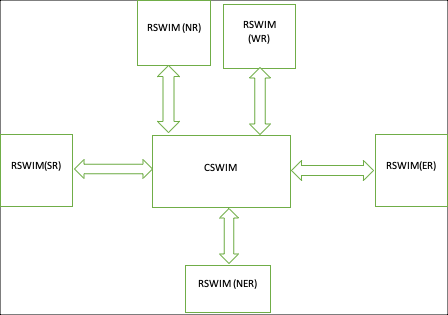
From India’s perspective, the entire Indian controlled airspace, which includes a large number of small airports, can be configured as shown in Figure-2. Each region will have dedicated infrastructure for managing the airports within its jurisdiction. It may also be possible to establish multiple SWIM nodes within a region, depending on the number of airports managed by the master controlling SWIM.
The regional SWIM nodes will be connected to all airports within the region, ensuring integrated data management and operations. These regional SWIMs will oversee the operation of all airports in their respective regions with reduced reliance on highly trained manpower. Additionally, the regional SWIMs will be connected to a Centralised SWIM (CSWIM), which will monitor and coordinate the operation of the entire Indian airspace.
The system will facilitate bidirectional digital data flow between regional SWIMs and the CSWIM, ensuring seamless and efficient air traffic management.
To optimise the use of airport data, aeronautical resources, and manpower, it is essential to explore alternatives that eliminate the need for constructing ATC towers at minor airports. Local airport data can instead be accessed through SWIM, providing a cost-effective solution. Constructing towers and deploying ATC-trained manpower at every CAT-I and CAT-II airport is an expensive proposition, especially as most of these airports operate under VFR conditions with limited flight movements, primarily involving small aircraft.
Furthermore, the Government’s objective to make all airports operational can be achieved effectively through the adoption of SWIM technology. This technology is well-suited to meet the operational requirements of small airports, ensuring their functionality without the need for extensive infrastructure or manpower investment.
The development of ICAO provisions for accessing information and utilising SWIM-enabled applications is essential. Performance requirements for data communication channels must be established, focusing on safety, security, throughput, and latency. Additionally, evaluating data transmission volumes in relation to traffic forecasts and future applications will aid in infrastructure planning, including spectrum and bandwidth requirements.
Defining common data formats and information exchange protocols is a key priority. This ensures compatibility and supports the progressive deployment or adaptation of appropriate ATM system architectures, fostering a seamless and efficient integration of SWIM-enabled services into global air traffic management.
It is worth noting that several ATS service providers have already initiated SWIM implementation, though currently at a very basic level. ICAO’s mandate is to establish a Global SWIM environment, requiring these localised SWIM enterprises to connect with similar systems through bilateral agreements to achieve interoperability.
The implementation of SWIM is likely to have a complex and significant impact on various ATM systems, and this complexity should not be underestimated. To address this, SWIM deployment should be carried out progressively in well-defined phases, with transition arrangements allowing a mix of SWIM and non-SWIM systems during the implementation period.
Why is such complex technology necessary? The answer lies in the need to integrate all airports within the country’s dedicated airspace using advanced technologies. This integration eliminates the need for constructing costly ATC towers at small airports and deploying trained air traffic controllers at each location. Consequently, the expenses for ATS service providers are significantly reduced, which, in turn, can lower airfares and aircraft fuel costs, benefiting the aviation industry and its stakeholders.
To keep pace with advancements in aviation technology, the Ministry of Civil Aviation established a committee under Order No. AV. 15012/5/2005-A dated 20th March 2006 to develop a “Next Generation Futuristic Air Navigation Services Master Plan.” The committee’s Terms of Reference were defined to examine and review the following aspects to formulate the Master Plan and provide recommendations:
- Assessment of Air Navigation Services (ANS):
- Evaluate the current state of ANS in the country based on the requirements outlined by ICAO in Regional Air Navigational Plans.
- Assessment of Weather Workstations:
- Review weather workstation infrastructure against the standards and recommended practices prescribed by ICAO.
- Recommendation of a Futuristic ANS Master Plan:
- Propose a comprehensive Master Plan for Air Navigation Services incorporating the latest technologies and forecasting future needs.
- Harmonisation of ANS Systems:
- Suggest methods to align the country’s ANS with systems used by other countries and regions to ensure seamless integration and interoperability.
This initiative aims to position India’s aviation infrastructure at the forefront of technological innovation while meeting global standards and future demands.The report on the subject was submitted in February 2008 to the Ministry of Civil Aviation (MoCA). This document serves as a comprehensive guide for the Airports Authority of India (AAI) in its master planning efforts. The innovative technologies outlined in the report were recommended by the Ajay Prasad Committee, constituted by the Ministry of Civil Aviation in 2006. Mr. Ajay Prasad, a retired Secretary of the Ministry of Civil Aviation, Government of India, chaired the committee.