













- The Vayuyan Vidheyak Bill 2024 aims to update India’s outdated aviation laws but faces criticism for retaining old practices, centralising power within the DGCA, and neglecting crucial reforms like independent regulation, aviation safety, and passenger rights.
For 90 years, India’s aviation space was guided and regulated under pre-independence legislation that had come into force far back in 1934. On August 9, 2024, when the Lok Sabha passed a new bill to replace the old Aircraft Act, hopes were high that it would address the huge challenges posed by the monumental growth in aviation over the last nine decades. But the bill has been billed as ” old wine in a new bottle.” Is this reading fair?
Vociferous political opposition to the bill skipped the real issues while drawing all attention only to the new nomenclature: Bhartiya Vayuyan Vidheyak Bill 2024. The bill seeks to get rid of the redundancies necessitated by the 21 amendments over the years to make it in sync with India’s growing civil aviation market.
Informed critics have questioned the bill for vesting too much power with the Directorate General of Civil Aviation (DGCA). Its enhanced discretion to grant exemptions and waivers, they contend, could foster corrupt practices. Besides, the legislation is based on a harsh working relationship between the aviation operators and the regulator, encouraging a penalties-driven ecosystem.
The dire need for an independent regulator and accident investigation bureau to address the growing aviation safety concerns is left unaddressed, they say.
Dubbing the bill’s content as a ‘cut and paste’ of old rules with only numbers changed, former airline instructor pilot and aviation safety adviser Capt Mohan Ranganathan draws attention to the issues left out. “When the European Union (EU) changed its aviation rules, all the constituent nations came together, formed a committee and did not blindly copy the FAA (Federal Aviation Administration) regulations,” he points out.
The EU Council studied the old rules and added what was practical to the aviation reality of the region. “They made it very simple. Here, every rule has a last line that stresses that the DGCA has the discretion to give dispensations and waivers. This negates the whole thing because the Ministry and the DGCA like to have control over everything. And, DGCA is controlled by the ministry,” says Capt Ranganathan, who was also a former member of the Civil Aviation Safety Advisory Council (CASAC).
No place for the Civil Aviation Authority
The bill is also silent about setting up a Civil Aviation Authority (CAA) as an independent regulator. Ten years ago, the CAA Bill 2013 was approved by the then Union Cabinet in February 2014 and was all set to be tabled in the Parliament. The proposed legislation was designed to govern and regulate aviation safety with oversight powers over air transport operators, navigation service providers, and other related issues.
If green-signalled, the new aviation regulator would have been also empowered to levy fees and charges under the 1934 Aircraft Act. The need for an independent regulator then was necessitated by the FAA’s downgrade of India’s aviation safety mechanism. A parliamentary Standing Committee on Transport, Tourism and Culture had recommended steps to strengthen provisions of the bill.
Besides safety, the proposed CAA was to draft a State Safety programme and approve a safety management system. It was also tasked with overseeing the implementation in coordination with the other concerned authorities. The Authority had to protect consumer interests and sort out issues related to financial stress and environment. Coordination with the International Civil Aviation Organisation (ICAO) was also part of its mandate. It had to take action related to the ICAO’s Safety Oversight Audit programme.
Fundamental issues unaddressed
The Vayuyan Vidheyak Bill basically empowers the DGCA without creating a separate CAA, notes former Bangalore Chamber of Commerce and Industry (BCIC) chairman Devesh Agarwal. “Basically, they increased the collection system. Where have they addressed the fundamental issues? They have done it by design. They don’t want an autonomous body because the moment they do it, their control goes away,” he notes.
Half the aviation-related problems in India can be solved by making the entire process of DGCA electronic. “Nothing manual. If there is a network issue or password failure, it has to get resolved within an hour. This is possible, but they don’t do anything deliberately.”
On the passenger front, too, the Bill is found wanting. “From one side, you have the Minister state his intention to reduce passenger fares. On the other side, you have many airports increasing their User Development Fees (UDF). Why? Because they are monopolies. And since airlines have become their favourite whipping boys, a passenger charter cannot be implemented on them that is stern. The latter just hike the fares,” he elaborates.
Government policies state that the airports will be made affordable. “But where will affordability come? For instance, in the previous hearing (with the Airports Economic Regulatory Authority of India), the Karnataka government actively opposed the reduction of UDF. Are they working in the citizens’ interest or as a shareholder of the airports?”
Pilot licensing gaps
Issues linked to pilots are glossed over in the proposed new legislation. Capt Ranganathan draws attention to a lacunae in the pilot licensing process: “India is a signatory of ICAU convention where Annex 1 is related to personnel licensing. According to this, if you hold an ICAU licence, you can get the licence of a country with just an air law exam and a Class-1 Medical.”
The implication is clear: If this rule is implemented, the acute pilot shortage currently faced by airlines could be addressed. “This applies to even Indian pilots getting a foreign licence. I know several such people working in airlines in the Gulf and other places. Applying this, qualified Boeing 777 and 787 captains could have walked into Air India, which is facing severe pilot shortage,” he explains.
However, these highly qualified pilots are now required to go through a paid training system to get an Indian licence. He calls it a racket that involves both the official authority and the airline concerned. “Can you imagine a guy who was an instructor on 787 and 777 with Qatar Airways was asked to pay Rs 70 lakh if he wanted to fly a Boeing 777 of this Indian airline? This is ridiculous. You pay 18,000 dollars to get an expat but will not take an Indian who is willing to come.”
Radio telephony devices under DGCA
A closer look at the 1934 Act and the Vayuyan Vidheyak Bill shows that the only main difference is related to the radiotelephony devices in the aircraft. “The devices that transmit and receive communication between the pilots and the ATC and other airplanes, used to be under the Telecom Ministry, a unit called the Wireless Planning Committee (WPC). While the entire aircraft is covered under the 1934 Act, the devices are under another legislation and authority. Under the new legislation proposed, DGCA is the single authority, a one-stop solution,” explains Capt Arvind Sharma, an aviation analyst.
Once the new Bill is enacted, new Aircraft rules will have to be framed. As he puts it, “In the existing system, the 1934 Act, which has hardly 20 sections, deals with very macro-level issues. Then there are Aircraft rules, 1937, which are 200 plus in number. There are also regulations under DGCA and other authorities that literally run into hundreds. All of the rules and regulations have to be streamlined.”
Amended over 20 times, the Aircraft Act provisions and rules have to be harmonised instead of looking like a document that is routinely edited. “Otherwise, the authorities are the same in the new Bill. You have the DGCA for aircraft and pilot monitoring, the Aircraft Investigation Bureau for accident investigation, the Bureau of Civil Aviation Security, and a couple of obligations under the Chicago Conventions of 1944, but a bit more reinforced. Otherwise, there is no major difference.”
Rules and regulations to follow Act
Will the new rules and regulations incorporate the concerns raised by the aviation experts? This is not certain, but the process is expected to take time. Capt Arvind recalls that it took three years for the rules on the 1934 Act to be framed. “The Act gives the spirit, it is like a table of contents. Each has to be magnified by various rules. They will have no choice, otherwise they may not be able to run the system,” he says.
With the Bill making no mention of the CAA or any other independent regulatory authority, the DGCA ecosystem is set to dig its roots deeper. Capt Ranganathan flags concerns about the safety of airports announced by politicians and given the go-ahead by the Authority. “For instance, in Salem, with the hills around, you can’t do an Instrument Landing System (ILS) because of the obstacles. They spent crores of rupees building the airport there. How many flights go there?”
Economic viability is another issue. He cites a recent announcement of direct flights between Vijayawada and Vietnam. While the objective was to open up new tourism opportunities between the two regions, he wonders how sustainable the traffic would be in the long run. “But this is nothing new. In 1989, a Minister of State wanted Pondicherry to be connected by Vayudoot. The Chief Pilot told me that that sector was not viable even if the 16-seater had 16 passengers. But for the minister’s sake, they had to operate the flight. This is how our aviation industry is being misused.”
Silence on passenger woes
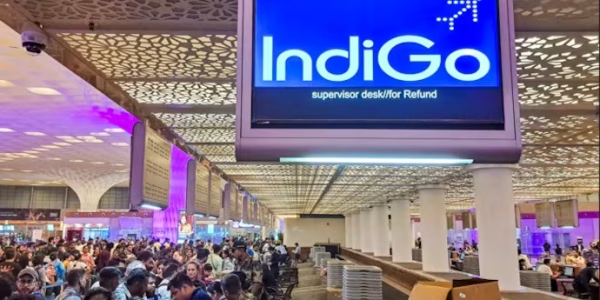
The unprecedented growth of the Indian aviation industry has inevitably raised concerns about passenger safety, convenience and comfort. In a survey of 13,000 air passengers by community social media platform LocalCircles, nine out of 10 respondents were convinced that the airlines compromised on comfort and cut corners. Excessive fares, cancellation of flights, delayed flights, denial of boarding, damaged or misplaced luggage, steep hike in onboard food and rude staff at check-in counters were among a long list of complaints.
“Passengers are at the mercy of these people. A scheduled flight, as per the Indian Aircraft Manual, cannot be cancelled,” he points out. “But the airlines are cancelling if they don’t have a load. Vistara flights have been cancelled, IndiGo flights too. Airlines take the licence and pay for it, but they don’t operate. This denies somebody else from operating.”
Today, airport schedules and slot capacities are dictated by the Bureau of Civil Aviation Security (BCAS). Devesh cites a recent complaint by a seasoned entrepreneur, who drew attention to the lack of trays at the security gates. “All the lanes ran out of trays. I am paying a separate passenger security fee that is paid to CISF, which means they are supposed to provide that service. Is there a provision to take this to consumer court?” he asks, indicating the lack of attention to passenger issues in the new legislation.
Lack of domain knowledge
Legislating on aviation-related issues mandate a basic understanding of the industry and the allied infrastructure. Aviation watchers note that the parliamentary debate on the new Bill was reduced to only the name precisely because there was no grasp of its implications on the industry.
In this context, Capt Ranganathan recalls Tamilnadu Industries Minister T R B Rajaa’s recent articulation of the need to upgrade the Chennai airport so that it could handle wide-body Code F aircraft. “Code F aircraft are the likes of Airbus 380 and Boeing 777 800s and 900s. Now you need a 60m wide runway for Code F aircraft. Chennai airport has only 45m. There is no space, and they can’t do it. But a study team will go to Singapore or the US, wasting taxpayers’ money,” he says.
The same lack of domain knowledge among those who legislate is linked to the Bill’s silence on aircraft-parking related concerns as well. Aviation experts refer to ICAO Annex 14 to the Chicago Convention, which mandates a minimum distance between aircraft wing tips at airport parking slots. While it is 22m for narrow-body aircraft, the minimum gap is 27m for wide-body aircraft.
At the Chennai International Airport, there are four aerobridges, but only two wide-body aircraft can be parked at a time. As an expert notes, the problem is with the design, and there has been no accountability. “They just sign on a dotted line to get crores of rupees sanctioned,” the expert says, echoing the state of parking infrastructure in airports countrywide.
Pilot fatigue and air safety
The Bill also does not talk about pilot fatigue and related issues that deeply undermine flight safety. International conventions are in place to ensure that pilot fatigue does not jeopardise the safety of passengers. Flight and Duty Time Limitations (FTL) have clear restrictions on the amount of time that pilots can fly. These restrictions apply to a pilot’s duty period such as hours per week.
As Devesh recalls, after the air crashes at the Mangaluru and Kozhikode airports, factors linked to pilot fatigue and human errors were raised. “Experts had given suggestions, but everything has been brushed under the carpet,” he says, flagging a critical air safety concern left unaddressed.
In the ultimate analysis, the Vayuyan Vidheyak Bill is seen as a golden opportunity lost. Its loud silence on establishing a Civil Aviation Authority (CAA) as an independent regulator, lack of clarity on pilot licensing, failure to address the critical issues linked to pilot fatigue and accidents, and apparent neglect of growing passenger concerns in an increasingly complex ecosystem leave a vacuum in desperate need of a serious relook.