













India’s Vertiport Question: Building the Foundations for Advanced Air Mobility

- India’s eVTOL ecosystem is moving beyond concept discussions, but vertiports remain the least visible element despite being central to operations, urban integration, and airspace coordination. Their development must account for dense city environments, safety systems, energy supply, and surface connectivity.
- Regulatory groundwork has begun with DGCA issuing an Aerodrome Advisory Circular on vertiport design and operations, followed by guidance on certification and flight crew licensing, and India referencing this framework in an ICAO working paper on advanced air mobility.
- Early physical planning is evident in BIAL’s exploration of air taxi operations with Sarla Aviation and in Maharashtra’s intent to develop vertiports through MADC. However, there are no confirmed sites, timelines, or national-level rollout plans in place.

India’s conversation around electric vertical take-off and landing aircraft, or eVTOLs, has moved well beyond concept visuals and early-stage announcements. Aircraft programmes are advancing, pilot training frameworks are emerging, and state governments are beginning to acknowledge urban air mobility as a future transport layer. Yet the most critical component of this ecosystem remains largely invisible in public discourse: the infrastructure that allows these aircraft to operate.
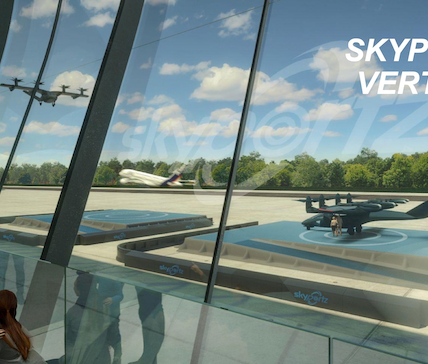
Vertiports — dedicated facilities designed for eVTOL take-offs, landings, passenger handling, and energy supply, will determine whether air taxis remain a theoretical idea or become a functional mode of transport. Unlike conventional airports, vertiports must fit into dense urban environments, operate within tightly constrained airspace, and integrate with ground transport systems. This makes their development as much a planning and governance challenge as an aviation one.
India is now entering the early phase of addressing this gap. Not through high-profile launches, but through regulatory groundwork, exploratory infrastructure planning, and a small number of location-specific initiatives that hint at how the country may approach the problem.

Photo: Vjaitra Air Mobility
The clearest signal so far has come from the regulator. In September 2024, the Directorate General of Civil Aviation (DGCA) issued an Aerodrome Advisory Circular laying out the framework for vertiport design and operations. The document outlined safety requirements, layout considerations, and operational parameters, effectively acknowledging vertiports as a new category of aviation infrastructure rather than experimental constructs.
It was followed by additional guidance on certification and flight crew licensing for vertical take-off and landing aircraft. The International Civil Aviation Organization (ICAO), in a July 2025 working paper submitted by India, explicitly references this vertiport guidance as part of the country’s advanced air mobility groundwork.
This regulatory step matters because it defines the perimeter within which any future project must operate. For the first time, developers, airport operators, and state agencies have a reference point for what constitutes an acceptable vertiport in India. It also signals that India intends to regulate eVTOL operations through formal aviation pathways rather than ad hoc exemptions.
Regulation alone, however, does not build infrastructure.

The early signs of physical planning are beginning to emerge at the airport level.
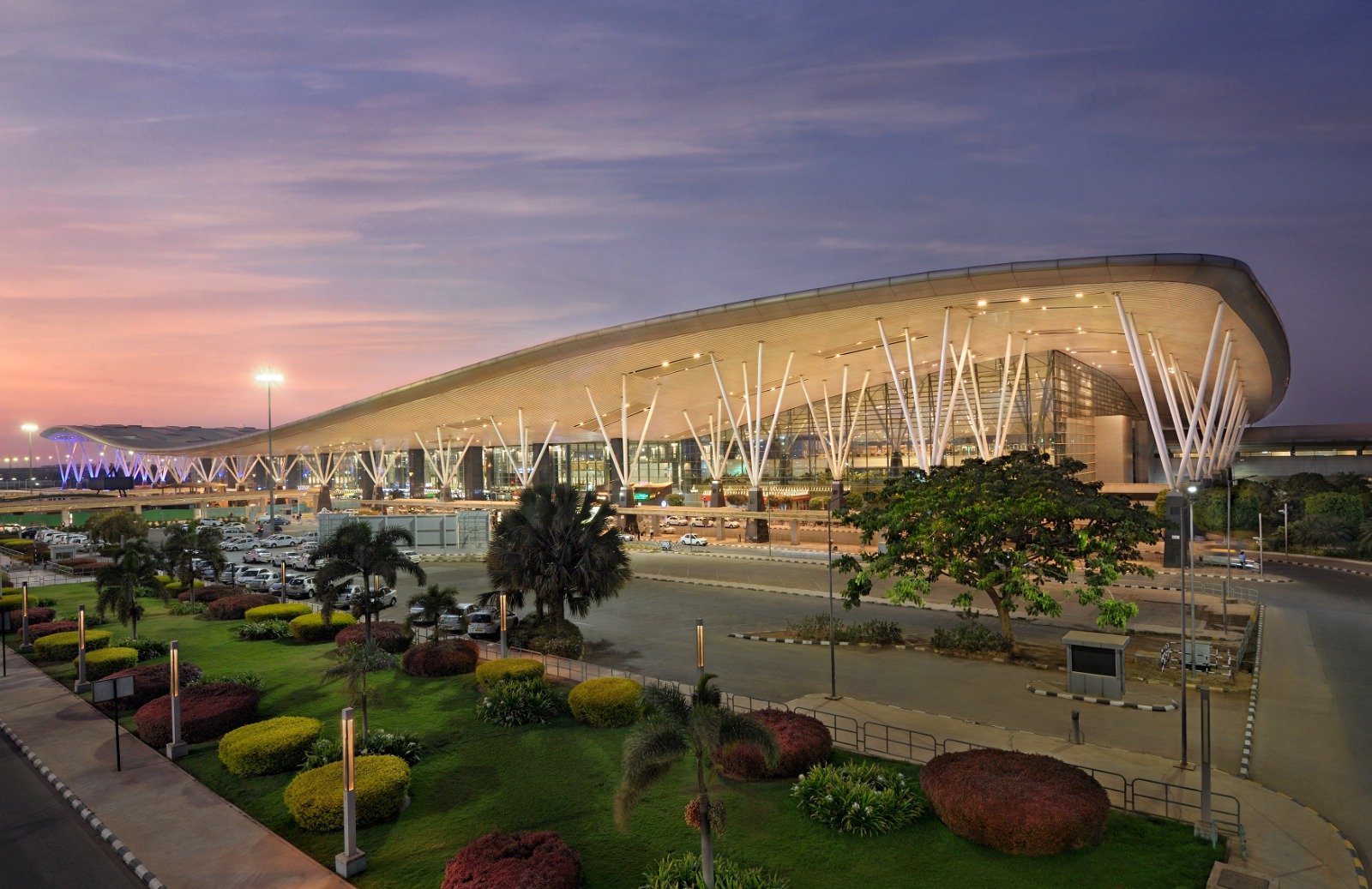
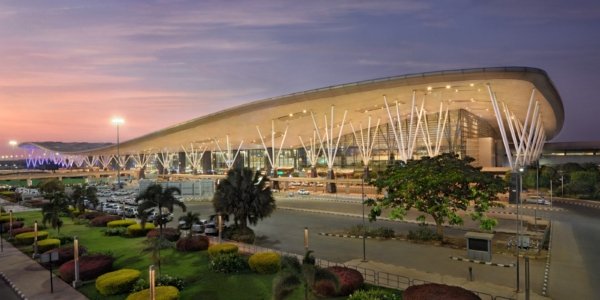
Bangalore International Airport Limited (BIAL) has publicly announced a collaboration with Sarla Aviation to explore potential air taxi operations connecting the city and the airport.
While this does not confirm a vertiport build, it establishes the airport as a likely early node for future operations and signals that major airport operators are considering how aerial mobility could integrate into their long-term master plans.
In parallel, Maharashtra has publicly indicated plans to develop vertiports across districts, with the Maharashtra Airport Development Company (MADC) acting as the nodal agency. While locations and timelines have not yet been disclosed, the announcement positions vertiports within the state’s broader transport planning rather than as isolated private initiatives. This approach matters because vertiports, unlike helipads, require alignment with land-use policy, emergency services, power infrastructure, and local governance frameworks.
These developments point to a pattern: India’s entry into urban air mobility is likely to be led by public-sector coordination rather than purely private experimentation.
That approach contrasts with some international markets but may be better suited to India’s urban density and regulatory environment.
Vertiports as infrastructure, not architecture
One of the persistent misconceptions around vertiports is that they are simply compact landing pads placed on rooftops or parking structures. In practice, they are infrastructure nodes that must manage aircraft movement, passenger flow, safety systems, and energy supply within constrained urban footprints.
Even relatively small vertiports require clear approach and departure paths, obstacle limitation surfaces, emergency response access, and compatibility with existing urban zoning. Power supply is another major factor. Electric aircraft demand high-capacity, reliable energy inputs, and different manufacturers use different charging architectures. Designing a site that can accommodate more than one aircraft type adds further complexity.

Because of this, build timelines vary widely. Smaller, modular sites may be completed within months, while larger, multi-stand vertiports with passenger facilities can take significantly longer. The constraint is rarely construction itself; it is approvals, coordination, and integration with surrounding infrastructure.
This is where global examples provide useful reference points.
In the United Arab Emirates, vertiport development has been approached as a networked system rather than isolated sites. In Dubai, four initial locations — Dubai International Airport, Downtown Dubai, Palm Jumeirah, and Dubai Marina — have been publicly identified as part of an early urban air mobility network. These are not standalone experiments but interconnected nodes intended to enable repeatable routes within the city.
Beyond Dubai, Abu Dhabi has outlined plans for a broader network that includes multiple vertiport locations linked to major transport and commercial zones. The emphasis has been on phased development: begin with controlled sites, prove operations, and expand once reliability and safety are demonstrated.


For India, the relevance of this model lies not in replication, but in structure. A viable vertiport ecosystem requires network thinking. A single vertiport does not create mobility; multiple coordinated nodes do.
The Indian context: where infrastructure must lead the aircraft
India’s urban fabric adds layers of complexity. High population density, mixed land use, and congested airspace mean that vertiport placement cannot be opportunistic. It must be deliberate and defensible. This is why early discussions have naturally gravitated toward airport-adjacent sites and controlled zones, where airspace management and security frameworks already exist.
Such locations offer a realistic starting point for early operations. They also allow operators to test turnaround times, passenger flows, and operational resilience without immediately confronting the most complex urban environments.

Another practical consideration is flexibility.
Vertiports designed to support both helicopters and future eVTOLs offer a transitional pathway.
Helicopter operations can generate utilisation and operational experience while electric aircraft mature.
This dual-use model reduces commercial risk and allows infrastructure to evolve rather than sit idle waiting for certification milestones.
From an economic standpoint, this phased approach is essential. Vertiports are capital-intensive, and early utilisation matters. Infrastructure that can serve multiple aviation use cases stands a better chance of viability during the early years of eVTOL deployment.
Where India stands today
What India does not yet have is a publicly declared, time-bound national vertiport rollout plan. There are no confirmed city-wide networks, no published site maps, and no timelines comparable to those announced in the UAE. That does not indicate inactivity; it reflects a more cautious sequencing.
At present, India’s progress can be summarised as follows:
- Regulatory foundations are in place through DGCA advisories.
- Airports and state agencies have begun exploratory planning.
- Industry players are aligning aircraft development with Indian operational realities.
- Early discussions are underway around integrating vertiports into existing transport ecosystems.
What remains unresolved is the transition from planning to execution — where sites are finalised, construction begins, and operations are tested under real conditions.
The road ahead
No vertiport discussion is complete without acknowledging airspace management. As low-altitude traffic increases, coordination between drones, eVTOLs, helicopters, and conventional aircraft becomes critical. India’s existing Digital Sky platform provides a foundation for unmanned traffic management, but eVTOLs introduce new complexities related to passenger safety, traffic density, and interaction with controlled airspace.
Discussions around urban air traffic management are ongoing, with industry and regulators exploring how future systems can integrate flight planning, monitoring, and conflict resolution. While still at a conceptual stage, this layer will ultimately determine how scalable any vertiport network can become.

India’s path to urban air mobility will not be defined by aircraft announcements alone. It will be shaped by how effectively cities plan for vertiports, how regulators balance safety with innovation, and how infrastructure is phased into already complex urban systems.
The early signals suggest movement in the right direction: regulatory clarity, pilot projects, and serious institutional engagement. But the outcome will depend on how effectively regulation, infrastructure and operations converge. The aircraft may capture public imagination, but it is the quiet, methodical build-up of ground infrastructure that will determine whether urban air mobility becomes part of India’s transport reality or remains an ambition on paper.
Also Read: Connecting cities to airports: Heli-taxis are out, air taxis are in