
















- The Wright brothers invented the airplane: Wilbur and Orville Wright achieved the world’s first controlled, sustained, powered flight on 17 December 1903 at Kitty Hawk, fulfilling all essential conditions of true flight.
- Many pioneers contributed before them: Thinkers like Leonardo da Vinci, Sir George Cayley, Otto Lilienthal, and Samuel Langley advanced aerodynamics and gliding, but none succeeded in controlled, powered flight.
- Control was the breakthrough: Unlike others, the Wright brothers focused on flight control (wing warping) along with power and lift, supported by wind-tunnel testing—this scientific approach changed aviation forever.
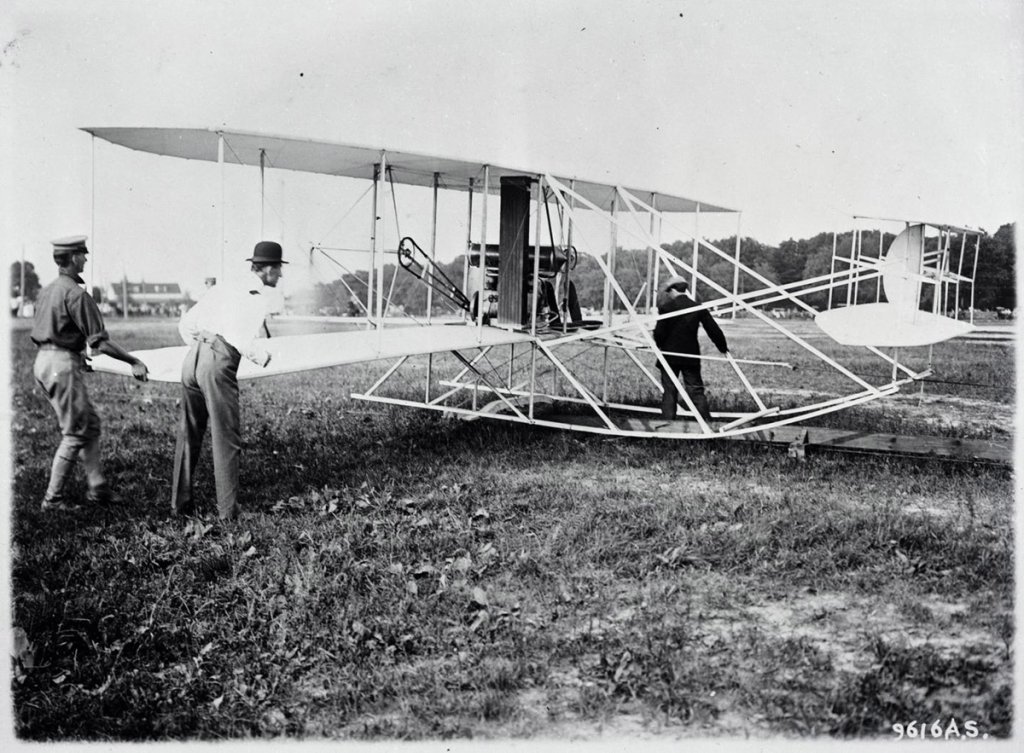
The invention of the airplane is one of the greatest achievements in human history. Flying was once only a dream, inspired by birds and imagination. Today, airplanes connect countries, cultures, and economies. But a common question still remains: Who invented the airplane?
The simple answer is the Wright brothers. However, the full story involves many inventors, experiments, and years of hard work. In this article, we will explore who invented the airplane, how it happened, and why the Wright brothers are credited, in a simple and SEO-friendly way.
Early Dreams of Human Flight
Long before modern airplanes, humans tried to understand flight.
- Ancient myths like Icarus from Greek mythology show early fascination with flying.
- Leonardo da Vinci (15th century) designed flying machines such as the ornithopter, but none were built successfully.
These early ideas laid the foundation for future inventors but did not result in controlled, powered flight.
Sir George Cayley – The Father of Aerodynamics
Before the Wright brothers, Sir George Cayley, an English engineer, made major contributions.
His Key Achievements:
- Identified the four forces of flight: lift, drag, thrust, and weight
- Built successful gliders that carried humans
- Introduced the idea of a fixed-wing aircraft
Because of his scientific approach, Cayley is often called the Father of Aeronautics, but his aircraft were not powered.
Attempts Before the Wright Brothers
Many inventors tried to build powered flying machines in the 19th century.
Notable Names:
- Otto Lilienthal (Germany) – successful glider pilot; studied lift from curved wings
- Samuel Langley (USA) – built powered models, but his full-size aircraft failed
- Clément Ader (France) – claimed powered flight, but lacked control and proof
These inventors made progress, but none achieved controlled, sustained, powered flight.
Who Were the Wright Brothers?
The airplane was invented by Wilbur Wright and Orville Wright, two brothers from Dayton, Ohio, USA.
Background:
- Not formally trained engineers
- Ran a bicycle repair shop
- Strong interest in mechanics and flight
What made them different was their scientific thinking and testing method.
The Wright Brothers’ Breakthrough
The Wright brothers focused on the three main problems of flight:
- Lift
- Power
- Control
Most inventors focused only on engines. The Wright brothers realized control was the most important factor.
Their Key Innovations:
- Wing warping for roll control
- Custom-built lightweight engine
- Wind tunnel testing for accurate data
First Successful Airplane Flight
📅 Date: 17 December 1903
📍 Location: Kitty Hawk, North Carolina, USA
✈️ Aircraft: Wright Flyer
Flight Details:
- Pilot: Orville Wright
- Duration: 12 seconds
- Distance: 120 feet (36.5 meters)
Later that day, Wilbur Wright flew 852 feet in 59 seconds.
This was the first controlled, sustained, powered flight of a heavier-than-air airplane.
Why Are the Wright Brothers Credited as the Inventors?
The Wright brothers are officially recognized because they achieved all four requirements of true flight:
✔ Powered
✔ Heavier-than-air
✔ Controlled
✔ Sustained
Other inventors achieved one or two of these, but not all together.
Did Anyone Fly Before the Wright Brothers?
Some claims suggest earlier flights, but they lack:
- Reliable documentation
- Witnesses
- Repeatable results
The Wright brothers’ flights were:
- Well documented
- Reproducible
- Scientifically proven
That is why historians and aviation authorities credit them.
Impact of the Airplane Invention
The invention of the airplane changed the world forever.
Major Impacts:
- Global travel became faster
- Military aviation developed
- International trade expanded
- Tourism and aviation industries were born
Modern aviation, from commercial jets to fighter aircraft, traces its roots back to 1903.
Evolution After the Wright Brothers
After their success:
- Airplanes improved rapidly
- World War I accelerated aviation technology
- Jet engines appeared in the 20th century
Today’s aircraft like the Boeing 787 or Airbus A350 are advanced versions of the Wright brothers’ idea.
Conclusion
So, who invented the airplane?
The clear and historically accepted answer is Wilbur and Orville Wright. Their dedication, experimentation, and focus on control made human flight a reality.
While many contributed to aviation history, the Wright brothers were the first to successfully combine power, control, and sustained flight, earning them the title of inventors of the airplane.