









Adani Defence & Aerospace–Leonardo: Building India’s Rotor-Wing Industrial Base

- Adani Defence & Aerospace’s partnership with Leonardo marks a shift from platform-centric manufacturing to building a locally sustained rotor-wing ecosystem encompassing assembly, indigenisation, MRO, and training in India.
- The emphasis on twin-engine helicopters and in-country lifecycle support reflects a move toward operational resilience and continuity, addressing long-standing gaps in how India sustains complex rotary-wing fleets.
- With defence volumes providing scale, the model helps sustain local MRO and training infrastructure, while creating room for civil applications to emerge without the cost burdens that have historically constrained India’s helicopter market.

When we talk about India’s journey toward becoming self-reliant, the defence sector usually takes centre stage. It is an area where we have historically leaned on other countries, but that is changing fast. At the heart of this shift is Adani Defence & Aerospace. Over the last few years, the company has evolved from a relatively new entrant into a significant force, moving beyond just assembly lines to building a more integrated, domestic defence ecosystem.
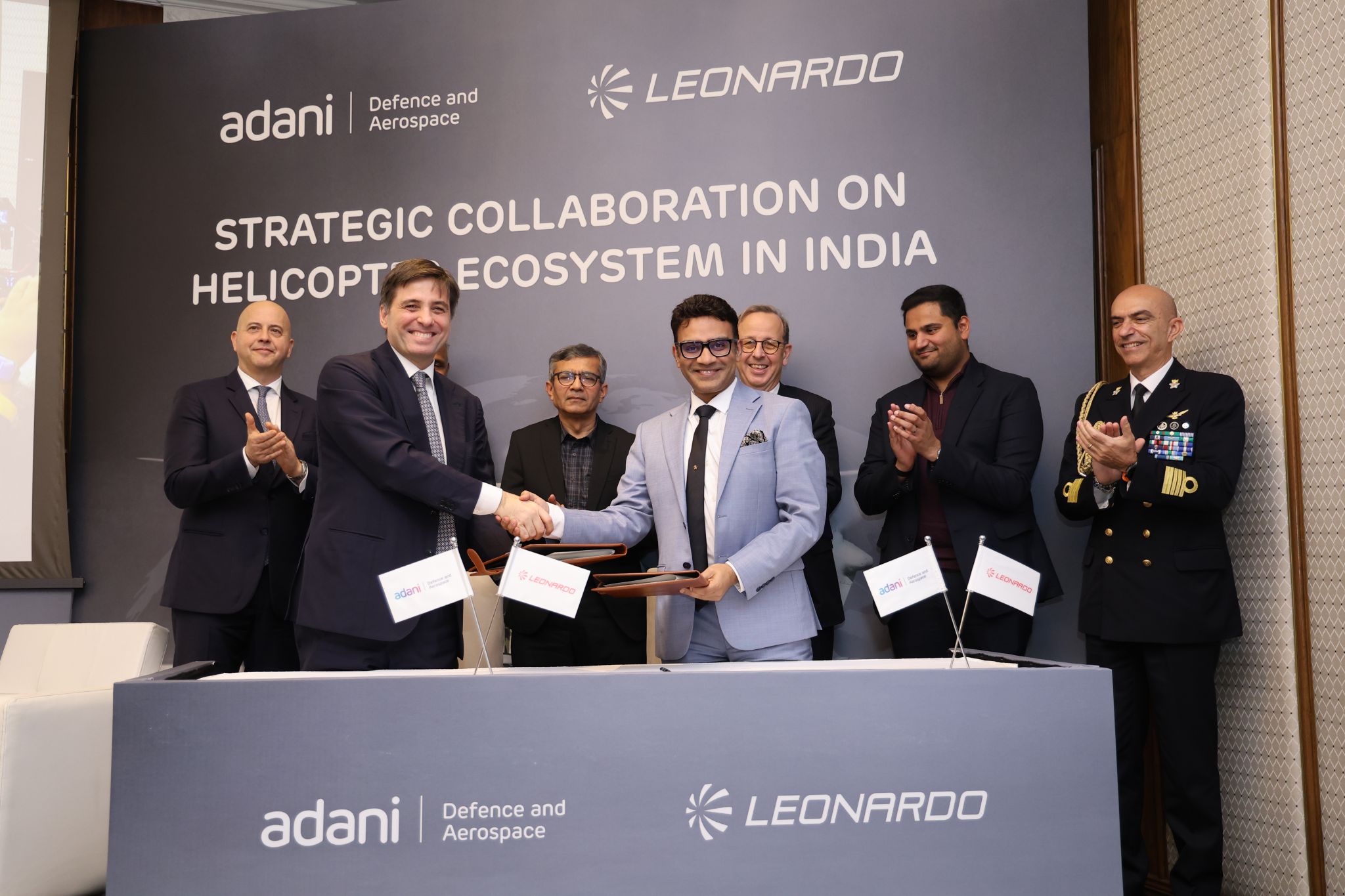
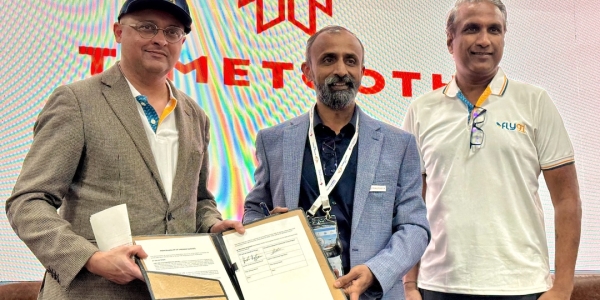
Their recent partnership with Leonardo is a clear illustration of this trajectory. This is not just another industrial tie-up; it represents a strategic attempt to reshape how helicopters are produced, supported, and sustained in India. By combining Adani’s industrial scale with Leonardo’s rotorcraft engineering depth, the partnership is aimed not merely at platform sales but at building long-term capability. It reflects an effort to establish a locally sustained rotor-wing ecosystem in a segment that has remained structurally constrained for decades
A Transformation Rooted in Growth
Adani Defence & Aerospace didn’t become a powerhouse overnight. Its growth has been steady and deliberate, focusing on areas that matter most for national security. From unmanned aerial vehicles (UAVs) and small arms to complex ammunition and missile related systems, they have expanded their portfolio rapidly. One of their biggest strengths is their ability to scale. Its ammunition manufacturing complex in Kanpur is one of the largest in South Asia, reflecting its industrial capacity.

In fact, the company has committed a massive investment of ₹7,000 crore aimed at supporting up to a quarter of India’s total ammunition demand, reflecting both ambition and execution intent.
The last few years have been truly transformational for the company. It has moved from being primarily a component manufacturer to a systems integrator, enabling it to design, build, and support entire platforms.
The stated approach—often articulated as “India for India” and “India for the World”—signals a dual focus on domestic self-reliance and export competitiveness. This ambition is reinforced by a strong network of small and medium enterprises (MSMEs) and startups, broadening participation across the Indian supply chain.

Leonardo’s Legacy and the New Indian Chapter
Leonardo is a well-established name in global aerospace and defence, with operations and customers spanning more than 150 countries. The company’s rotorcraft portfolio ranges from light utility helicopters to advanced military platforms, backed by decades of design and certification experience.
From Adani’s standpoint, the selection of Leonardo is also a calculated one. While competitors have often focused on light, single-engine platforms, Adani is moving straight into the intermediate twin-engine segment. This is a high-stakes entry into the most commercially significant segment of the estimated $74 billion global helicopter market, aligned with the projected Indian Armed Forces’ requirement for over 1,000 helicopters in the coming decade.
This partnership focuses on Leonardo’s advanced AW169M and AW109 TrekkerM helicopters—modern, versatile machines that can handle everything from combat to search and rescue.
The strengths of this alliance are distinctly complementary. Leonardo remains a global repository of rotorcraft IP, with a lineage that includes the legendary Agusta and Westland brands. They bring established design capability, extensive flight certification experience, and a safety-by-design philosophy that spans from light to heavy-lift military platforms.

Adani Defence & Aerospace, however, brings the “industrial momentum” that global OEMs often find difficult to navigate alone in India. Beyond its capital reserves, Adani provides a vertically integrated aviation value chain that includes airport operations, a massive logistics footprint, and a proven ability to scale high-tech manufacturing. For Leonardo, Adani is the industrial “force multiplier” that can turn European designs into locally sustained programmes in India.
Beyond the helicopters themselves, the focus is on ecosystem creation. Plans extend beyond a final assembly line to phased indigenisation, progressively increasing the share of locally manufactured components. Parallel investments in expanding and integrating Maintenance, Repair and Overhaul (MRO) infrastructure and pilot training are intended to ensure lifecycle sustainability. The objective is not only to build helicopters in India, but to operate, maintain, and upgrade them domestically.
The broader national dividend lies in skill creation and capability depth, contributing to India’s long-term aerospace ambitions under Aatmanirbhar Bharat. As articulated by Jeet Adani, Director, Adani Defence & Aerospace and the leadership during the announcement, this is not just about making machines; it is about positioning India as a global aerospace powerhouse for years to come.
The timing of this announcement is impossible to ignore, coming just months after Airbus and Tata Advanced Systems (TASL) began work on India’s first private-sector Final Assembly Line (FAL) for the H125 in Karnataka.
A market bifurcation is now clearly visible. The Tata-Airbus facility focuses on the H125, a light, single-engine helicopter known for high-altitude and hot-and-high performance.

Adani and Leonardo, however, are focusing on twin-engine platforms, reflecting an emphasis on redundancy and operational resilience. The AW109 and AW169 are widely used for demanding missions such as night-time search and rescue, offshore operations, and utility roles in complex operating environments, where safety margins and availability are critical. Building an industrial and support ecosystem around these platforms aligns with the broader rotary-wing requirements of India’s armed forces.
Implications for India’s Civil and Military Helicopter Market
India’s civil helicopter fleet remains limited, with fewer than 250 active helicopters serving a population of over 1.4 billion. Growth has long been constrained by regulatory structures that largely mirrored fixed-wing norms, as well as perceptions that helicopters were restricted to VVIP or emergency use.
That environment is beginning to change. A December 2025 DGCA circular directing airports to earmark designated zones for helicopter operations signals institutional recognition of rotary-wing integration. For Adani, which operates multiple airports, this creates the potential to link regional hubs with Tier-2 and Tier-3 cities, positioning helicopters as infrastructure rather than exception.
The partnership announcement includes references to potential civil domestic demand alongside localisation, leaving scope for future civil variants such as VIP, offshore, or emergency medical services roles.

Low civil volumes have historically undermined the viability of domestic MRO and training ecosystems.
A defence-anchored, dual-use industrial base offers one pathway to break this cycle, allowing military scale to subsidise broader capability.
A defence-driven ecosystem like Adani–Leonardo’s will not, by itself, fix those structural issues. What it can do is change the economics of participation. If there is enough volume on the military side to sustain local assembly, component manufacturing and MRO, then the incremental cost of supporting civil variants of the same types comes down. Training pipelines for pilots and technicians become more sustainable. Suppliers can justify investment in tooling and processes that can serve both markets.
There is another dimension to it. eVTOLs and Advanced Air Mobility (AAM) concepts are drawing enormous attention globally, and India will eventually be part of that story. But most of the missions driving near-term Indian demand—mountain logistics, ship-borne operations, combat support, disaster relief in remote regions—will remain the domain of conventional helicopters for a long time. Building a rotorcraft ecosystem today is not an alternative to AAM; it is a prerequisite.
The Adani-Leonardo partnership, following Adani’s earlier collaboration with Embraer for regional aircraft, signals a clear intent: Adani is positioning itself as a long-term participant in India’s aerospace industrial base.
More broadly, the partnership represents a significant leap from transactional procurement to transformational capability development. By leveraging an existing ecosystem of MRO, training, and airports, the alliance creates a high barrier to entry for competitors while providing the Indian Armed Forces with greater autonomy in rotor-wing capability.
If executed as outlined, this will do more than create thousands of high-skill jobs—it will ensure that India’s rotor-wing sector finally has the structural depth to serve both national security and civil aspirations over the long term.
Also Read: What the Embraer–Adani Partnership Means for India’s Regional Aircraft Push