










Air India Rethinks Growth: Cuts Routes, Builds Back International Network with Caution

- Air India begins phased resumption of major international routes, led by Europe and Asia.
- North American operations lag due to high costs, aircraft usage demands, and route reassessment.
- The airline shifts focus from rapid expansion to targeted consolidation and operational resilience.
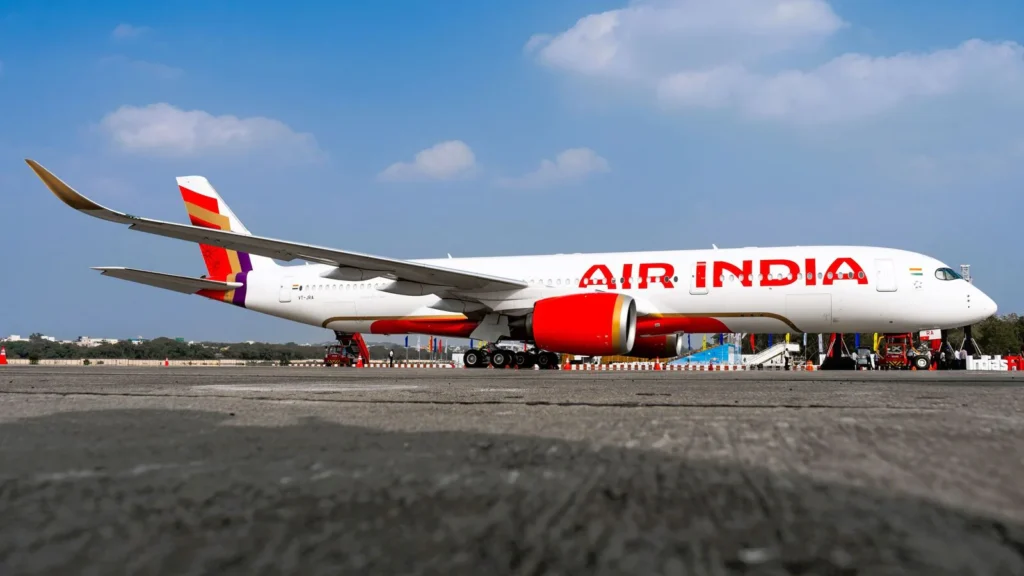
Air India on Monday announced a phased return to full operations following its “Safety Pause,” implemented in the wake of the fatal AI171 crash on June 12. The airline has begun partially restoring several curtailed international routes starting August 1, with full resumption targeted by October.
As a result, Air India reduced frequencies across its global network. The pause was abrupt and sweeping, affecting routes to Europe, North America, Australia, and Asia. This was a stark reversal for a carrier that had, under Tata ownership, been rapidly expanding its international footprint with new aircraft orders, revived destinations, and an ambitious bid to challenge global competitors.
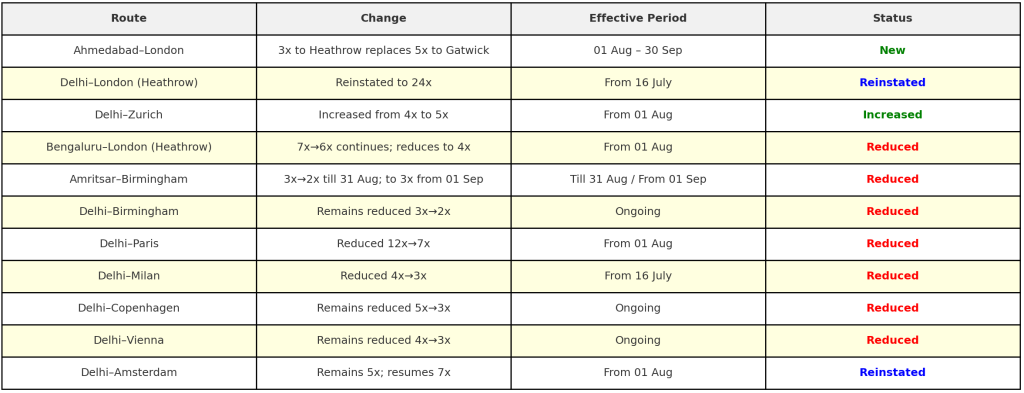
Airline management has said that the pause, which grounded some part of the Boeing 787 fleet for precautionary checks, also helped the airline adjust to longer flight durations caused by regional airspace closures. As of mid-July, flagship routes like Delhi–London Heathrow have returned to full frequency (24x weekly), while services to Zurich, Tokyo, and Seoul are being progressively reinstated through August and September.

Cautious Restoration, Measured Steps
More than a month later, the airline is starting to rebuild, but with caution and clarity. Beginning in August, Air India will restore curtailed frequencies on several key routes, with full schedule normalization expected by October. One of the first routes to return is the flagship Delhi–London Heathrow service, which has been reinstated to its full pre-crisis frequency of 24 weekly flights. Additional capacity is being added to Zurich, Tokyo Haneda, and Seoul Incheon, with services gradually resuming through August and September. Amsterdam is also set to return to a daily schedule starting next month.

Moreover, the airline has temporarily reinstated its Delhi–Nairobi service for August, although this will be suspended again in September. These adjustments reflect the fluid nature of the airline’s current network planning, which is being carefully calibrated to match operational capacity with evolving demand and safety oversight.
North America Still Lags
Despite the uptick in Europe and parts of Asia, Air India’s North American network remains significantly under capacity. Flights to key cities like Chicago, New York, Toronto, and San Francisco are operating well below their original summer schedules. For example, the Delhi–Chicago route is currently down to three flights a week, with only a slight increase to four planned for August. Similarly, routes to Toronto and Vancouver are functioning at just over half of their earlier frequency, while connections to JFK, Newark, and San Francisco remain limited.
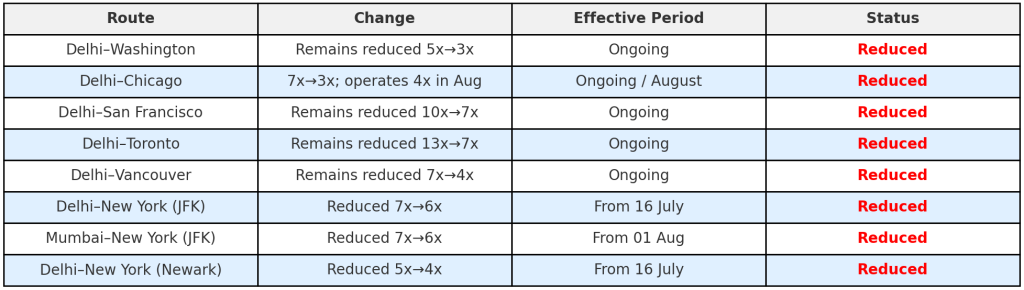
This reduced presence in North America highlights the high operational costs and complexity associated with ultra-long-haul flying. These routes are crew- and aircraft-intensive, requiring meticulous scheduling precision, a challenge in the current environment. The delay in restoring full capacity may also indicate that Air India is reassessing load factors and profitability on these routes in light of its broader transformation goals.
Strategic Consolidation
In parallel, several routes will remain suspended until at least the end of September. These include services from Amritsar and Goa to London Gatwick, and from Bengaluru and Pune to Singapore. Their continued suspension indicates a shift away from expanding the network towards a model that prioritizes profitability and sustainability. Rather than trying to restore every route at once, the airline seems to be consolidating its efforts around its strongest markets and most efficient corridors.

At present, Air India expects to operate more than 525 international flights per week across 63 routes, spanning short-, long-, and ultra-long-haul destinations. While this reflects a substantial recovery, it remains below pre-crisis levels. and below what had originally been planned for the summer season.
Rebuilding Trust, One Route at a Time
The airline is actively reaching out to affected passengers to provide alternative flights or full refunds. Despite ongoing disruptions, there is a noticeable shift toward transparency and responsiveness, key features of the more professional culture that the Tata Group aims to establish.
What began as a crisis response has gradually evolved into a strategic reset. By focusing on core markets, utilising premium hubs such as Heathrow, and aligning its restoration efforts with operational readiness, Air India demonstrates that it is no longer pursuing growth for its own benefit. Instead, it is emphasising resilience, dependability, and relevance, which could define the next stage of its long-term revival.

Read More: Pilot Safety Row Prompts DGCA to Set Up Medical Review Committee