















- The growth of inflight Wi-Fi technology will result in greater adoption of such services by Indian carriers.

India’s domestic carriers, despite having some of the most modern commercial airline fleets anywhere in the world, have been slow to adopt inflight Wi-Fi services, mainly due to regulatory constraints. Existing aviation regulations in India had earlier not permitted airlines to offer inflight Wi-Fi services on their domestic and international flights. It was only in March 2020 that the Government gave its approval for Indian airlines to provide inflight Wi-Fi services.
In the past few years, there has been an exponential growth in the global adoption of in-flight connectivity. Passengers are demanding faster internet speeds for traditional services like email, web browsing, social media, and messaging and increasingly stream content, play games inflight, and use collaborative cloud-based applications. Many airlines in India and abroad are now either introducing Wi-Fi services or are in discussions to understand further how they can introduce Wi-Fi connectivity on board their aircraft.
Access to inflight Wi-Fi services, even when flying 35,000 ft, will dramatically upgrade the inflight experience for passengers. With the availability of high-speed inflight Wi-Fi services now a reality, airlines will have access to high-speed data transfer rates that are actually fast and reliable enough to support streaming services onboard the aircraft. One important shift as a result of this will be the ability for passengers to log into their own streaming services and enjoy their own content as they would at home rather than depending on the content provided by airlines provide through their traditional seatback In-Flight Entertainment (IFE).
The erstwhile Vistara, now merged with Air India Group, was the first Indian carrier to offer complimentary in-flight Wi-Fi on international flights in July 2024. In September, Air India announced that it would soon provide inflight Wi-Fi services on its new Airbus A350-900 aircraft operating from Delhi to the UK’s London Heathrow airport
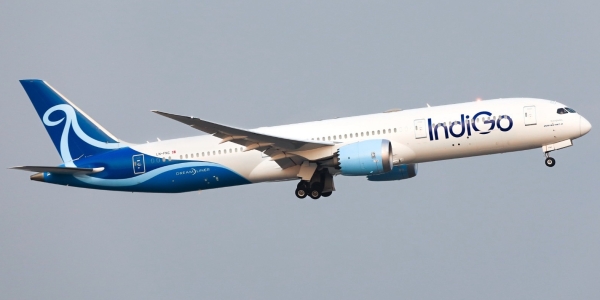
It also remains to be seen how airlines in India decide to position their inflight Wi-Fi services, either offering them free to their high-value First Class and Business Class passengers or offering paid onboard Wi-Fi across the aircraft. Low-cost carriers (LCC) such as IndiGo, Air India Express and Akasa Air would look at offering Wi-Fi services in flight to drive revenue by connecting with their passengers through serving food and beverages online and providing access to in-flight shopping. There is also the option for LCC’s to offer simple messaging capability, which will allow their passengers to stay connected to family and friends when on an aircraft.
Operational Inflight Wi-Fi
Vistara’s inflight Wi-Fi services were available across all cabins on its Boeing 787-9 Dreamliner and Airbus A321neo jetliners. Vistara offered its passengers a 20-minute complimentary plan that catered to internet browsing, email access, and staying connected with friends and family.
Air India recently launched Vista, a wireless Inflight Entertainment (IFE) service across some of its existing wide-body jetliners. It will soon also be made available on its narrow-body aircraft. Vista is powered by Bluebox, an award-winning digital services provider, and is being deployed on the latter’s Blueview digital services platform, which is delivered to customers via the Bluebox Wow wireless network system. This offering differs from inflight Wi-Fi but could be an option for other Indian carriers. The availability of a digital ecosystem allows airlines to engage and entertain their customers on board and earn ancillary revenue for the airline in the process.
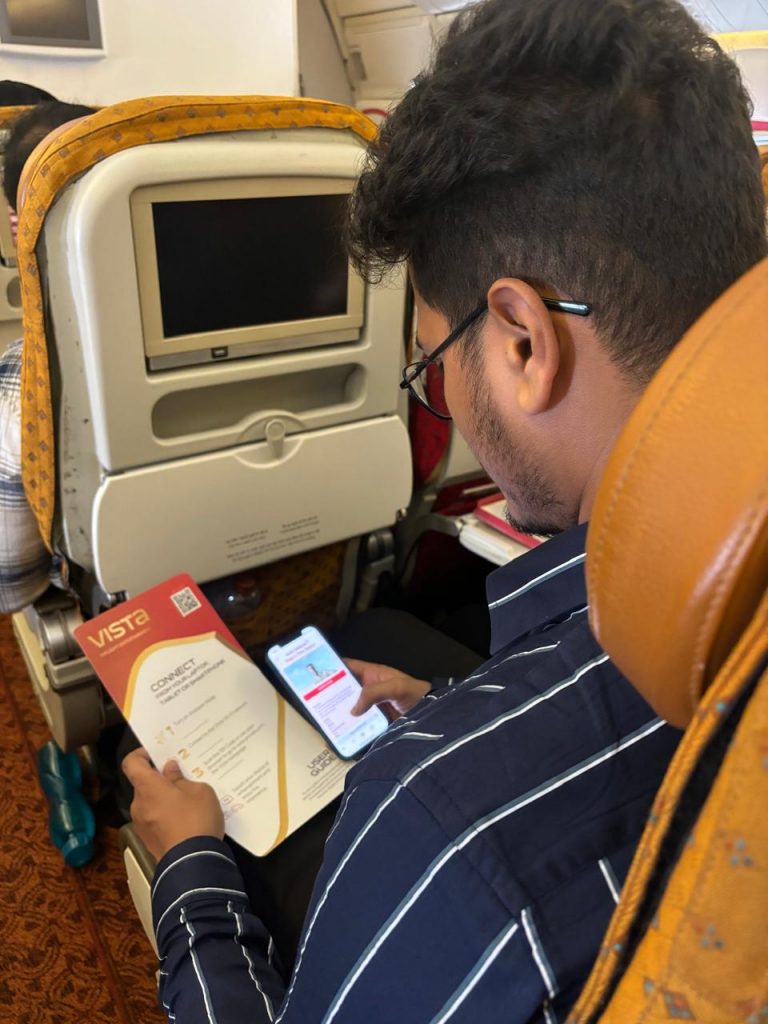
Vista enables customers to stream content seamlessly on their Personal Electronic Devices and is available on iOS, Android, Windows, and macOS devices. “At Air India, we are continuously striving to anticipate and meet the evolving needs of our modern travellers. We are pleased to introduce Vista, a new feature for our customers. It allows seamless integration of personal devices, enhancing the overall travel experience for our customers,” said Rajesh Dogra, Chief Customer Experience Officer, Air India.
Blueview is an innovative software platform that provides a browser-based portal through which passengers can view and access a range of digital services, such as onboard retail and in-flight entertainment, alongside a moving map. The size of a lunchbox, Bluebox Wow is lightweight and can easily be deployed in overhead lockers. It is scalable and available in a portable battery-operated version or a certified solution with a fitted partition, aircraft power, and further options such as automated PA pause.
Intelsat Moving Inflight Wi-Fi Tech Ahead
To meet the growing demand among airlines to offer onboard Wi-Fi services to their customers, Intelsat has developed a new Electronically Steered Array (ESA) antenna that allows aircraft to be connected to both GEO (Geostationary) satellites and LEO (Low-Earth Orbit) satellites, allowing for high-speed streaming services to be provided on aircraft.
Intelsat provides all the satellite capacity and the equipment onboard (including the actual hardware itself) and, finally, all the services and applications that go together with it, such as the data packages and applications, front-end portals, etc. The company is now bringing together its own Geostationary satellites together with its partner, One Web’s LEO network. According to Intelsat, with a multi-orbit network, airlines can deliver a dramatically enhanced onboard connectivity experience. This will allow Wi-Fi network connectivity, even when operating over polar regions, on the fringes of the network, or in high-traffic areas where congestion can potentially limit speeds. Airlines will be able to access the best network to maintain the highest quality of service. Each network also offers redundancy for the other, ensuring uninterrupted connectivity in the unlikely event an individual satellite or element of the network is disrupted.
To connect to this network of satellites, Intelsat has now brought to the market a new Electronically Steered Antenna, which is available to customers. This antenna is not only smaller and lighter in weight and size, but it’s also significantly lower in profile since it has no moving parts. This electronic terminal can quickly switch between all of the LEO satellites, which pass by very quickly and, of course, to the geostationary satellites as well.
Intelsat has been testing the new antenna for the past 18 months on the company’s own CRJ 700 regional jet test aircraft. Intelsat has been undertaking test flights to test the new antenna, flying it in different geographical locations and environments. Once Supplementary Type Certification (STC) is obtained, which was planned for June this year, Intelsat will roll out the STC across many different aircraft types.
Panasonic Growing Inflight Wi-Fi
Panasonic Avionics Corporation (Panasonic Avionics) has also expanded its global connectivity network with the addition of new and expanded GEO (geostationary) Ku-band satellite capacity that delivers higher-speed in-flight internet connections for airlines and their passengers. Its new High Throughput Satellites (HTS) and Extreme Throughput Satellites (XTS) in its connectivity network have enhanced coverage over North, Central and South America, the North and South Atlantic Ocean, Europe, the Middle East, the Arabian Sea, Africa, and the Indian Ocean. Panasonic Avionics has also introduced additional HTS capacity over China and Japan, building on existing connectivity investments in this region.
“Given our unique approach to satellite capacity, and with our multi-layered, multi-orbit connectivity network, Panasonic Avionics has the unique ability to leverage a wide range of different, industry leading satellites, rather than the high-risk approach of relying solely on proprietary satellite technology. This enables Panasonic Avionics to add new capacity quickly and easily when and where it’s needed, ensuring we can deliver an advanced and virtually uninterrupted service. The result is a better passenger experience and higher Net Promoter Scores (NPS) for airlines,” John Wade, Vice President of Panasonic Avionics’ In-flight Connectivity Business Unit, said.
As a result of this expansion, Panasonic Avionics has delivered a 50 per cent global capacity increase, ensuring reliable and robust high-speed internet services with accelerated speeds of up to 75 Mbps per aircraft through HTS and up to 200 Mbps through XTS satellites. With the network coverage now spanning continents and oceans, Panasonic Avionics is able to offer enhanced connectivity to both domestic and international travellers. These enhancements have benefited current and future customers, who can access services without any changes to hardware or software.
Gogo Galileo Marches Toward Commercial Launch
The demand for inflight Wi-Fi does not only exist in the commercial aviation market but is also highly sought after by business aviation customers, both in India and abroad. Earlier this September, Gogo Business Aviation (Gogo) announced that it had completed the first installation of the Gogo Galileo HDX on a Bombardier Challenger 300 in conjunction with Duncan Aviation and commenced flight testing as the company marches toward commercial launch of its LEO global broadband solution later this year. “As will be true for any of the approximately 4,000 aircraft with AVANCE platform equipment installed, installation on the Challenger consisted only of adding the fuselage-mounted antenna on top of the aircraft, running power from the aircraft to the antenna, and running a data line from the HDX back to the already-installed AVANCE L5 LRU (line replaceable unit),” Gogo said.
“Our expert team completed the installation, and then, alongside Gogo’s engineers, immediately started testing the system on the ground with eight devices connected and streaming at the same time,” said Duncan Aviation Houston Satellite Manager Mark Winter. “It was impressive to say the least, and we know our customers who upgrade to Gogo Galileo will love this step-function improvement in the connectivity experience.”
The HDX antenna features a small form factor to fit on any size business aircraft with mean speeds of 57 Mbps and peak speeds up to 60 Mbps. It will be followed by the Gogo Galileo FDX antenna in the first half of 2025, which is a larger antenna designed for larger aircraft that will achieve mean speeds of 189 Mbps and peak speeds up to 195 Mbps. Gogo is the world’s largest provider of broadband connectivity services for the business aviation market. As of June 30, 2024, Gogo reported 7,031 business aircraft flying with its broadband ATG systems onboard, 4,215 of which are flying with a Gogo AVANCE L5 or L3 system, and 4,247 aircraft with narrowband satellite connectivity installed.